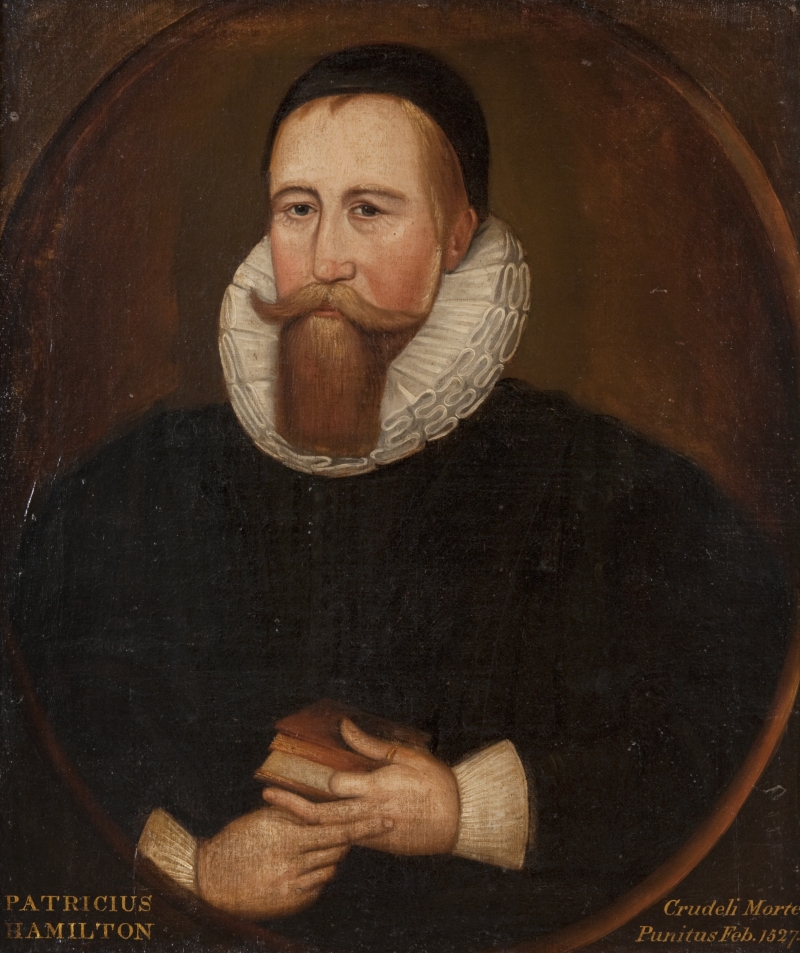
Patrick Hamilton
Hamilton the Proto-Reformer
Life and Ministry
Patrick Hamilton was born in 1504 to one of the great noble houses of Scotland — a great-great-grandson of King James II — and entered the University of Paris at fourteen, where he took his master of arts in 1520 and was exposed to the early printed works of Erasmus and to the first stirrings of Lutheran controversy in the Sorbonne. Returning to Scotland in 1523 he became a member of the chapter at St Andrews and lectured at the university there. By 1527 his teaching on justification, the priesthood of believers, and the authority of Scripture had drawn the attention of Archbishop James Beaton, who summoned him for examination. Hamilton fled to the continent, spent six months at the new University of Marburg under Francis Lambert, and came home in late 1527 having decided that he would not run a second time.
Circumstances of Death
Hamilton was summoned to St Andrews in late January 1528 under safe-conduct, examined for several weeks, and condemned of heresy on February 28. The execution was ordered for the same day rather than the next, lest the powerful Hamilton family arrange a rescue. Patrick was led to the gate of St Salvator's College on the morning of February 29, tied to a stake on a pyre that had been hastily built and made of green wood that would not burn cleanly, and a priest pressed a final demand that he recant. Hamilton answered, "I will rather be content that my body burn in this fire for the confession of my faith than that my soul should burn in the fire of hell for denying the same." The pyre took six hours to consume him.
Legacy
Hamilton was twenty-three years old at his death and the first Protestant martyr of the Scottish Reformation. The Scots proverb that gathered around the long, smoking pyre — "the reek of Master Patrick Hamilton has infected as many as it blew upon" — captured what the executioners had not anticipated: a public execution that became a sermon. Within twenty years, George Wishart and many others would die at the same place; within thirty, Mary Queen of Scots would be ruling a kingdom whose Reformed party traced its founding witness to the morning of Hamilton's burning. John Knox, who heard the story as a young man, would write that "no one in Scotland after Hamilton wanted long for the truth of the gospel."
Sources
John Foxe, Acts and Monuments (1563); John Knox, History of the Reformation in Scotland (1559–66); Alexander Alesius's eyewitness letter to Luther (1528); Martin Dotterweich, Patrick Hamilton: First Reformer of Scotland (2008).