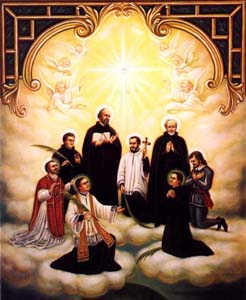
John de Brébeuf and the North American Martyrs
the Canadian Martyrs; the Eight Jesuit Martyrs (Brébeuf, Lalemant, Jogues, Goupil, de la Lande, Daniel, Garnier, Chabanel)
Life and Ministry
Jean de Brébeuf was born in Normandy in 1593, entered the Society of Jesus at twenty-four, and arrived in New France in 1625 as part of the second wave of Jesuit missionaries to the Huron Confederacy of the Great Lakes. He spent the better part of twenty-four years among the Huron — learning the language well enough to compose a Huron grammar and a Huron-language catechism, baptizing over seven thousand Huron Christians, and helping found the mission settlement of Sainte-Marie-among-the-Hurons on Georgian Bay. The eight Jesuit priests and lay brothers who would die together as the North American Martyrs included Brébeuf, his colleague Gabriel Lalemant; Isaac Jogues, who had been tortured and ransomed by the Mohawks once before his second mission; the lay brothers René Goupil and Jean de la Lande; and the priests Antoine Daniel, Charles Garnier, and Noël Chabanel.
Circumstances of Death
The Iroquois Confederacy launched a sustained military campaign against the Huron beginning in 1648. On July 4, 1648, Antoine Daniel was killed at the village of Saint-Joseph during a Mohawk raid, shot at the door of the chapel as he held the consecrated Host. On the morning of March 16, 1649, an Iroquois war party of roughly one thousand attacked the village of Saint-Louis where Brébeuf and Lalemant were ministering. Both priests refused to flee and were captured. The Iroquois carried them back to Saint-Ignace, the village they had taken the day before, and tortured them through the night and the following day. Brébeuf, by the eyewitness account of Christophe Regnault, who later examined the bodies, was scalped, mutilated with red-hot tomahawks pressed into his armpits and groin, scalded with boiling water in mockery of baptism, and finally his heart cut out and eaten by the captors who reportedly told him they wished to take his courage. He died after fourteen hours; Lalemant lasted seventeen. Garnier was killed at Saint-Jean in December 1649; Chabanel disappeared on the road shortly after.
Legacy
The Huron Confederacy was destroyed within two years of the martyrdoms; the surviving Christian Huron migrated to a refuge near Quebec where their descendants form the Wendat Nation today. The North American Martyrs were canonized together by Pope Pius XI in 1930. The Martyrs' Shrine at Midland, Ontario, on the site of Sainte-Marie-among-the-Hurons, is the most-visited Catholic pilgrimage site in English Canada. Brébeuf's Huron Carol, the Christmas hymn he composed in the Wendat language around 1642, is the oldest Canadian Christmas carol and is still sung in Wendat, French, and English in churches across Canada every Christmas Eve.
Sources
Jesuit Relations (annual mission reports, 1632–1673, edited by Reuben Gold Thwaites in 73 volumes); Christophe Regnault, eyewitness account of Brébeuf and Lalemant's deaths (1649); Francis Parkman, The Jesuits in North America (1867); Joseph P. Donnelly, Jean de Brébeuf, 1593–1649 (1975).