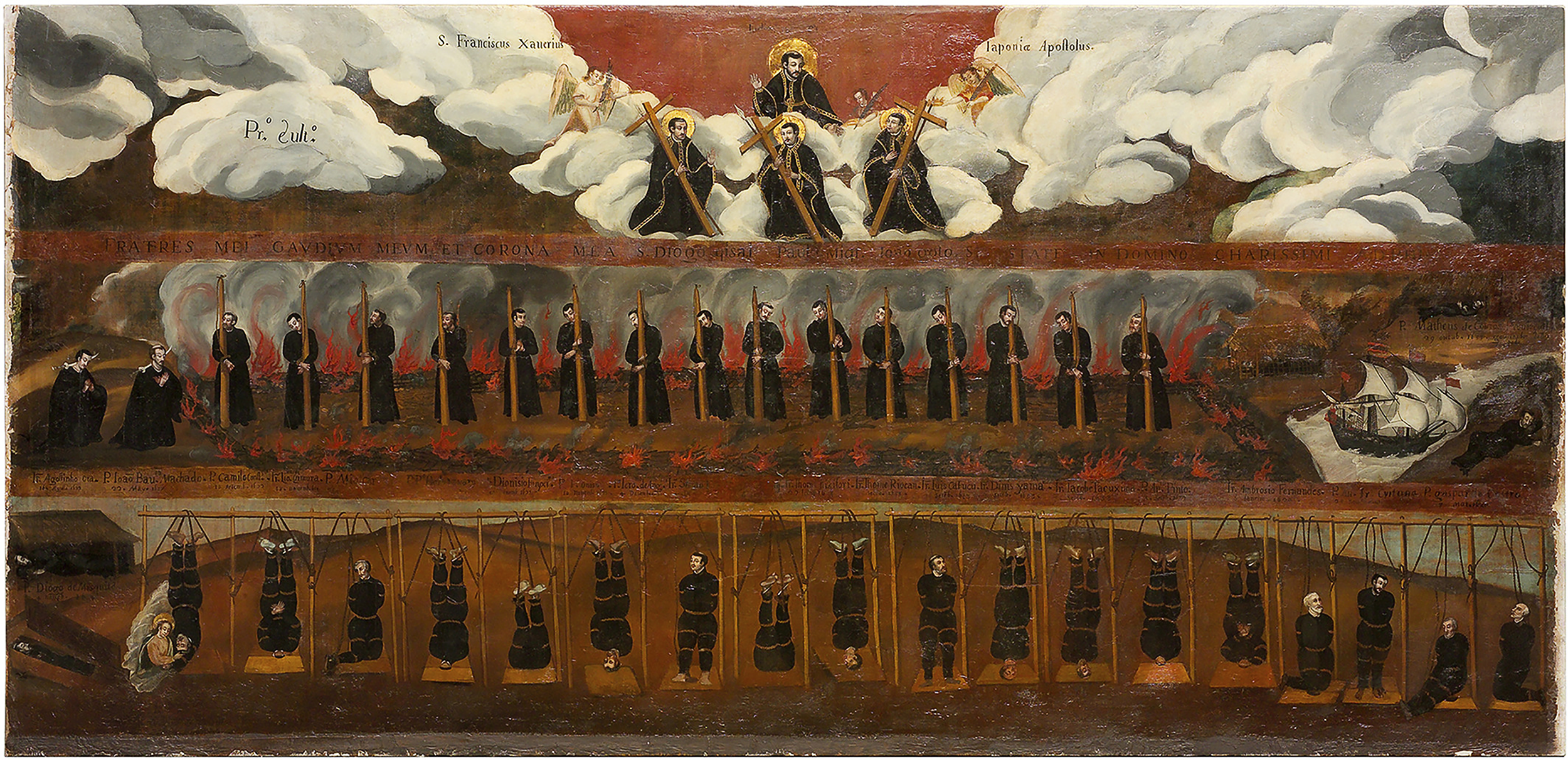
26 Martyrs of Japan
the Nagasaki Martyrs; the Martyrs of Nishizaka
Life and Ministry
The Christian community of Japan had been founded by Francis Xavier in 1549 and had grown over forty years to perhaps three hundred thousand baptized believers, with a substantial flowering of Japanese clergy under the Society of Jesus and from 1593 the Spanish Franciscans. The 26 who would die at Nagasaki in 1597 were a representative cross-section of that community: six Spanish Franciscan missionary priests including Pedro Bautista, three Japanese Jesuit brothers including Paulo Miki (who was a renowned preacher to his own people), seventeen Japanese laymen — catechists, churchwardens, sacristans, and three boys aged twelve, thirteen, and fourteen who served as altar attendants. The shogun Toyotomi Hideyoshi, having tolerated the Christians for years, became convinced in late 1596 that Spanish missionaries were the advance party of an imperial conquest and ordered the suppression of the church.
Circumstances of Death
The 26 were arrested at Kyoto and Osaka in December 1596 and made to walk the eight hundred kilometers to Nagasaki in midwinter, in the company of an executioner who cut off the left ear of each prisoner at the start of the journey as a public mark. They sang the Te Deum on the road. On the morning of February 5, 1597, they were brought to the hill of Nishizaka outside Nagasaki harbor, where twenty-six wooden crosses had been raised. Each prisoner was tied to a cross — Roman crucifixion not having been a Japanese practice, the executioners had improvised the technique. Two soldiers stood at the foot of each cross with spears. At a signal the spears were thrust upward through the ribs, and the 26 died together on the hilltop in sight of the city. Paulo Miki preached his last sermon from the cross, asking forgiveness for his executioners.
Legacy
The 26 were the first major group of Japanese Christians to die together for the faith and the founding witness of what became, over the next four decades, perhaps the largest persecution of Christians in any single country until the twentieth century — an estimated four thousand documented martyrs and many tens of thousands more whose names are lost. The hidden Christians of Kyushu, who survived in secret villages for two and a half centuries until the reopening of Japan, kept the memory of the Nagasaki martyrs at the center of their underground catechesis. The bronze monument and church on the Nishizaka hill, built in 1962 for the centenary of the rediscovery of the Kakure Kirishitan, marks the spot.
Sources
Luís Fróis, S.J., Relación del Martirio (1597, eyewitness); Pedro Morejón, Historia y Relación de lo sucedido (1631); Diego Pacheco, S.J., The Martyrs' Hill (1962); Stephen Turnbull, The Kakure Kirishitan of Japan (Routledge, 1998).