Uganda Martyrs
the Martyrs of Namugongo; Charles Lwanga and Companions
Life and Ministry
Christianity entered the Bugandan court in the 1870s — Anglican CMS missionaries from 1877, French Catholic White Fathers from 1879 — and met its most receptive hearing among the royal pages, the boys aged twelve to twenty-five who served the king's household. By 1885 there were perhaps two hundred baptized Christians in the king's immediate entourage, divided roughly evenly between Anglican and Catholic. Mwanga II, who had succeeded Muteesa I in 1884, had inherited a Bugandan court tradition in which the king possessed every member of the household sexually as he chose. The young Christian pages refused on conscience grounds, both Catholic and Anglican, and this refusal — coinciding with Mwanga's execution of Bishop Hannington in October 1885 — convinced the king that the new faith was a direct threat to royal authority.
Circumstances of Death
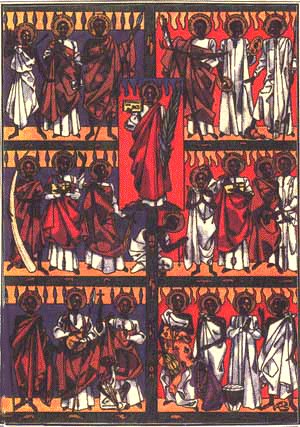
The first burnings began with the killing of Joseph Mukasa, the chief Catholic page, in November 1885 at Mwanga's order — for having rebuked the king for the murder of Hannington. The general persecution opened on the morning of May 26, 1886, when Mwanga summoned all the Christian pages of his court to declare themselves and ordered all who would not renounce baptism to follow him to Namugongo, twenty miles outside the capital. Twenty-six were burned together at Namugongo on June 3, 1886 — wrapped in reed mats and laid on a pyre, bound there for several hours with the pyre prepared but not yet lit, encouraged through the wait by Charles Lwanga, the senior Catholic page, who told them not to fear. They were eventually burned alive together. The youngest, Kizito, was thirteen. Other martyrs were killed by spear and dismemberment over the following months across Buganda. The total documented deaths between 1885 and early 1887 reach forty-five, roughly twenty-three Catholic and twenty-two Anglican.
Legacy
The persecution of 1885–87 broke the king's grip on the Christian movement in Buganda — by 1890 there were fifteen thousand baptized Christians in the kingdom, by 1900 perhaps two hundred thousand. Pope Paul VI canonized the twenty-two Catholic martyrs in 1964 and visited Namugongo in 1969 — the first papal journey to Africa. The Anglican martyrs are commemorated together at the Anglican shrine on the same site. June 3, the principal burning day, is a Ugandan national holiday. Namugongo today is the largest Christian pilgrimage site in sub-Saharan Africa, drawing two to three million pilgrims annually.
Sources
J. F. Faupel, African Holocaust: The Story of the Uganda Martyrs (1962, with full eyewitness sources); Pope Paul VI, canonization homily, October 18, 1964; Pope Paul VI, address at Namugongo, July 31, 1969; M. Louise Pirouet, Black Evangelists: The Spread of Christianity in Uganda 1891–1914 (1978).