Public domain · via Wikimedia Commons ↗
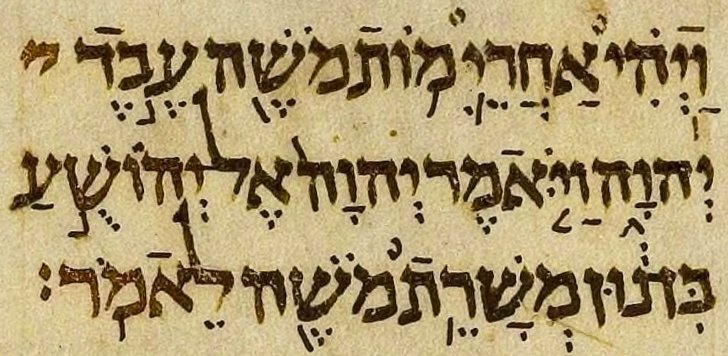
The Aleppo Codex
Also called Keter Aram Tzova, The Crown of Aleppo.
Reflection
Maimonides — the greatest Jewish scholar of the Middle Ages — said this codex was the standard. When he wrote his rules for how a Torah scroll must be copied, he pointed to one manuscript and said: copy from this one. That manuscript was the Aleppo Codex. Vocalized around AD 930 by Aaron ben Moses ben Asher, the last and greatest of the Tiberian Masoretes, the Aleppo Codex was for centuries treated as the most accurate Hebrew Bible on earth.
This is also a manuscript with wounds. For 600 years it was kept in the Central Synagogue of Aleppo, Syria — chained, guarded, and revered as the Crown (Keter) of the community. In November 1947, three days after the United Nations vote on the partition of Palestine, riots broke out in Aleppo. The synagogue was burned. The codex was thought destroyed. It re-emerged a decade later, smuggled to Israel — but with roughly 40% of its leaves missing, including most of the Torah. Where it survives, it remains the gold standard. The Hebrew University Bible Project and the Mikraot Gedolot Haketer use the Aleppo Codex as their primary base, falling back to Leningrad only where Aleppo's pages were lost.
For the believer today, the Aleppo Codex is a reminder that the preservation of God's Word has cost something. Scribes worked themselves blind to copy it. Communities chained it inside synagogues to guard it. Men ran into burning buildings in 1947 to save what pages they could. And here is the wonder — even with 40% of its leaves gone, the text the Aleppo Codex witnessed is not lost. The Masoretic tradition is so densely cross-attested that we know what was on every missing page. God did not entrust his Word to one manuscript. He entrusted it to a tradition. The fire in Aleppo did not silence the prophets.
Why this manuscript matters
- Most authoritative Masoretic witness
- Vocalized by Ben Asher personally
- Partially destroyed 1947