Public domain · via Wikimedia Commons ↗
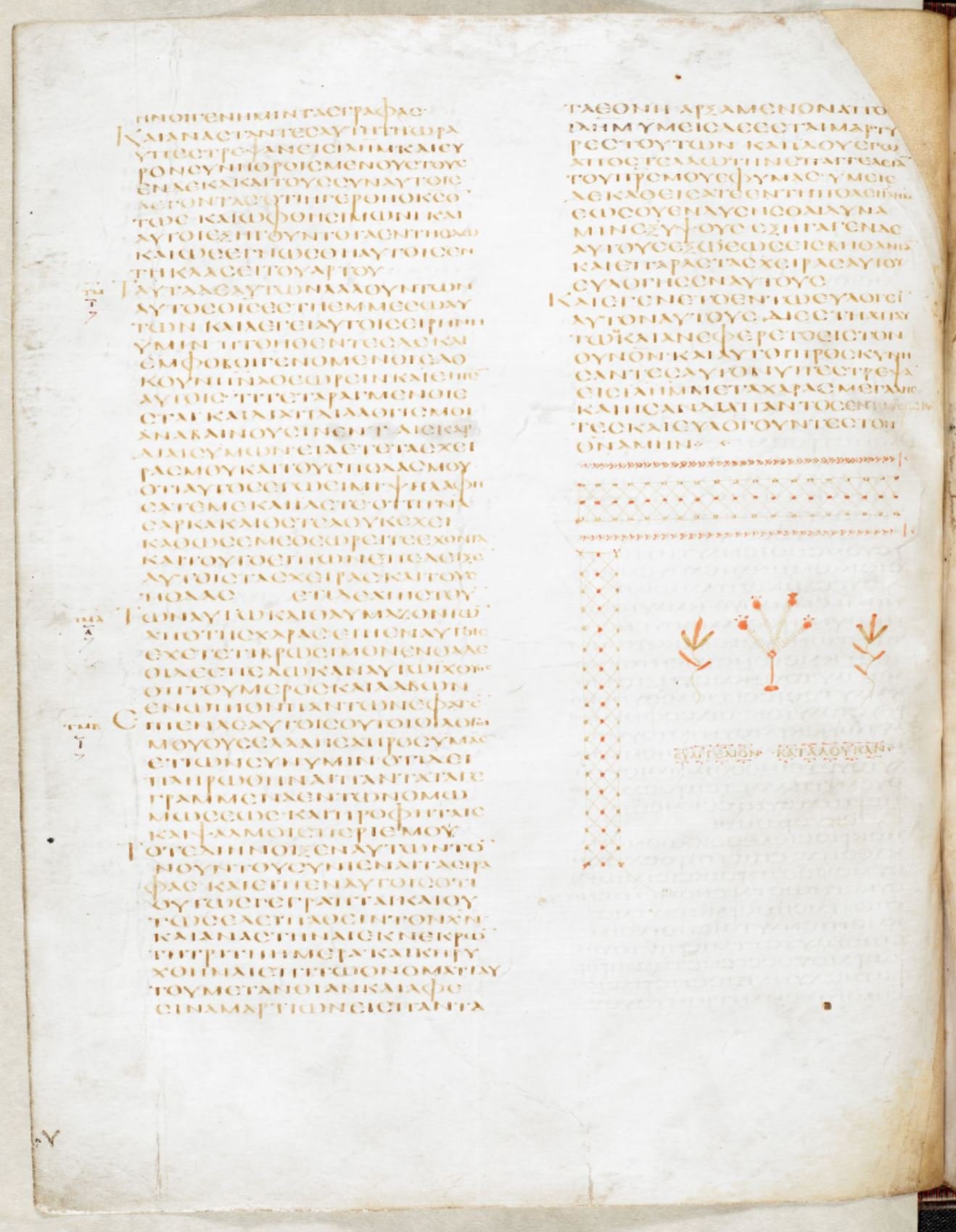
Codex Alexandrinus
Also called A, 02, Alexandrinus.
Reflection
Codex Alexandrinus came to Europe as a diplomatic gift. In 1627, Cyril Lucaris, Patriarch of Constantinople, sent it to King Charles I of England. It is one of the great Greek biblical codices and the first to reach Western European scholarship — a generation before Vaticanus was even widely known. Today it sits in the British Library, with most of its 773 leaves intact and the script as legible as it was sixteen hundred years ago.
What Alexandrinus witnesses depends on which book you open. In the gospels, Alexandrinus carries a Byzantine text, distinct from Sinaiticus and Vaticanus and reflecting a different stream of transmission. In Acts and the Pauline epistles, it returns to Alexandrian readings. In Revelation, Alexandrinus is the single best uncial witness in existence — better than Sinaiticus there, better than 𝔓47 in completeness — and it is the foundation of every modern critical edition of the Apocalypse. Where you read the seven letters to the seven churches, the throne room of chapter 4, the Lamb of chapter 5, the New Jerusalem of chapters 21 and 22 — Alexandrinus stands behind your text.
The codex also includes 1 and 2 Clement at the end of the New Testament — early Christian letters that some communities valued highly but that the church did not ultimately receive as canonical. As with the deuterocanonical inclusions in Sinaiticus, this is a historical witness to 4th- and 5th-century usage, not a doctrinal claim for today. The Protestant canon is what it is; Alexandrinus shows us part of how the church got there.
For the believer today, Codex Alexandrinus is the witness that brought Greek biblical scholarship to England — and through England, to every translation in your hands. When the Authorized Version translators were at work in the early 1600s, the original Alexandrinus had not yet arrived. By the time they revised, it was reshaping the field. The Word came west. The Word stands.
Why this manuscript matters
- Earliest near-complete Greek Bible in the West
- Best uncial witness to Revelation
- Includes 1 and 2 Clement