Public domain · via Wikimedia Commons ↗
The Garima Gospels
Also called Garima 1, Garima 2, Garima 3.
Reflection
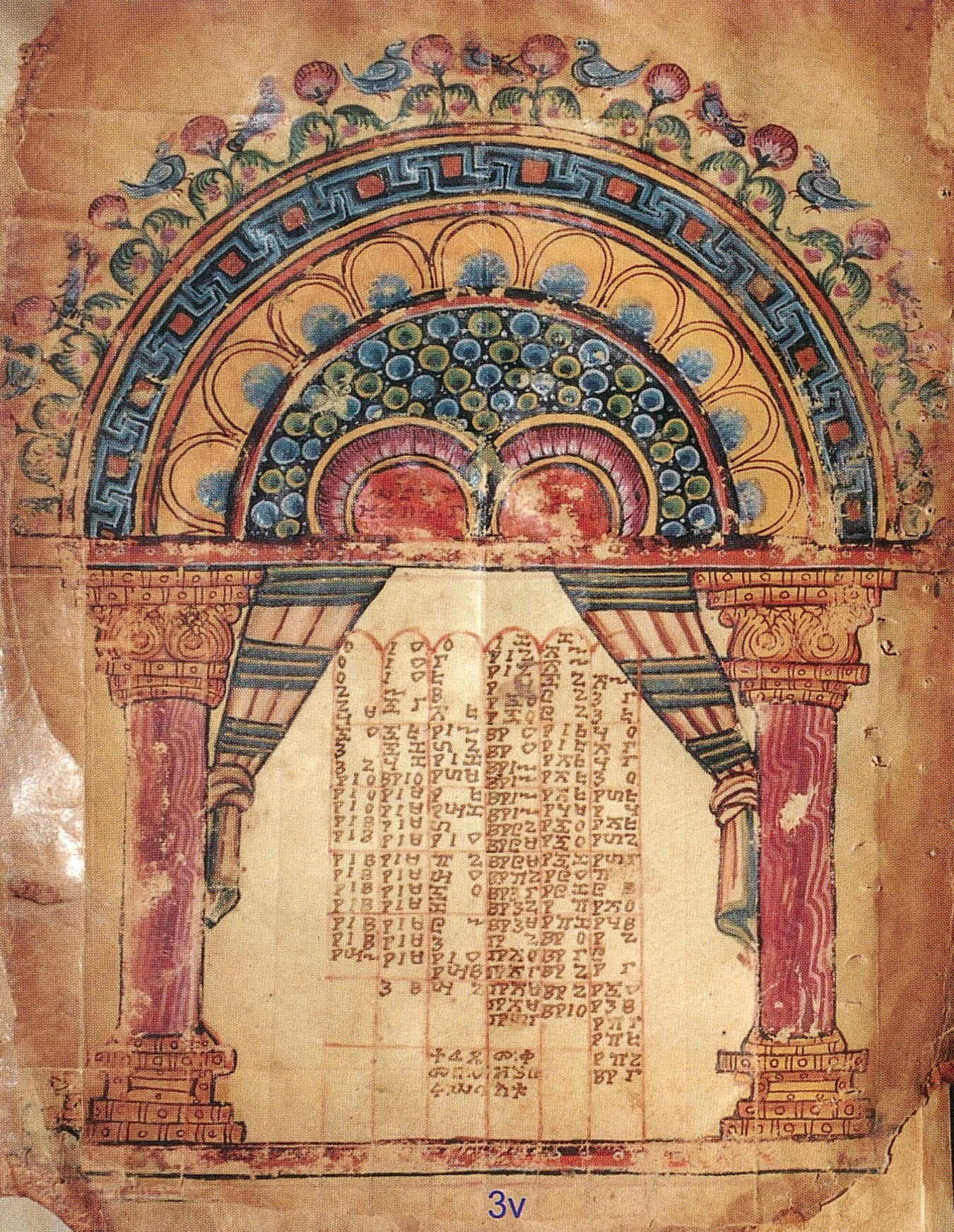
Tradition says that Saint Abba Garima, one of the Nine Saints who brought monasticism to Ethiopia in the late 5th century, copied the gospels in a single day, the sun staying still in the sky to give him the light he needed. Whether the legend is literal, three illuminated gospel codices have been preserved at his monastery in the Tigray highlands of northern Ethiopia for nearly fifteen hundred years. They have never left the monastery walls. They were not looted, not sold, not relocated to a Western library. They are still there, in the same hills where they were produced, read in liturgy by the same Ethiopian Orthodox Tewahedo Church that produced them. Recent radiocarbon dating has placed their production between the late 4th and early 7th centuries — making them the oldest substantially intact illuminated Christian manuscripts in existence and likely the oldest complete Gospels in any language.
The Garima Gospels are also a wonder of art. The illuminations include the earliest known portraits of the four evangelists, canon tables of breathtaking color, and a famous architectural rendering of the Temple in Jerusalem. The translator and scribe combined the artistic traditions of late-antique Mediterranean Christianity with distinctly Ethiopian aesthetic sensibilities — producing something that is unmistakably Christian, unmistakably ancient, and unmistakably Ethiopian.
The Ethiopian church received the gospel through Aksumite missionary contact in the 4th century. The Ethiopian Bible, in Ge'ez (Classical Ethiopic), was translated from Greek beginning in that period. The Garima Gospels are the earliest manuscripts of that translation we possess. They are more than a textual witness; they are the single longest continuous monastic Christian tradition in the world.
For the believer today, the Garima Gospels are a witness that the gospel reached Africa not as a colonial import in the 19th century, but as an apostolic-era plant in the highlands of Ethiopia, where it has flourished for almost two thousand years. African Christianity is older than European Christianity in many places. The Word reached the highlands. The Word stands.
Why this manuscript matters
- Oldest illuminated Christian manuscript
- Earliest Ethiopian Bible
- Continuous monastic preservation