Public domain · via Wikimedia Commons ↗
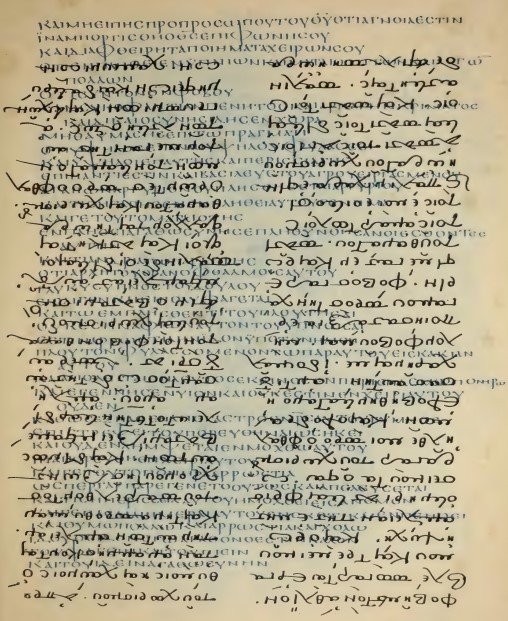
Codex Ephraemi Rescriptus
Also called C, 04, Ephraemi Syri Rescriptus.
Reflection
Sometime in the 12th century, a Christian scribe ran short of parchment. He took an old, faded 5th-century Greek Bible, scraped off the original ink, and wrote on top of it — Greek translations of sermons by Ephrem the Syrian, a 4th-century church father. The original Bible underneath was thought lost. It was not lost. It was sleeping.
In the 1840s, the same Constantin von Tischendorf who would later save Sinaiticus turned his attention to this Paris codex, identified its underlying text as biblical, and applied chemical reagents to revive the faded original ink. The reagents damaged the manuscript permanently, and Tischendorf would later regret his methods, but he did manage to read most of the underlying text. In our own century, multispectral imaging — photographing the codex at multiple wavelengths invisible to the human eye — has recovered far more, and the work continues.
What Ephraemi witnesses is breadth. Among the great uncials, only Sinaiticus and Alexandrinus carry comparable breadth across both testaments. Ephraemi covers nearly the whole New Testament — only 2 Thessalonians and 2 John are entirely missing — and substantial Old Testament portions. The text-type is mixed, leaning Byzantine, and provides an independent check against the more famously Alexandrian Sinaiticus and Vaticanus. Where 5th-century manuscripts agree across text-types, the agreement is strong textual evidence; where they disagree, careful weighing of witnesses follows.
For the believer today, Codex Ephraemi Rescriptus is a witness that even the manuscripts the church almost lost are not lost. A scribe scrubbed a Bible to write something else on top of it; eight hundred years later, technology nobody could imagine peeled back the cover and let us read what was underneath. God preserves his Word. He preserved it through this manuscript when men did not know they were preserving it. The Word stands — sometimes hidden, never silenced.
Why this manuscript matters
- Greek palimpsest — biblical text recovered from beneath
- Tischendorf's first major project
- 5th-century mixed text