Public domain · via Wikimedia Commons ↗
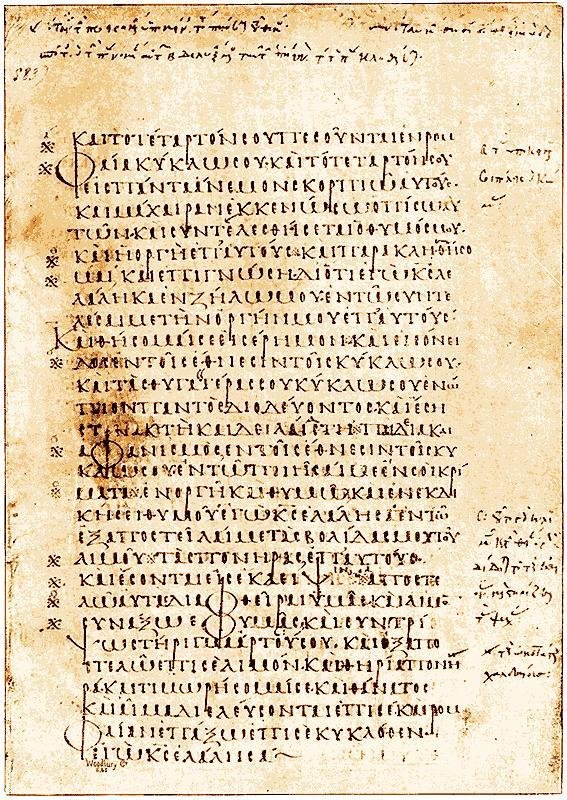
Codex Marchalianus
Also called Q, Vat. gr. 2125.
Reflection
Origen of Alexandria, in the 3rd century, undertook one of the most ambitious editorial projects in the history of biblical scholarship. He arranged six versions of the Old Testament side by side in parallel columns — the Hebrew, a Greek transliteration of the Hebrew, the translations of Aquila and Symmachus, the Septuagint with critical markers, and the version of Theodotion. He called it the Hexapla. The full Hexapla is lost. But manuscripts that preserve Origen's editorial work survive — and Codex Marchalianus is one of the best.
What Marchalianus witnesses is the Septuagint of the Prophets, the 6th-century Christian text of Isaiah, Jeremiah, Ezekiel, Daniel, and the Twelve, with Origen's markers still visible in the margins. The obeli (÷) mark passages present in the Greek but missing from the Hebrew. The asterisks (※) mark passages added from the Hebrew that the Greek had lacked. The marginal notes preserve readings from Aquila, Symmachus, and Theodotion — the three Jewish Greek translations whose original manuscripts have not survived. Without Marchalianus and a few sister manuscripts, we would not know what those translations said.
The text is essential for understanding how the early Christian church read the Old Testament prophets. The Septuagint was the church's Bible — the text Paul quoted in Romans, the text Hebrews quoted in chapter 1, the text Matthew used when he traced the prophecies of Christ. Where the Septuagint of the prophets agrees with the Hebrew Masoretic Text, Marchalianus witnesses that agreement; where it differs, Marchalianus preserves the Christian reading the early church relied on.
For the believer today, Codex Marchalianus is a witness that the prophetic words quoted in the New Testament — Isaiah's Suffering Servant, Daniel's Son of Man, Joel's outpoured Spirit, Habakkuk's just shall live by faith — were read in Greek with this care, this scholarship, this attention. The prophets came to the church in Greek, and they came preserved. The Word stands.
Why this manuscript matters
- Best Septuagint witness for the Prophets
- Preserves Hexaplaric markers
- Aquila/Symmachus/Theodotion marginal readings