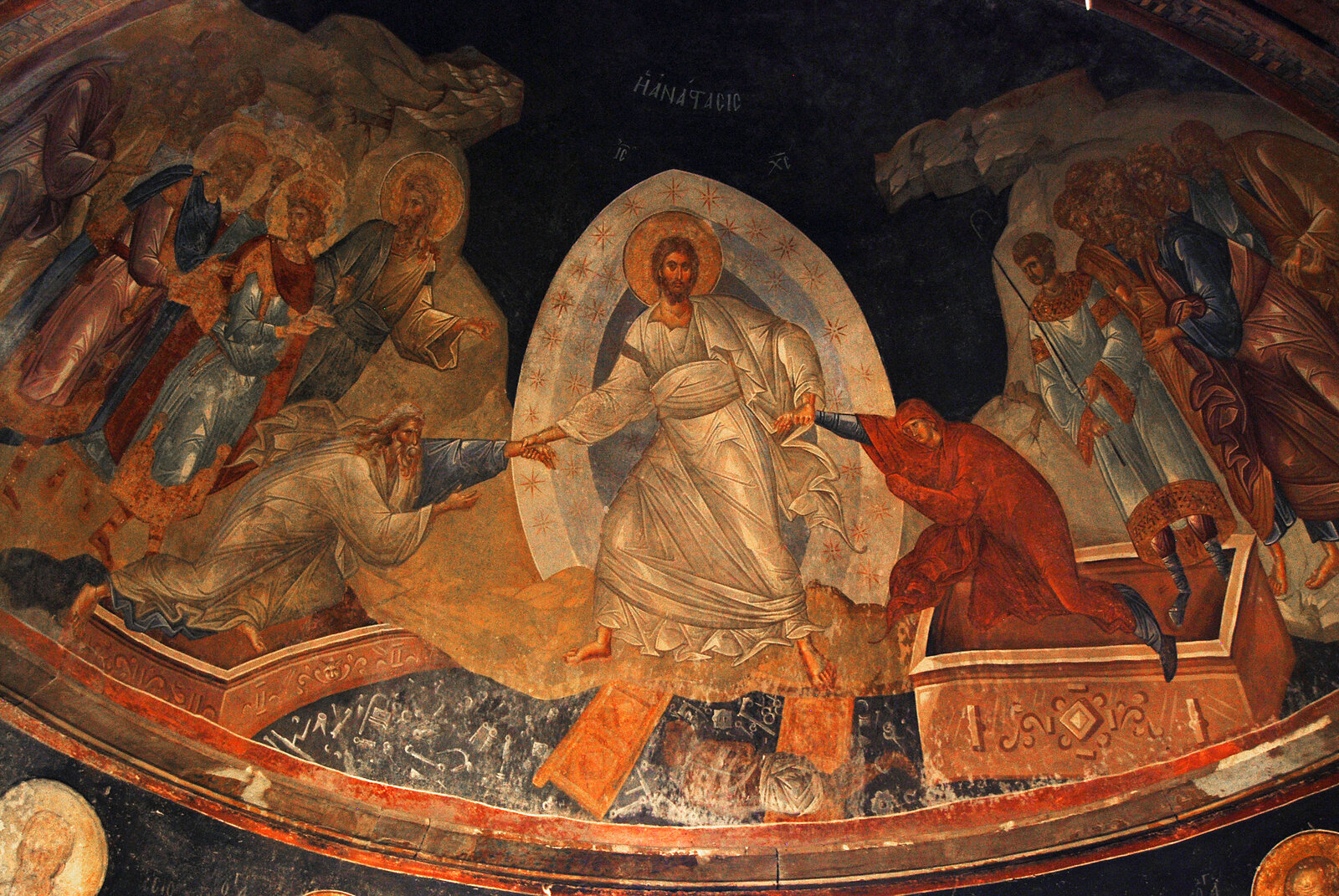
The Anastasis
Apse Fresco, Chora Church Parekklesion
Doctrinal reflection
Christ is reaching into the grave.
The Anastasis fresco in the apse of the Chora Church parekklesion shows the moment between Good Friday and Easter Sunday — what Christ was doing while his body lay in the tomb. He is in white, in a mandorla of light, robes flying. He is standing on the broken gates of Hades, which form a cross beneath his feet. He is pulling Adam out of the grave on his right and Eve out of the grave on his left. Behind them are the kings and prophets of the Old Testament — David, Solomon, John the Baptist, Abel — all looking on as Christ does what they had only hoped for.
This is the Eastern church's image of the Resurrection. Western artists tend to show Christ alone, stepping out of the tomb. The Byzantines show him coming back with Adam. The point is that his resurrection is not a private victory. It is corporate. He goes into death and brings humanity out with him.
1 Peter 3:18–19 says, "Christ also hath once suffered for sins... being put to death in the flesh, but quickened by the Spirit: by which also he went and preached unto the spirits in prison." Paul writes in Ephesians 4:9–10 that Christ "descended first into the lower parts of the earth" before he ascended on high. The artists at the Chora staged that descent in fresco.
The wrist is the key. Christ does not extend his hand and ask Adam to grab on. He grabs Adam by the wrist. The grip is his, not ours. "As in Adam all die, even so in Christ shall all be made alive" (1 Corinthians 15:22). Adam stands in for everyone.
When you stand at a grave — your own coming, or someone else's gone — preach this fresco. The Lord has already gone in. The gates are already broken. The grip is on the wrist. Whatever death you fear, he was there before you and came back out, pulling.
He is still pulling.