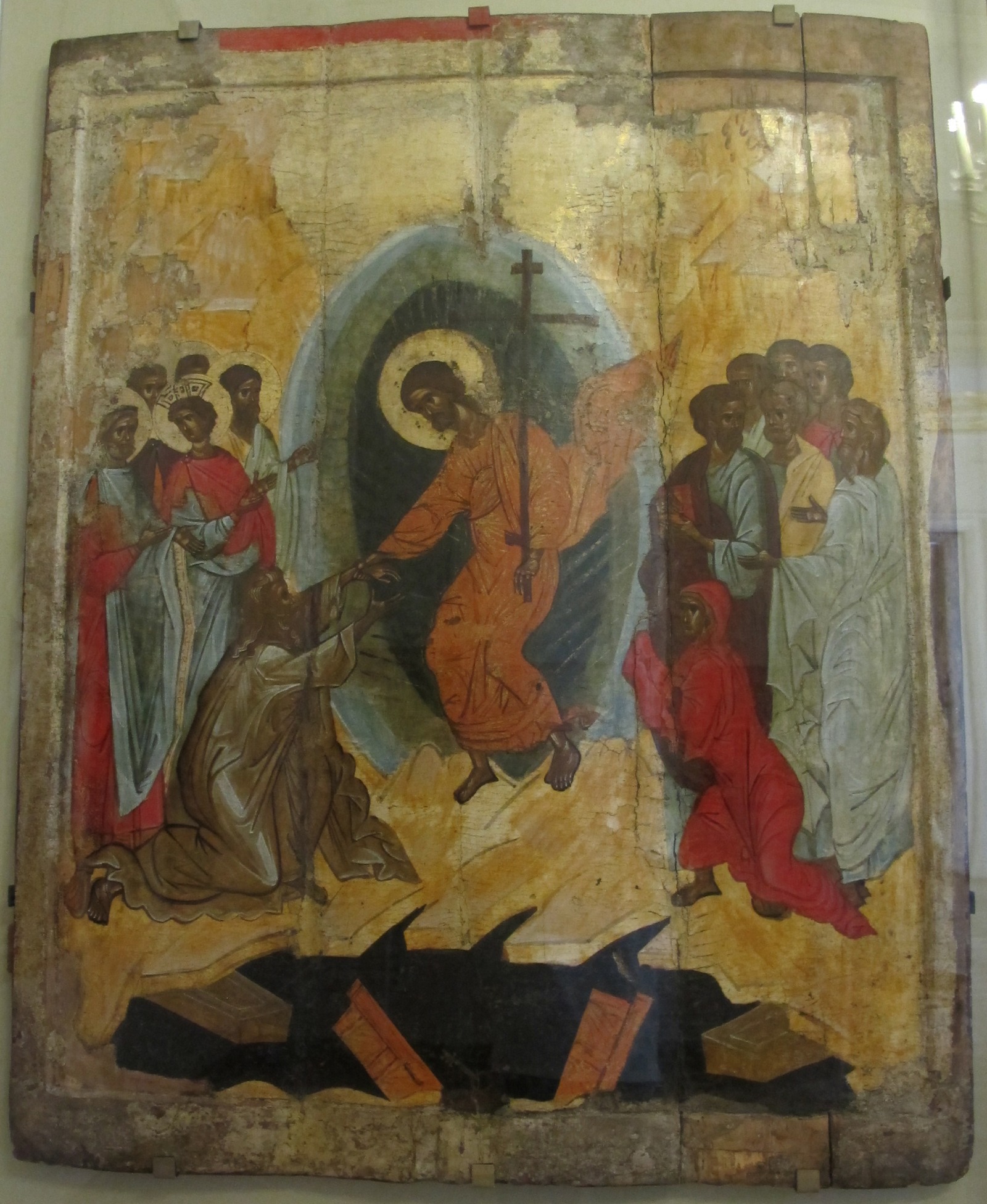
The Anastasis (Resurrection)
Late 15th-Century Novgorod School Icon — State Russian Museum, St Petersburg
Doctrinal reflection
Christ stands at the center on the broken doors of hell, mandorla of glory around him, robes flying as if the resurrection itself is moving the air. He grips Adam's wrist and pulls him up out of his stone sarcophagus — Adam half-risen, eyes wide. Behind Adam stands Eve. Behind them David and Solomon in royal regalia. To Christ's left stands John the Baptist, identifying the One whose path he prepared. Beneath Christ's feet, the gates of hell are smashed in cross-pattern; locks, keys, hinges scattered. The icon is late 15th-century Novgorod school, now in the State Russian Museum, St Petersburg — the corpus's first entry from the Russian Museum, opening a third Russian institution alongside the Tretyakov and the Khanenko.
The Anastasis register pattern-matched. The corpus has the Anastasis at Chora (#37) and Hosios Loukas (#23). Chora rendered the Constantinopolitan iconographic peak; Hosios Loukas rendered the Macedonian-Renaissance vocabulary. The Novgorod icon takes the same iconographic vocabulary 600 years after the post-iconoclast renewal, and renders it in the distinctive Novgorod-school register — bright primary colors, frontal compositional clarity, restrained emotional expression. The iconographic-survival principle (#70 lock) operates here at the long-arc level: a single iconographic vocabulary continuous from c. 6th-c. Egypt through 14th-c. Constantinople through 15th-c. Novgorod, doctrinally stable, regionally inflected.
1 Corinthians 15 — the typological-doctrinal anchor. "For as in Adam all die, even so in Christ shall all be made alive" (15:22). The Anastasis iconography is 1 Cor 15:22 made visible: Christ raises Adam by the wrist, undoing the fall in a single gesture. The Pauline argument and the iconographer's gesture point to the same place — the Second Adam reverses what the First Adam did. Collection 3 anchored.
The two-horizon Anastasis. The Collection 3 framework holds two horizons together: (1) Christ's resurrection-victory already accomplished at the empty tomb (Mode 1, NT-named: Acts 2:24; Romans 1:4; 1 Cor 15:3–8), and (2) the universal resurrection yet to come at the last day (1 Cor 15:51–54; 1 Thess 4:13–18; Revelation 20:11–15). The Anastasis icon renders the first horizon as the firstfruits of the second. The resurrection-victory at Easter is the down-payment on the great resurrection at the parousia. Christ raises Adam now as the prefigurement of the church being raised then.
The Novgorod school's distinctive register. Novgorod the Great (Великий Новгород) developed a regional iconographic style in the 14th–15th centuries that Russian art historians (Lazarev, Onasch) identified as a distinctive northern-Russian tradition: heraldic clarity, simplified compositional patterns, primary-color saturation, emotional restraint. The Novgorod painters worked while Constantinople was falling (1453) and the Russian Orthodox identity was consolidating around Moscow as the Third Rome. The Anastasis icon's compositional confidence is the confidence of an iconographic tradition that knows its doctrinal ground — Christ is risen; the church is the pilgrim community awaiting the great resurrection.
Russian Museum opens. The third Russian institution after the Tretyakov (Moscow, 3 entries: Rublev, Vladimir, Theophanes) and the Khanenko (Kyiv, 1 entry: Sergius and Bacchus). The Russian Museum's icon collection (founded 1898 by Alexander III) is one of the most extensive globally; the corpus may grow Russian Museum entries to 2–3 over time as iconography supplies occasion.
Adam half-risen. Eve waiting. The doors of hell scattered under Christ's feet. The first resurrection accomplished; the second resurrection promised. The firstfruits of them that slept.