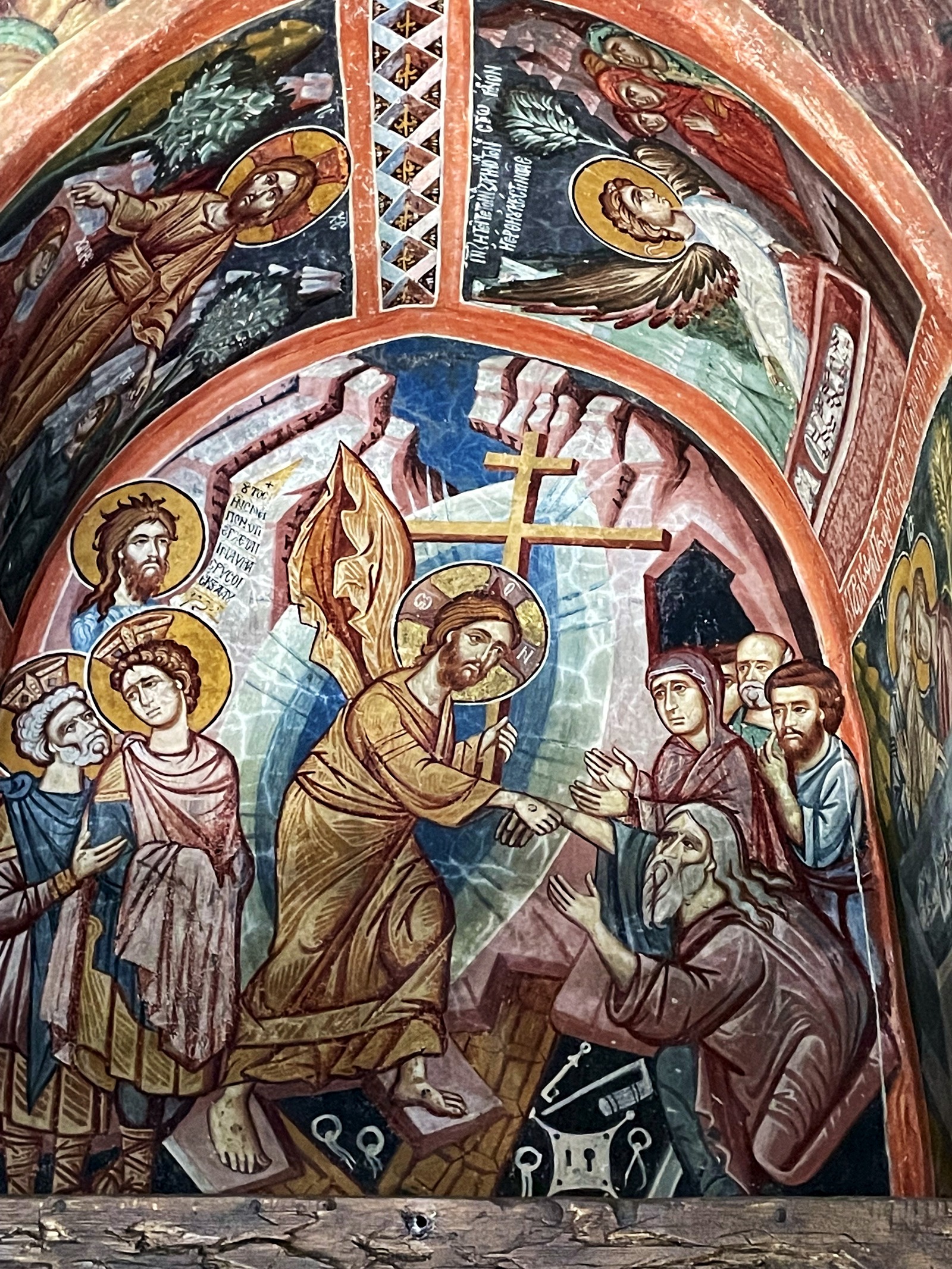
The Anastasis (Resurrection)
Fresco, Church of Timios Stavros tou Agiasmati, Platanistasa, Cyprus — 1494
Doctrinal reflection
Christ stands at the center on the broken doors of hell, mandorla of glory around him. He grips Adam's wrist in his right hand and pulls him from the tomb; his left hand reaches across to Eve. Behind Adam, David and Solomon in royal regalia; behind Eve, John the Baptist. Beneath Christ's feet, the gates of hell are smashed in cross-pattern, scattered locks and keys among them. The fresco belongs to the same 1494 program by Philippos Goul as the Crucifixion at #crucifixion-stavros-agiasmati — completing the Passion-Resurrection iconographic arc within the small village church at Platanistasa, Cyprus. Stavros tou Agiasmati at 2/4.
Anastasis-iconography standing rule applied (locked at #110+2, anchored at #111 Novgorod Anastasis). The corpus's Anastasis reading is anchored at 1 Corinthians 15:22 ("as in Adam all die, even so in Christ shall all be made alive") — Second-Adam-reverses-First-Adam gesture. The two-horizon Anastasis frame (already-accomplished resurrection-victory + yet-to-come universal resurrection at the parousia) is the locked Collection 3 reading. 1 Peter 3:18–19 (the spirits in prison) referenced briefly but not adjudicated: the corpus does not take a side on the contested harrowing-of-hades exegesis. Goul's Cypriot Anastasis pattern-matches into this locked reading without re-articulation.
Iconographic continuity at the Latin-Greek boundary. The 1494 Stavros tou Agiasmati Anastasis is iconographically the same composition as the 11th-c. Byzantine Anastasis at Hosios Loukas (#anastasis-hosios-loukas), the 14th-c. Constantinopolitan Anastasis at Chora (#anastasis-chora), and the late-15th-c. Novgorod Anastasis (#anastasis-novgorod-russian-museum). The iconographic vocabulary travels across 600 years and several thousand miles; the doctrinal content — Christ raises Adam by the wrist, undoing the fall — stays stable. The Iconographic-survival principle (#70 lock) operates at the long-arc level once again. The Cypriot village church at Platanistasa, painted by a Syriac-Orthodox master under Venetian-Latin rule, holds the same gospel the Constantinopolitan workshop painted at Chora a century earlier.
Collection 5 + Collection 3 within the same program. Stavros tou Agiasmati's Crucifixion (#118 west wall gable) and Anastasis (this entry) form the doctrinal hinge: the cross is the place of substitutionary death; the Anastasis is the place of accomplished resurrection. The Collection 5 (Life of Christ Passion) and Collection 3 (Second Coming / resurrection horizon) collections meet at the same iconographic program. He died and rose; the dying and the rising are the gospel. 1 Corinthians 15:3–4 names the two as the apostolic confession-formula — Christ died for our sins according to the scriptures; he was buried; he rose again the third day according to the scriptures — and Goul renders both in the same chapel.
The cross-pattern of the broken doors — compositional theology. The Goul painter renders the scattered hell-doors in cross-pattern — they form a cross-shape under Christ's feet. The compositional theology is direct: the cross broke the doors of hell. The eye-line-as-doctrine principle (locked at #72 Climacus) operates here in resurrection-iconography register: the viewer's eye runs from the Crucifixion (west wall gable) to the Anastasis (interior fresco) through the broken-cross-doors that link them. The doors of hell are broken into the very shape of the cross that broke them. The painter knew exactly what he was doing.
The cross-tradition convergence (locked at #77 Georgian Pentecost enamel). Goul was a Syriac Orthodox painter; the church was built by the Greek Orthodox community of Platanistasa; the political context was Venetian-Latin rule. Three traditions meeting at one iconographic moment, and the painter rendered the apostolic gospel without the polemical-tradition register. The corpus's named-decline rule applies silently — no Marian-mediation drift, no purgatory-suggestion in the Anastasis composition (Christ raises Adam directly from the tomb, not from a holding-state), no harrowing-of-hades adjudication. The doctrinal restraint is the painter's discipline.
Christ raises Adam. The cross broke the doors of hell. The doors lie scattered in cross-pattern beneath his feet. The first resurrection accomplished; the second resurrection promised at the parousia. The same gospel at the village church as at the imperial workshop.