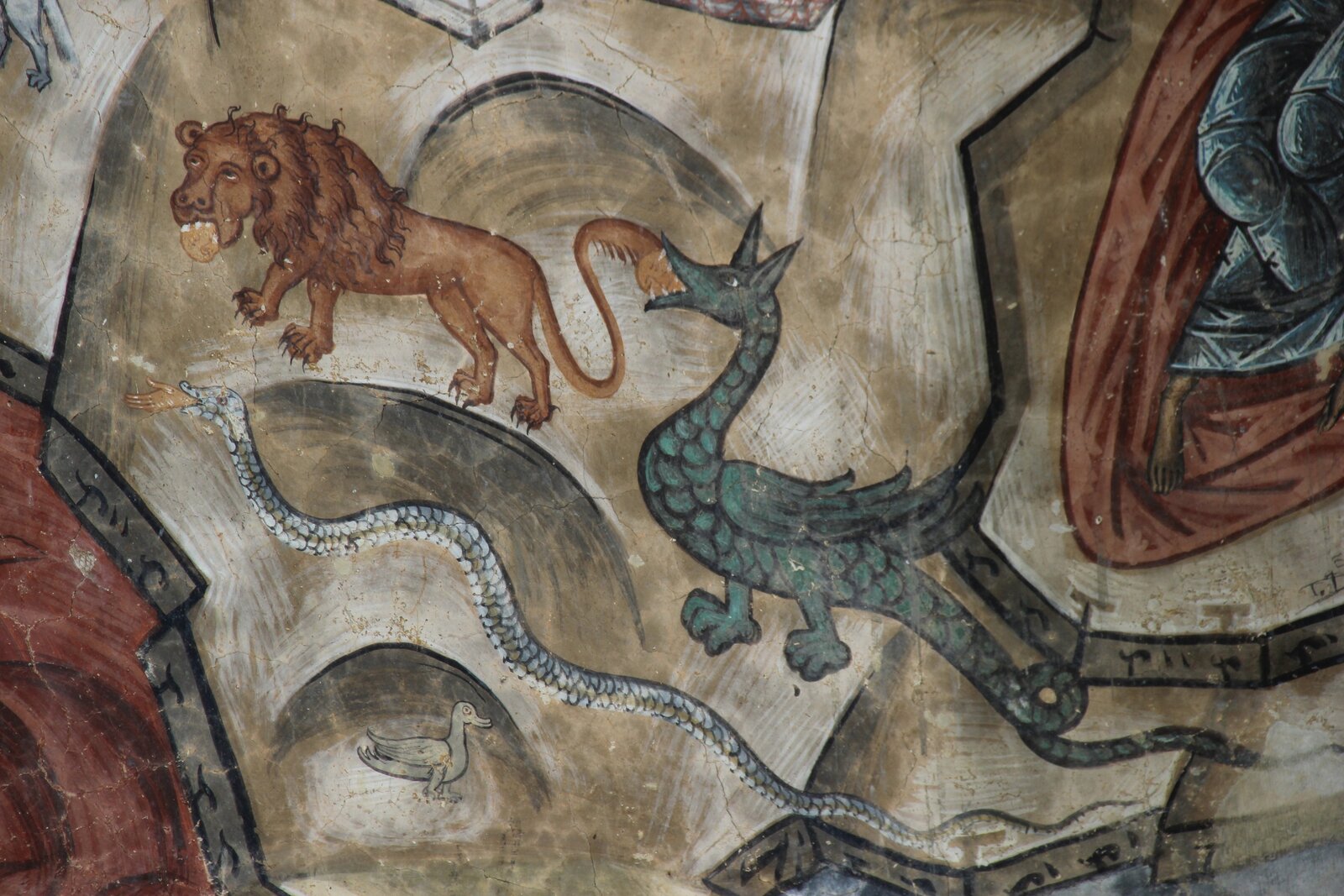
The Lion and the Dragon
Exterior Fresco Detail, Voroneț Monastery, Bukovina, Romania — c. 1547
Doctrinal reflection
A lion and a dragon flank a central decorative band on the exterior wall of Voroneț Monastery. The lion in heraldic-frontal posture, mouth open, paws spread; the dragon with serpentine body, wings outstretched, mouth turned back toward the lion. Both creatures are stylized, painted in the same pigment vocabulary as the surrounding figural frescoes — the famous Voroneț blue that defines the monastery's exterior. The mural is part of the c. 1547 exterior fresco program commissioned under Metropolitan Grigore Roșca during the reign of Voivode Petru Rareș. Voroneț's exterior is one of the most extensively-frescoed church exteriors in the Christian world, with virtually every wall surface bearing iconographic content.
The lion and the dragon are scriptural pairings, not decorative motifs. Two passages anchor the iconographic vocabulary:
Psalm 91:13. "Thou shalt tread upon the lion and adder: the young lion and the dragon shalt thou trample under feet." The psalm's promise to the one who dwelleth in the secret place of the most High (91:1) — the four-creature catalogue (lion, adder, young lion, dragon) — is read messianically across early Christian exegesis. The Septuagint groups these as aspida kai basiliskon... leonta kai drakonta — and patristic readings consistently apply them to Christ's triumph over the demonic. Christ himself was tempted with the psalm by Satan in the wilderness (Matt 4:6); the irony is that the psalm describes Christ's actual victory, which Satan could not accomplish by quoting it. The corpus has named the species/figure split pattern at #48 George (dragon as adversary, George as figure, Christ as canonical actor); the same logic applies here. The dragon is real adversary; the lion-and-dragon as paired adversaries are the demonic-eschatological forces; Christ tramples them.
Revelation 12:9 names the dragon explicitly: "And the great dragon was cast out, that old serpent, called the Devil, and Satan, which deceiveth the whole world." The Voroneț painter's dragon participates in this Revelation register — the eschatological adversary already cast out by Christ's victory but still operative in the world until the final judgment.
Why this is on the church's exterior. Voroneț's exterior fresco program is itself an iconographic argument. Most Byzantine and post-Byzantine churches keep figural iconography inside, where the gathered congregation worships under it. Voroneț turns the iconography outward — the eschatological tableau (Last Judgment, corpus #last-judgment-voronet, on the western wall) faces the village; the lion-and-dragon and other apotropaic-eschatological imagery faces outward. The church proclaims to anyone who passes: Christ tramples the lion and the dragon. The Reformation-era's loss of exterior iconographic preaching is one of the costs the corpus quietly notes; Voroneț shows what was lost when interior-only iconography became the norm.
The Hetoimasia connection (#hetoimasia-bode-relief). The 5th-century Berlin Hetoimasia and the 16th-century Voroneț lion-and-dragon are both eschatological-iconographic in different keys. The Hetoimasia depicts the prepared throne in waiting; the Voroneț lion-and-dragon depicts the trampled adversaries already underfoot of the One who sits on the throne. Together they bracket the Collection 3 framework: the throne is prepared; the adversaries are defeated; the church watches.
Romania at 2 entries. The Last Judgment (#last-judgment-voronet) on the western exterior and the Lion-and-Dragon (this entry) on a side wall together open Voroneț's iconographic program at two doctrinal angles within the same Collection 3 (Second Coming) framework. Voroneț's exterior cycle has dozens of additional scenes; the corpus may grow Voroneț entries to 3 over time if the iconography supplies further occasion.
Christ tramples. The lion and the dragon are real adversaries. They are already underfoot of the Lamb who was slain.