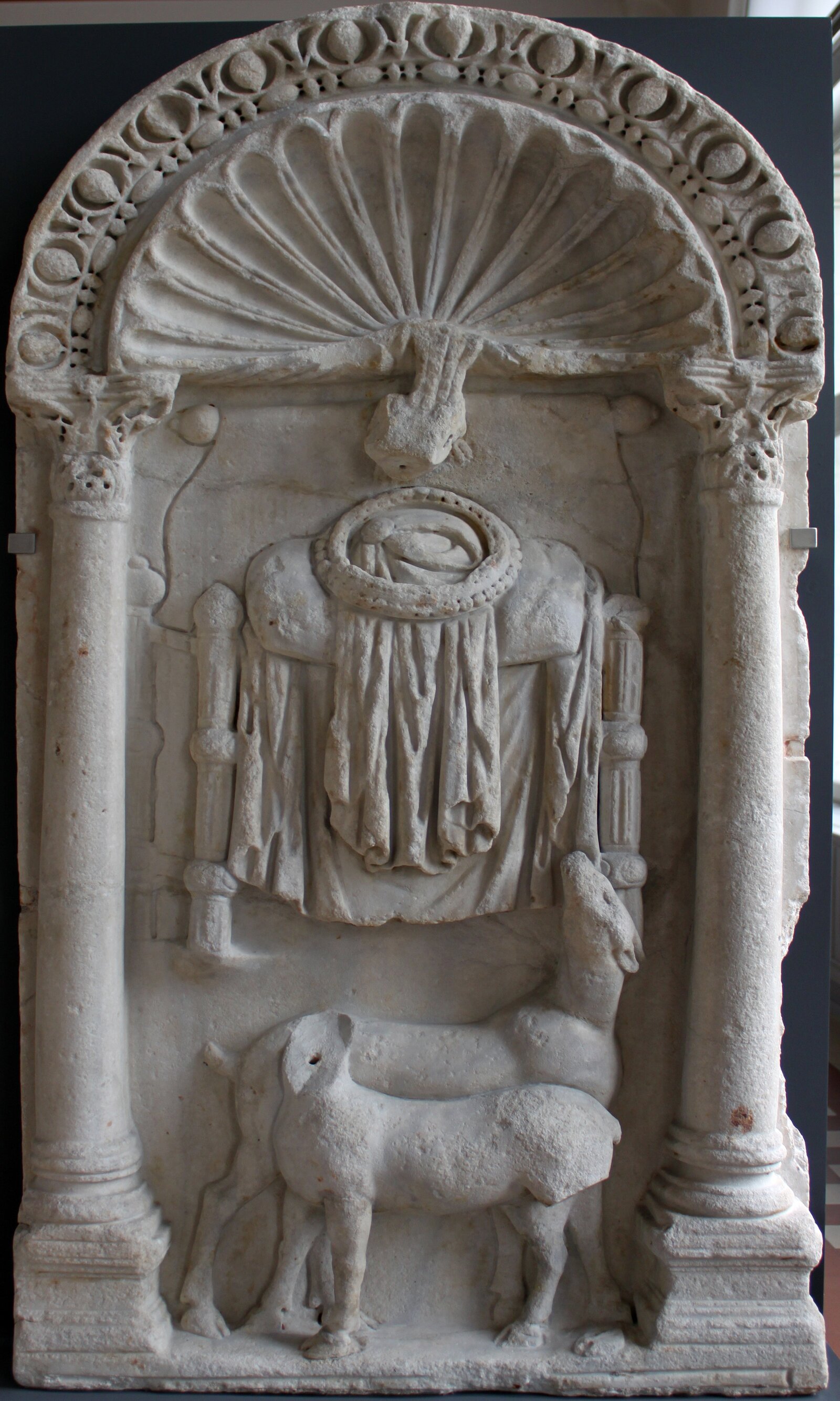
The Hetoimasia
The Prepared Throne of Christ — c. 400 marble relief, Bode Museum, Berlin
Doctrinal reflection
An empty throne. A cushion on the seat. A draped cloth across the back. No figure. The marble relief in Berlin's Bode Museum, carved in Constantinople around 400, is one of the oldest surviving examples of the Hetoimasia — Greek ἑτοιμασία τοῦ θρόνου, the preparation of the throne — the iconographic type that depicts not Christ enthroned but the throne prepared for Christ's return. The fifth-century iconographer renders the absence as the doctrine.
The Hetoimasia is the corpus's first dedicated Collection 3 entry on a non-Last-Judgment eschatological iconography. Where the parousia compositions at Torcello (#16), Vatopedi, and Voronet show Christ's actual return-and-judgment, the Hetoimasia shows the waiting throne — the iconographic-tense between the resurrection-ascension and the visible second coming. The composition is a single proposition: the throne is prepared, the King is coming, the church watches.
Apostolic anchors. Psalm 9:7 supplies the linguistic root: "But the LORD shall endure for ever: he hath prepared his throne for judgment" (Hebrew konen lammishpat kis'o, LXX hētoimasen en krisei ton thronon autou). The Greek verb hetoimazō — to prepare — gives the iconographic type its name. The throne was prepared in eternity; the throne is occupied in heaven now (Hebrews 8:1, we have such an high priest, who is set on the right hand of the throne of the Majesty in the heavens); the throne will be visible at the parousia. The Hetoimasia composition holds all three tenses in one image.
Revelation 4:2 + 22:1. "And, behold, a throne was set in heaven, and one sat on the throne" (Rev 4:2). John on Patmos sees the throne occupied; the iconographer renders the moment before the seer's vision is shared with the watching church. "And he showed me a pure river of water of life, clear as crystal, proceeding out of the throne of God and of the Lamb" (Rev 22:1). The throne is the source of the river of life. The empty-throne relief points the watcher forward to that occupation.
Acts 1:11 and the post-tribulation register (corpus #37 Thessaloniki). "This same Jesus, which is taken up from you into heaven, shall so come in like manner as ye have seen him go into heaven." The Hetoimasia is the iconography of between the two clauses — between the ascension already accomplished and the visible return still future. The corpus's post-trib eschatology (1st flagship, anchored at #16 Torcello and #37 Ascension Thessaloniki) reads the parousia as one event, public and bodily, after the tribulation. The Hetoimasia composition holds the church's posture of watching in the meantime — eyes on the prepared throne, expecting the One who will sit on it.
The iconographic restraint. The 5th-century carver does not render Christ. The doctrinal claim is enacted by absence: Christ is not yet visibly returned, and the iconographer refuses to depict him as though he were. This is the iconographic-restraint sub-pattern the corpus has named at #74 Rossano (every figure whose eyes can see is looking at Christ; the blind man cannot yet), at #86 Karanlık (the painter renders the kiss, not the heart), at #91 Mileševa (an absence with an angel pointing at it). The Hetoimasia is restraint at its most architectural: no figure at all, just the throne, just the cushion, just the draped cloth. The doctrine of the parousia is preserved in stone by the artist who refused to anticipate it.
Bode Museum opens. This is the corpus's first entry from Berlin's Museum für Byzantinische Kunst — the Bode Museum's Byzantine collection, one of the major non-Eastern repositories of Byzantine sculpture and panel-painting. The museum may grow to additional corpus entries as iconography supplies occasion.
The throne is prepared. The King has not yet returned. The church watches.