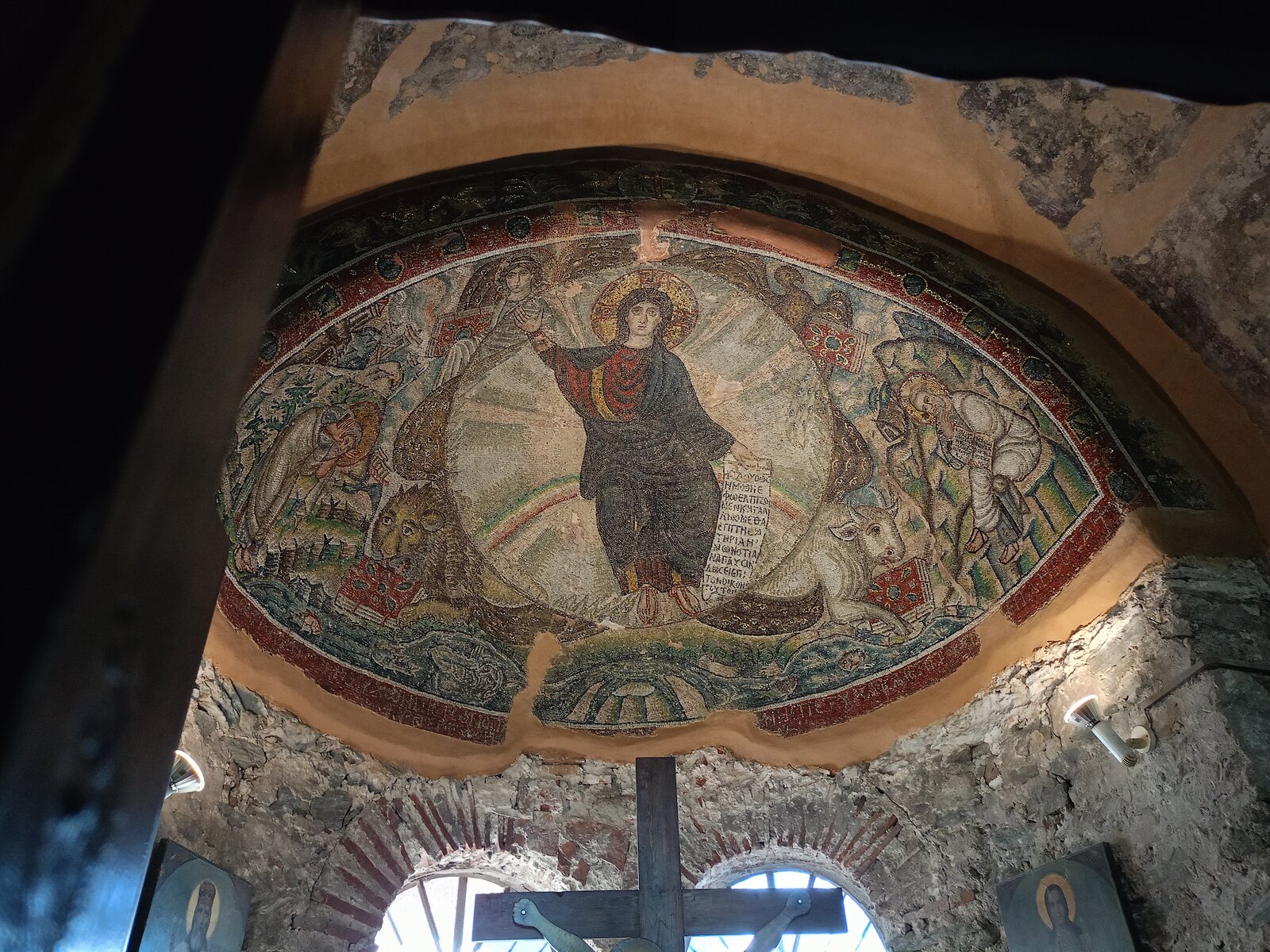
The Vision of Christ in Glory
Apse Mosaic, Hosios David (Latomos Monastery), Thessaloniki — c. 425–450
Doctrinal reflection
Christ sits enthroned on a rainbow-arch within a brilliant mandorla, beardless, holding an open scroll. The four living creatures of Ezekiel and Revelation crowd the mandorla — the man, the lion, the ox, the eagle. Beneath Christ's feet, four rivers flow outward. To the left, Ezekiel raises his hands, awestruck; to the right, Habakkuk gestures upward. The apse half-dome of Hosios David in Thessaloniki, c. 425–450, holds one of the oldest surviving Christophany images in the Byzantine corpus. By a medieval legend, the apse was preserved through iconoclasm because the monks plastered hides over it and hid the mosaic from imperial inspectors. It survived because the iconography is what the gospels say (#70 iconographic-survival principle).
This is the 14th flagship articulation in the corpus's doctrinal-position emergence map: Old Testament theophany read as Christophany — the apostolic-hermeneutic flagship.
The Hosios David iconographer is doing exactly what the apostle John does with Isaiah 6. "These things said Esaias, when he saw his glory, and spake of him" (John 12:41). John locates Isaiah's throne-vision — I saw the Lord sitting upon a throne, high and lifted up (Isaiah 6:1) — as a vision of Christ. The Hosios David artist runs the same move on Ezekiel 1 and Revelation 4: the throne Ezekiel saw is Christ's throne; the four living creatures attend Christ; the prophet who fell on his face fell before the pre-incarnate Word. The iconographer is not over-reading. He is following John 12:41's lead.
Three more apostolic anchors fix the hermeneutic. 1 Corinthians 10:4 — "that Rock was Christ" — Paul reads the wilderness theophanies as Christophanies. The God who fed and led Israel was the pre-incarnate Son. John 1:18 — "No man hath seen God at any time; the only begotten Son... he hath declared him" — the structural undercut to any reading that places the Father as the visible figure of OT theophanies. If no one has seen the Father, then whoever Israel saw on Sinai, by the river Chebar, in the temple, in the fiery furnace was the Son. Hebrews 1:1–3 closes the disposition: God... hath in these last days spoken unto us by his Son... the brightness of his glory, and the express image of his person. Christ is the brightness Ezekiel saw and Isaiah saw and the cloud spoke from on Sinai.
This is a Mode 1 extension, not a sixth mode. The five-mode framework (#38 Rublev) handles NT-named typologies as Mode 1; theophany-as-Christophany is a sub-category — the apostles themselves reading specific OT theophanies as visions of Christ. The Hosios David mosaic does not invent the move; it visualizes a hermeneutic already supplied by John, Paul, and the Hebrews writer.
The corpus holds three fences around the flagship. Affirm the Christophany reading where the apostles affirm it — Isaiah 6 (John 12:41), the wilderness rock (1 Cor 10:4), the Son's pre-incarnate declaring of the Father (John 1:18). Decline speculative Christological readings the apostles do not themselves authorize — not every angel of the LORD, not every theophanic cloud, not every Old Testament wonder is automatically a Christophany; the corpus reads where the apostolic warrant runs and stops where it stops. Refuse the modern liberal reduction that turns OT theophanies into symbolic-literary devices with no real referent. Ezekiel saw something. Isaiah saw something. The apostles say what they saw was Christ. Both ends of the fence — over-reading and under-reading — are wrong; the apostolic middle is the doctrine.
Compositional theology — sequential attention. Ezekiel and Habakkuk look up; the four creatures attend the throne; Christ holds the open scroll outward to the viewer. The iconographer's eye-line argument is the apostolic argument: what was hidden in the prophets was always Christ, and what we receive is the same Christ they saw, now declared.
What Ezekiel saw was Christ. What Isaiah saw was Christ. What we now see in his face was already what they saw, foreshadowed.