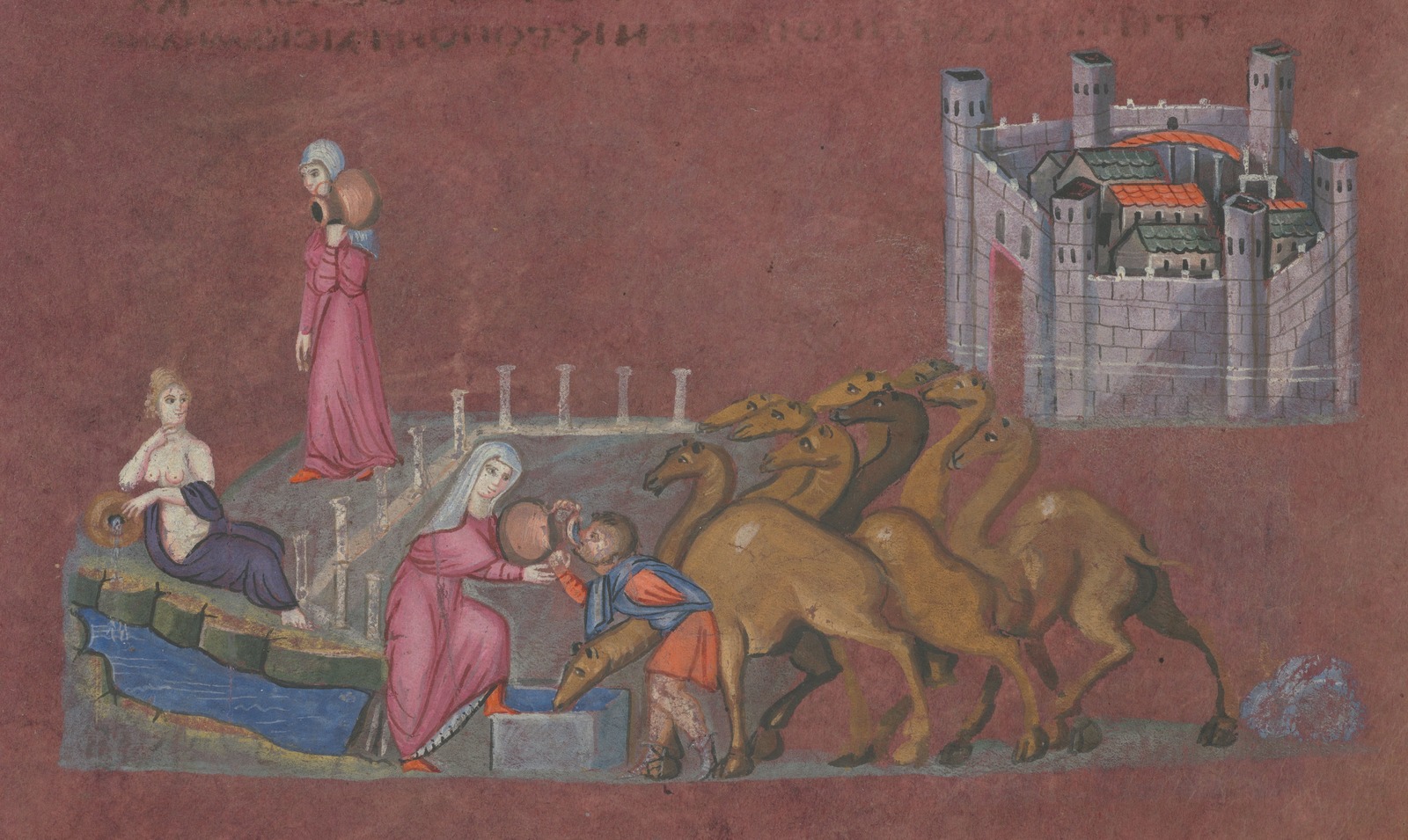
Rebecca at the Well
Vienna Genesis, fol. 7 — c. 6th century, Antioch / Syria (Codex Vindobonensis Theol. gr. 31)
Doctrinal reflection
The folio reads as a continuous-narrative strip across two scenes. Left: Rebecca walks from the city of Nahor, jar on her shoulder, toward the well; a personification of Spring (a reclining female figure beside a flowing source) marks the well as an inhabited landscape feature. Right: Rebecca tilts the jar to give Eliezer's camels water; Eliezer himself stands beside, watching. The scene is Genesis 24:15–20 — the chosen bride identified by the sign of unsolicited service. The folio belongs to the c. 6th-century Vienna Genesis, the corpus's second entry from this manuscript alongside the Joseph-and-Potiphar's-wife folio (#joseph-vienna-genesis). Vienna Genesis manuscript at 2/3 (Lock A's three-entry-gap activates after this 2-from-non-consecutive cluster).
The narrative anchor — Genesis 24. Abraham sends Eliezer to find a wife for Isaac from among Abraham's kin. Eliezer prays at the well: "O Lord God of my master Abraham... behold, I stand here by the well of water; and the daughters of the men of the city come out to draw water: and let it come to pass, that the damsel to whom I shall say, Let down thy pitcher, I pray thee, that I may drink; and she shall say, Drink, and I will give thy camels drink also: let the same be she that thou hast appointed for thy servant Isaac" (Gen 24:12–14). Rebecca arrives, offers water unsolicited, waters all the camels — the sign answered. The Vienna Genesis iconographer renders the unsolicited service register: Rebecca's posture is bent forward in active service, not passive waiting.
Ephesians 5 — the apostolic typology anchor. "Husbands, love your wives, even as Christ also loved the church, and gave himself for it; that he might sanctify and cleanse it with the washing of water by the word, that he might present it to himself a glorious church" (Eph 5:25–27). Paul names Christ-and-church-as-bridegroom-and-bride as the apostolic typology; Revelation 21:2 names the New Jerusalem as the bride adorned for her husband. Rebecca's Genesis 24 narrative is one OT-typological prefigurement of this apostolically-named pattern. Mode 1 typology by patristic extension (locked at #92 Abel-Melchizedek San Vitale framework): the apostles name the type (Christ-and-church-as-bridegroom-and-bride); patristic exegesis (Origen, Ambrose, Augustine) reads Genesis 24 within that named pattern; the corpus follows. Eliezer prefigures the Holy Spirit-sent-by-the-Father-to-find-the-bride; Rebecca prefigures the church brought from far country to be the Son's; Isaac prefigures the Son who waits in the field at evening (Gen 24:63) for the bride to arrive.
The unsolicited-service sign — covenant election by character, not appearance. Eliezer's prayer-test does not ask for the most beautiful or wealthy maiden; it asks for the one who serves unsolicited. Rebecca offers water before being asked, then waters all ten camels (a substantial physical labor — camels can drink 25 gallons each after a long journey). The sign locates the chosen bride in the willingness to serve. The corpus reads this through Mark 10:43–45 — whosoever will be great among you, shall be your minister... for even the Son of man came not to be ministered unto, but to minister. Rebecca's character at the well is the iconographic prefigurement of the church's character throughout history: given to serve, not to be served. The bride takes after the bridegroom; the bridegroom serves; the bride serves.
The Vienna Genesis's continuous-narrative strip — compositional theology. Both Vienna Genesis folios in the corpus (#97 Joseph-Potiphar's-wife and this Rebecca-at-the-well) use the continuous-narrative compositional strategy: multiple moments of a single narrative rendered side-by-side without panel-divisions, the figures repeating across the strip. The compositional theology: biblical narrative is a moving sequence, not a static tableau. The viewer's eye reads the strip left-to-right (matching the Greek text's reading direction); the narrative unfolds in time as the viewer's attention moves through space. The compositional choice is doctrinally meaningful: the gospel-narrative is sequential — promise, fulfillment, working-out — and the iconography renders the sequence rather than freezing one moment. The sequential-attention sub-pattern (locked at #79 Xoranasat) operates here in narrative-cycle register.
The personification figure of Spring. The reclining female personification beside the well is Spring (or Source) — a classical-pagan iconographic vocabulary that the Vienna Genesis iconographer imports into Christian biblical illustration. The pattern is identical to what the Paris Psalter does (#108) with Melodia and Echo beside David — pre-Christian classical-allegorical figures reframed in service of biblical narrative. The corpus has named this pattern at #108: the iconography imports antique-classical visual vocabulary into Christian-biblical illustration without endorsing the underlying paganism. The personification is decorative-iconographic, not doctrinal.
Rebecca walked to the well. She offered water unsolicited. She watered the camels. The chosen bride was identified by service. The pattern returns at every moment of the church's life: the bride takes after the bridegroom; the bridegroom served; the bride serves.