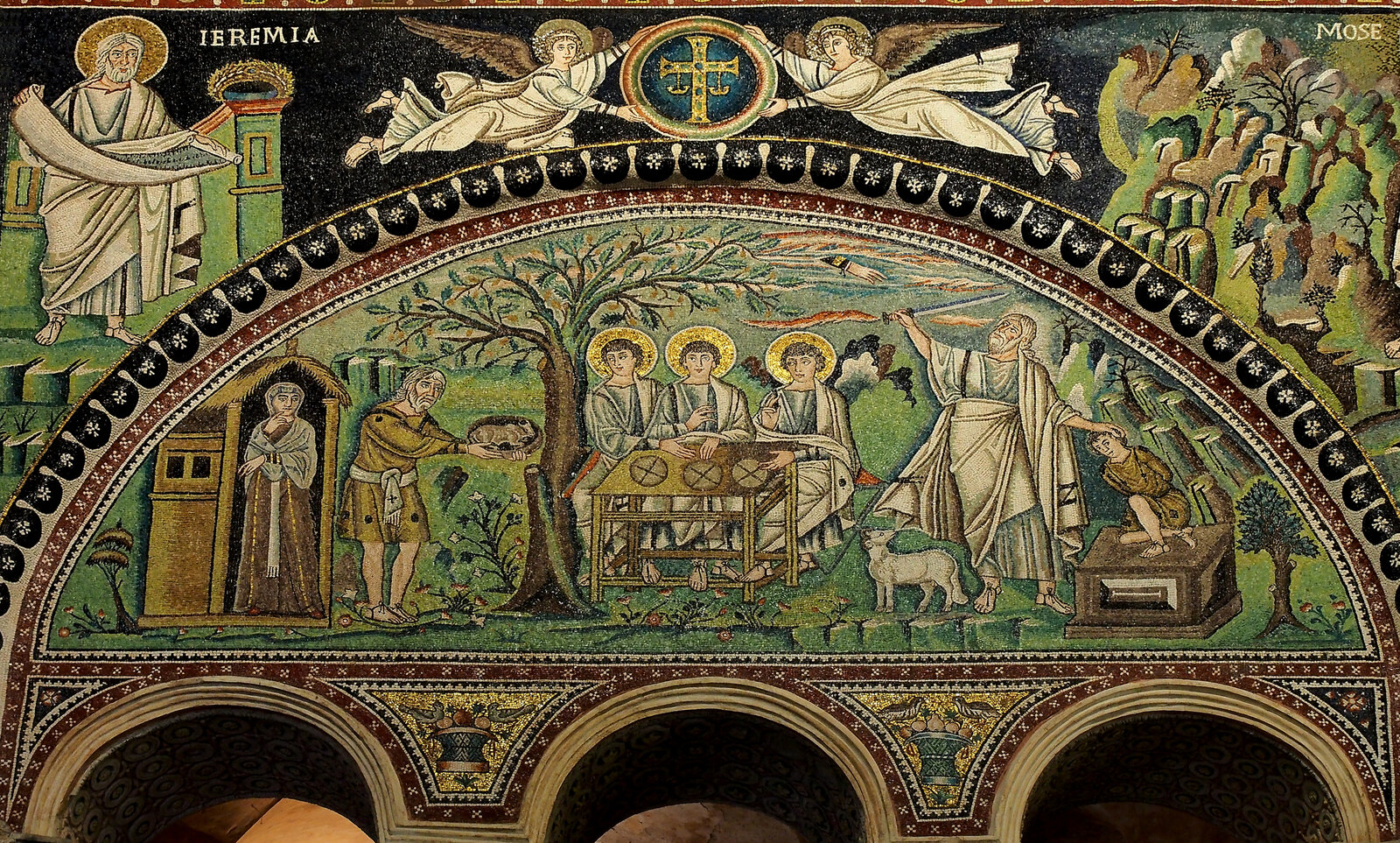
The Sacrifice of Isaac
Presbytery Lunette, San Vitale, Ravenna
Doctrinal reflection
Hebrews 11 read this picture before it was painted.
The presbytery of the Basilica of San Vitale at Ravenna has a series of paired Old Testament panels above the windows, all of them prefiguring the cross. On the south wall, the Sacrifice of Isaac. Abraham raises a knife over the bound boy on a stone altar; the hand of God descends from clouds at the upper-right; a ram is caught in a thicket nearby. The 6th-century mosaicists were rendering Genesis 22 — but they were also rendering Hebrews 11.
Hebrews 11:17–19 names this scene as a type. "By faith Abraham, when he was tried, offered up Isaac... Accounting that God was able to raise him up, even from the dead; from whence also he received him in a figure." The KJV's figure translates the Greek en parabolē — "in a parable / as a type." The author of Hebrews is doing typological exegesis explicitly. Abraham received Isaac back as a type of the resurrection. The Sacrifice of Isaac is not a private family near-tragedy. It is the apostolic-confirmed pattern of the cross.
Look at what Abraham believed in Genesis 22:5: "Abide ye here with the ass; and I and the lad will go yonder and worship, and come again to you." I and the lad will come again. Abraham did not say "I will come back" — he said "we will." He had already calculated that God could raise Isaac from the dead (Hebrews 11:19 reports this calculation). His faith was not in a last-minute reprieve. His faith was in resurrection.
The ram in the thicket is the substitute. "And Abraham lifted up his eyes, and looked, and behold behind him a ram caught in a thicket by his horns: and Abraham went and offered him up for a burnt offering in the stead of his son" (Genesis 22:13). The substitution is the type's center. The ram dies; Isaac lives. Two thousand years later at Calvary, the substitution is reversed in scale: the Son dies; the world lives. In the stead of.
John 3:16 echoes Genesis 22 deliberately. "For God so loved the world, that he gave his only begotten Son." Abraham was prepared to give his only beloved son and was stopped by the angel of the LORD. God the Father gave his only beloved Son and was not stopped. The mountain at Moriah where Isaac was bound is, by ancient Jewish tradition, the same mountain where the Jerusalem temple stood — and Calvary lay on a ridge of the same mountain range.
The Ravenna mosaicists understood. They put the Sacrifice of Isaac on the wall of the church because the church meets at the table where the substitution is remembered. The Lamb who was caught in the thicket is the Lamb who was nailed to the wood. The ram saved Isaac. The Son saved everyone.
When you preach Genesis 22, do not soften it into a parenting lesson about trust. Preach it as Hebrews preaches it: a type of the cross, anchored in Abraham's resurrection-faith. The apostles read it that way. So should we.