Byzantine Art Project
150 artworks from the great traditions of Byzantine and Eastern Christian iconography, each paired with a doctrinal reflection. The corpus surfaces GLM's confessional shape case by case as the iconography requires it — read what the picture argues.
150
ARTWORKS
10
COLLECTIONS
17
FLAGSHIPS
1,250+
YEARS
COLLECTION:
ERA:
REGION:
MEDIUM:
SITE / MUSEUM:
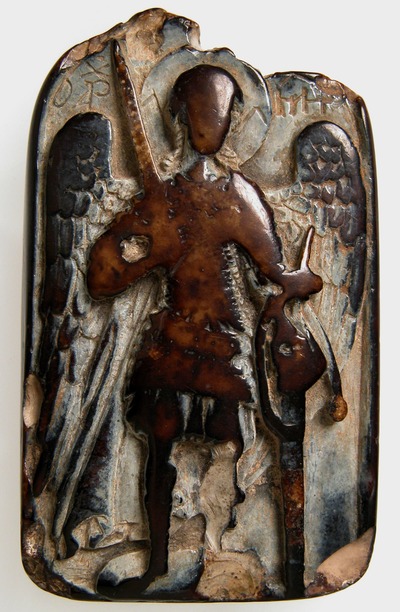 Angels
Two-Sided Pendant with the Archangel Michael and Daniel in the Lions' Den
Photograph: The Metropolitan Museum of Art, New York. Open Access (Public Domain / CC0). The underlying c. 1200+ serpentine pendant is in the public domain. Credit line: Gift of Mrs. Hayford Peirce, 1987.
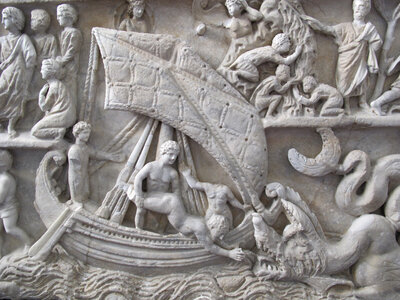 OT Typology
The Sign of Jonah
Photo by Sailko (2013). Wikimedia Commons. Released under Creative Commons Attribution 3.0 Unported (CC BY 3.0). The underlying late-3rd-century relief is in the public domain.
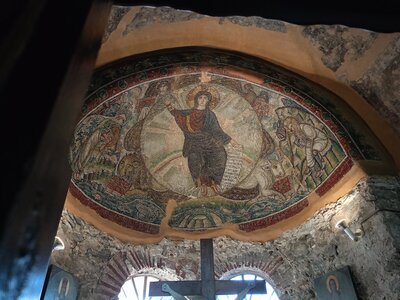 OT Typology
The Vision of Christ in Glory
Photograph by Giovanni Dall'Orto (2024). Wikimedia Commons. The photographer permits use for any purpose with attribution. The underlying 5th-century mosaic is in the public domain.
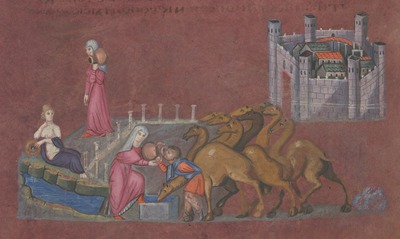 OT Typology
Rebecca at the Well
Photographic reproduction in the public domain (Wikimedia Commons; from the Yorck Project's *10,000 Masterworks of Painting*; faithful reproduction of a 6th-century manuscript folio). The underlying Vienna Genesis (Codex Vindobonensis Theol. gr. 31) is in the public domain.
 OT Typology
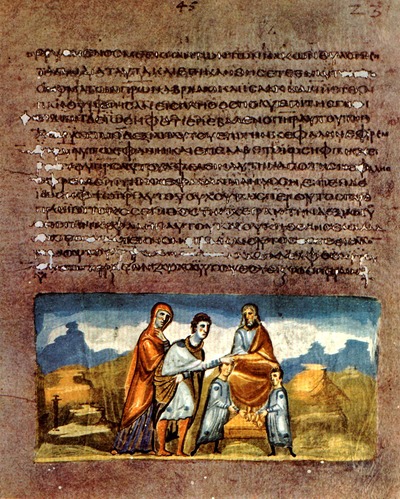
Jacob Blessing Ephraim and Manasseh
Photographic reproduction in the public domain (Wikimedia Commons; faithful reproduction of a 6th-century manuscript folio). The underlying Vienna Genesis is in the public domain.
 OT Typology
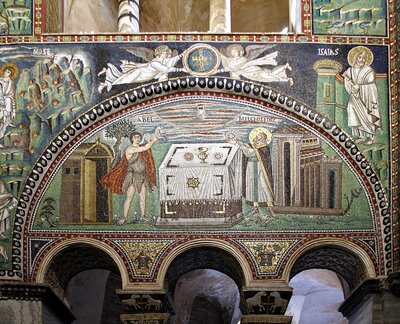
Abel and Melchizedek at the Altar
Photograph by José Luiz Bernardes Ribeiro (2016). Wikimedia Commons. Released under Creative Commons Attribution-ShareAlike 4.0 International (CC BY-SA 4.0). The underlying 6th-century mosaic is in the public domain.
 OT Typology
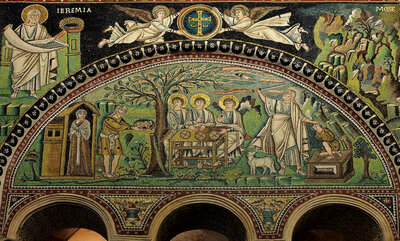
The Sacrifice of Isaac
Photo by Petar Milošević (2015). Wikimedia Commons. Released under Creative Commons Attribution-ShareAlike 4.0 International (CC BY-SA 4.0). The underlying 6th-century mosaic is in the public domain.
 OT Typology
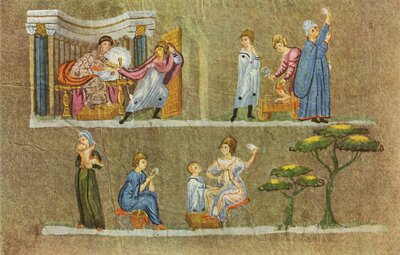
Joseph and Potiphar's Wife
Photographic reproduction in the public domain (Wikimedia Commons; The Yorck Project). The underlying late-6th-century manuscript page (Austrian National Library) is in the public domain.
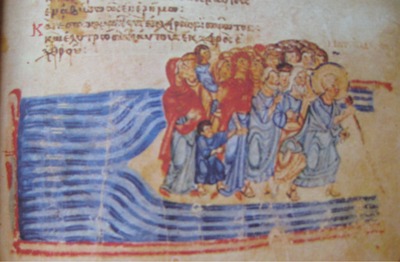 OT Typology
The Crossing of the Red Sea
Photographic reproduction in the public domain (Wikimedia Commons; faithful reproduction of a 9th-century manuscript folio published before 1931). The underlying Khludov Psalter (State Historical Museum, Moscow, MS D.129) is in the public domain.
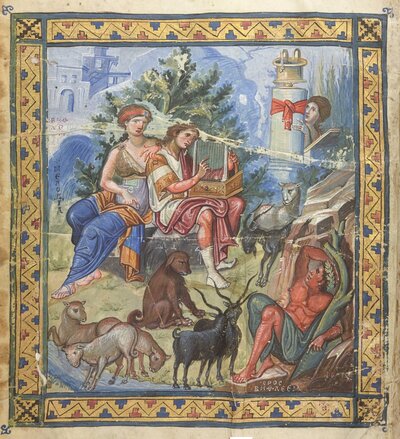 OT Typology
David Composing the Psalms
Photographic reproduction in the public domain (Wikimedia Commons; faithful reproduction of a 10th-century manuscript). The underlying Paris Psalter (BnF MS gr. 139) is in the public domain.
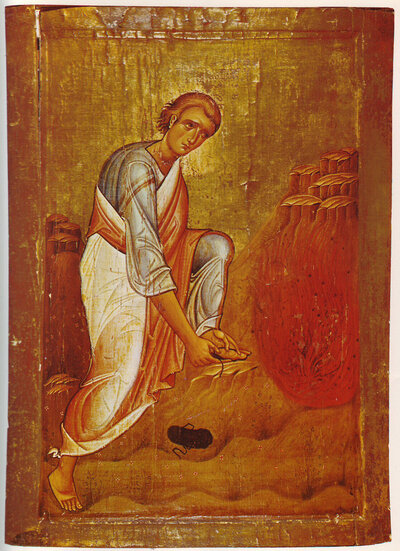 OT Typology
Moses and the Burning Bush
Photographic reproduction in the public domain (Wikimedia Commons, scanned 2008). The underlying 12th-century icon (92 × 64 cm) is in the public domain.
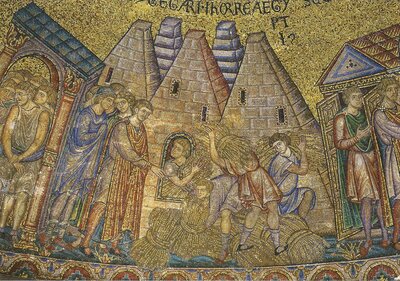 OT Typology
Joseph Gathering Corn
Photographic reproduction in the public domain (Wikimedia Commons; faithful reproduction of a 13th-century mosaic). The underlying San Marco mosaic is in the public domain.
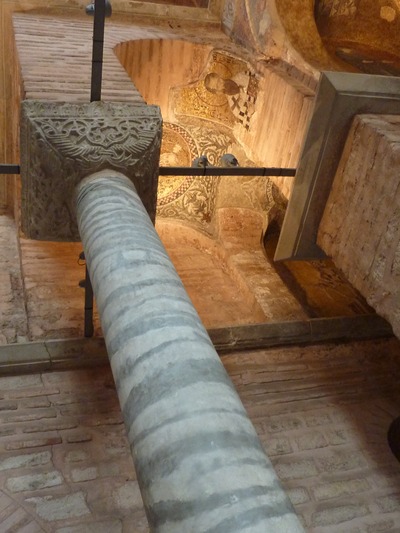 OT Typology
Pammakaristos Parekklesion: Old Testament Prophet
Photograph by Vmenkov (2010). Wikimedia Commons. Released under Creative Commons Attribution-ShareAlike 3.0 Unported (CC BY-SA 3.0) and GNU Free Documentation License 1.2+. The underlying c. 1310 mosaic at the Pammakaristos parekklesion is in the public domain.
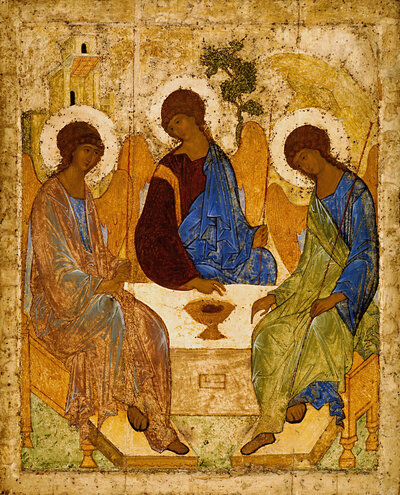 OT Typology
The Hospitality of Abraham
Photographic reproduction in the public domain (Wikimedia Commons, Google Art Project file). The underlying 15th-century icon (141.5 × 114 cm, tempera on panel) is in the public domain.
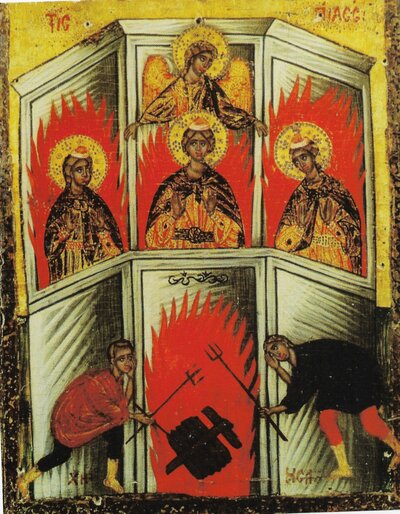 OT Typology
The Three Hebrews in the Fiery Furnace
Photograph by Michel Bakni (2020) via the Wikimedians of the Levant 'One Hundred Icon Project.' Wikimedia Commons. The underlying 16th-century icon is in the public domain.
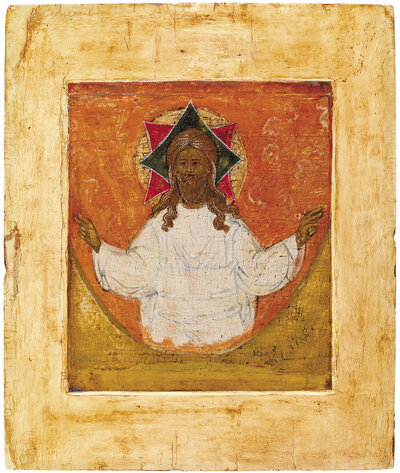 Pantocrator
The Lord Sabaoth
Photographic reproduction in the public domain (Wikimedia Commons; faithful reproduction of a public-domain icon). The underlying mid-17th-century Russian icon (private collection, Old Believer provenance) is in the public domain.