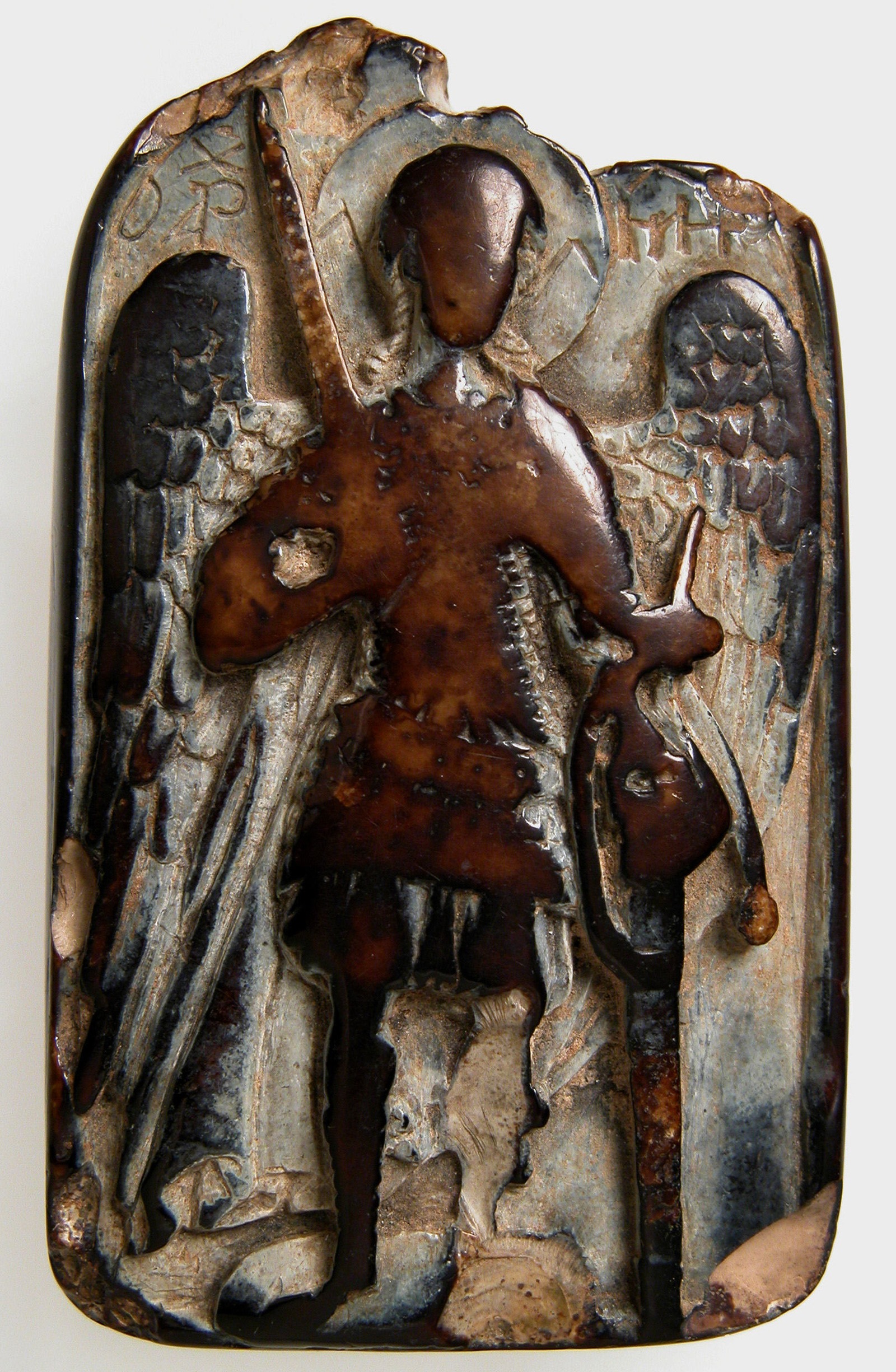
Two-Sided Pendant with the Archangel Michael and Daniel in the Lions' Den
Carved Serpentine Pendant, c. 1200 or later, Constantinople — Metropolitan Museum of Art (Acc. 1987.442.4)
Doctrinal reflection
A small dark-green serpentine pendant, 5.7 cm tall — small enough to hang from a cord at the neck. Side A: the Archangel Michael in court dress, scepter in hand, Greek inscription naming him Ο ΑΡΧ(ΩΝ) ΜΙΧΑΗΛ. Side B: Daniel standing frontal between two lions, hands raised in the orans posture, the lions' heads turned upward at his hands. The pendant is c. 1200 or later, Constantinople workshop, now at the Metropolitan Museum (Acc. 1987.442.4). The corpus's third Met entry (after #74 Saint Paul Medallion and #88 Koimesis ivory) — Met 3/4. Carved serpentine pendant opens as a fresh medium category alongside ivory, cloisonné, mosaic, fresco, and panel icon.
The two sides paired theologically. The pairing is not arbitrary. Daniel 10:13, 21 names Michael as Israel's prince-defender — "Michael, one of the chief princes, came to help me... Michael your prince" — and Daniel 12:1 names Michael as the one who shall stand up in the time of trouble. Daniel 6 narrates Daniel's deliverance from the lions' den under Darius. The Byzantine iconographer of this pendant pairs the defender (Michael) and the delivered (Daniel): the angel-prince who defends God's people on one side, the prophet whose deliverance prefigured the deliverance of all God's people on the other. The pendant unites the heavenly defense and the earthly deliverance in a single portable object.
Daniel's deliverance as deliverance-type. Patristic exegesis (Augustine, Chrysostom, Bede) read Daniel 6 typologically: Daniel cast into the lions' den, sealed in the den as Christ was sealed in the tomb, brought out at dawn unhurt — "my God hath sent his angel, and hath shut the lions' mouths, that they have not hurt me" (Dan 6:22). The deliverance prefigures Christ's resurrection, and through Christ the deliverance of all who are in him from death's grip. The corpus reads the typology as legitimate apostolic-tradition extension grounded in Hebrews 11:33 (which lists the prophets "who through faith... stopped the mouths of lions" in the catalog of faith-witnesses) and 1 Peter 5:8 ("the devil, as a roaring lion, walketh about, seeking whom he may devour" — Christ defeats the lion-adversary who circles the church). Mode 1 typology by patristic extension, anchored in apostolic-tradition reading.
Heb 1:14 pattern-match (no re-articulation). The corpus's locked angelological frame — angels as ministering spirits, not mediators (Heb 1:14, locked at #109 archangel-michael-byzantine-museum) — applies cleanly to Side A of this pendant without re-articulation. Michael is rendered in court dress, scepter in hand, but the pendant's Greek inscription names him Ο ΑΡΧ(ΩΝ) — the chief — not the Lord. The iconographic discipline holds even on a 5.7-cm wearable.
The apotropaic-use question — Collection 7 named-decline applied. The corpus must handle this candidly. Personal-pendant icons in late-Byzantine devotional culture were often worn as protective amulets — against demons, illness, military danger, the lion-adversary in the Petrine register taken literally. The corpus declines this use. The pendant's iconographic content is memorial-witness (Michael's defense; Daniel's deliverance); the medieval-Byzantine wearable-protective use slides past the apostolic line into image-as-protective-magic, which is the trajectory the named-decline rule (locked corpus-wide since #43) closes against. Christ alone is the protector; the pendant teaches what scripture teaches; the pendant does not protect by being worn. Wearing a Bible verse is not different from wearing this pendant — the words instruct; the words do not act independently.
The medium widens. The corpus has now opened five icon-medium registers: large mosaic programs (architectural sites), large fresco programs (architectural sites), panel icons (museum-housed), illuminated manuscripts (manuscript-tracked), ivory carving (#88 Koimesis), cloisonné enamel (#42 Pentecost), and now carved-serpentine pendant. Each medium reflects a distinctive devotional context: the pendant is what was worn against the body, distinct from what was hung on a wall or held in a procession. The corpus reads what was worn the same way it reads what was hung — the iconography teaches; the wearer is taught; the teaching points to Christ.
Michael on one side. Daniel on the other. The angel who defends and the prophet who was delivered. The lion's mouth shut by an angel sent. The Lord is my keeper. The pendant teaches; the pendant does not protect.