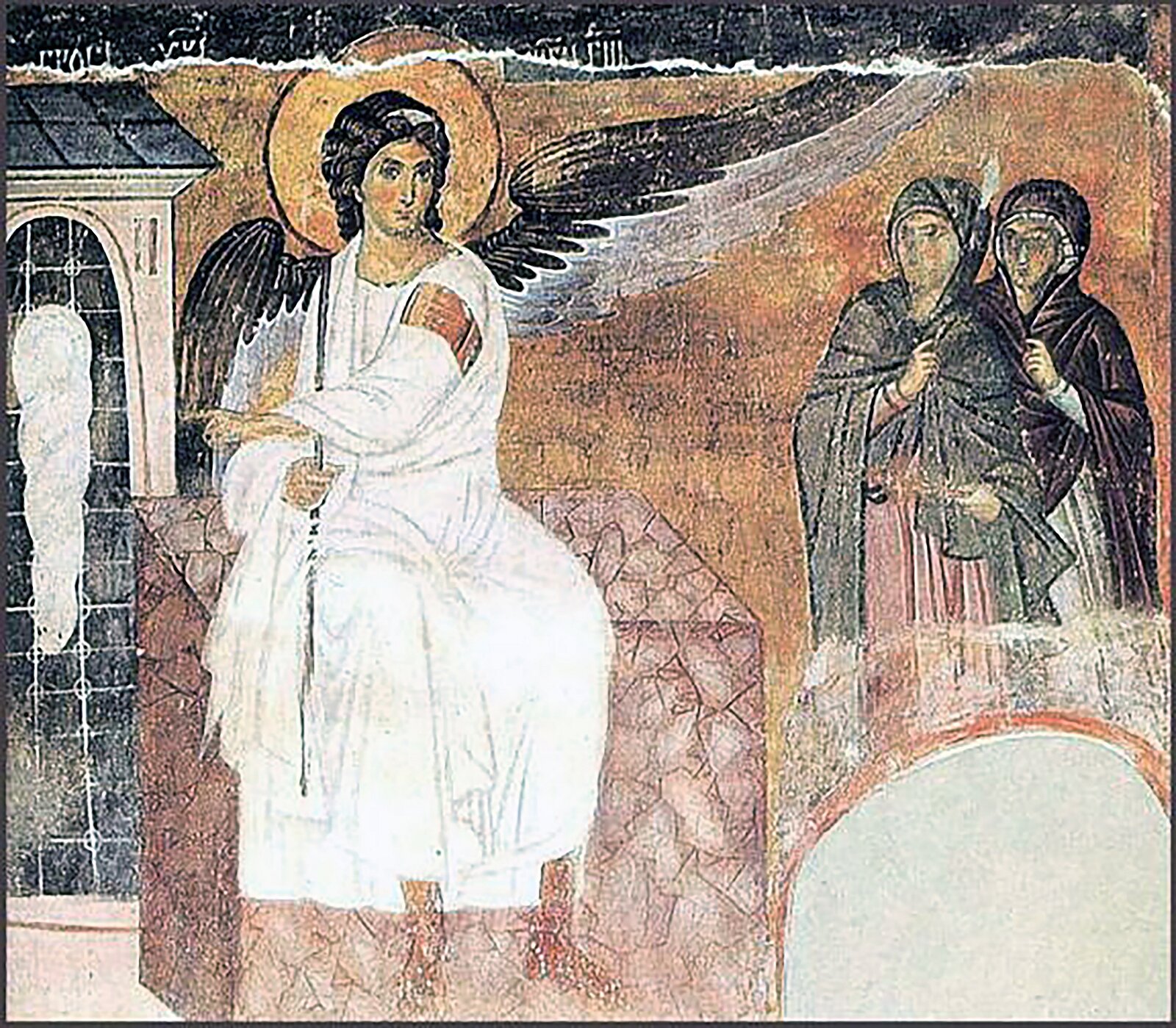
The White Angel
Fresco, Mileševa Monastery, Serbia — c. 1230 (the angel at the empty tomb)
Doctrinal reflection
The angel sits on the empty tomb. White robe, white wings, white face — luminous against a deep ground. The right hand gestures outward, palm open, in the speaking-posture of Byzantine messenger figures. The left hand rests against the slab. At his feet lie the abandoned grave-cloths. To his right the women approach with their spice-jars; on the left, sometimes truncated by later wall damage, soldiers sleep where the resurrection has already passed them by. The Mileševa White Angel was painted c. 1230 by Greek-trained Serbian masters in the church of the Ascension at the monastery King Stefan Vladislav had founded. The figure has become the most-reproduced single image in Serbian medieval art.
The scene is Matthew 28:1–7 (with Mark 16:1–7 and Luke 24:1–9 in close parallel). At dawn on the first day of the week, the women come to the tomb with spices to anoint the body. They find the stone rolled away. The angel is sitting where the body had been. "Fear not ye: for I know that ye seek Jesus, which was crucified. He is not here: for he is risen, as he said. Come, see the place where the Lord lay" (Matt 28:5–6). The Mileševa fresco renders the speaking moment — the gesture, the open hand, the calm face, the empty tomb behind him.
Ministering not mediating, in the most explicit form the corpus has yet shown. The angel does not raise Christ. The angel does not declare the resurrection by his own authority. The angel announces what has already occurred and points to the empty place where Christ lay. He is not here. The angel's role is exactly the role Collection 8's locked framing rule names: ministering messenger, not mediator. The resurrection is Christ's own act (John 10:18 — no man taketh it from me, but I lay it down of myself... and I have power to take it again); the angel is dispatched to tell what has happened, and to point.
Gabriel, by tradition. The Mileševa tradition identifies the angel as Gabriel — the same archangel who announced the conception at Nazareth (Luke 1:26–38) now announces the resurrection. Same messenger frames incarnation and resurrection. The corpus's canonical-archangels rule (#58 Hagia Sophia, locked at the Collection 8 framing) affirms only Michael and Gabriel by name. The Mileševa identification is consistent with that rule.
The empty tomb is the iconographic argument. The angel is present, the women approach, the soldiers sleep — but Christ is not in the picture. The tomb is empty. The iconographer renders what the gospels render: an absence with an angel pointing at it. The resurrection is announced by what the tomb does not contain. The corpus has met this iconographic-restraint pattern before (#86 Karanlık — the painter renders the kiss, not the heart). At Mileševa the restraint is the doctrine: the resurrection is not depicted because the resurrection is not contained — it is announced, attested, pointed to.
Fear not ye. The first words to the first witnesses of the resurrection are words of consolation, not threat. The angel speaks calmly; the women are met where they are; the gospel begins, on Easter morning, with a messenger at an empty tomb saying do not be afraid. Pastoral instruction for every messenger of the resurrection since: announce what Christ has done, point to where the body is no longer, do not be the message — only carry it.
The angel sits. The tomb is empty. He is not here: for he is risen.