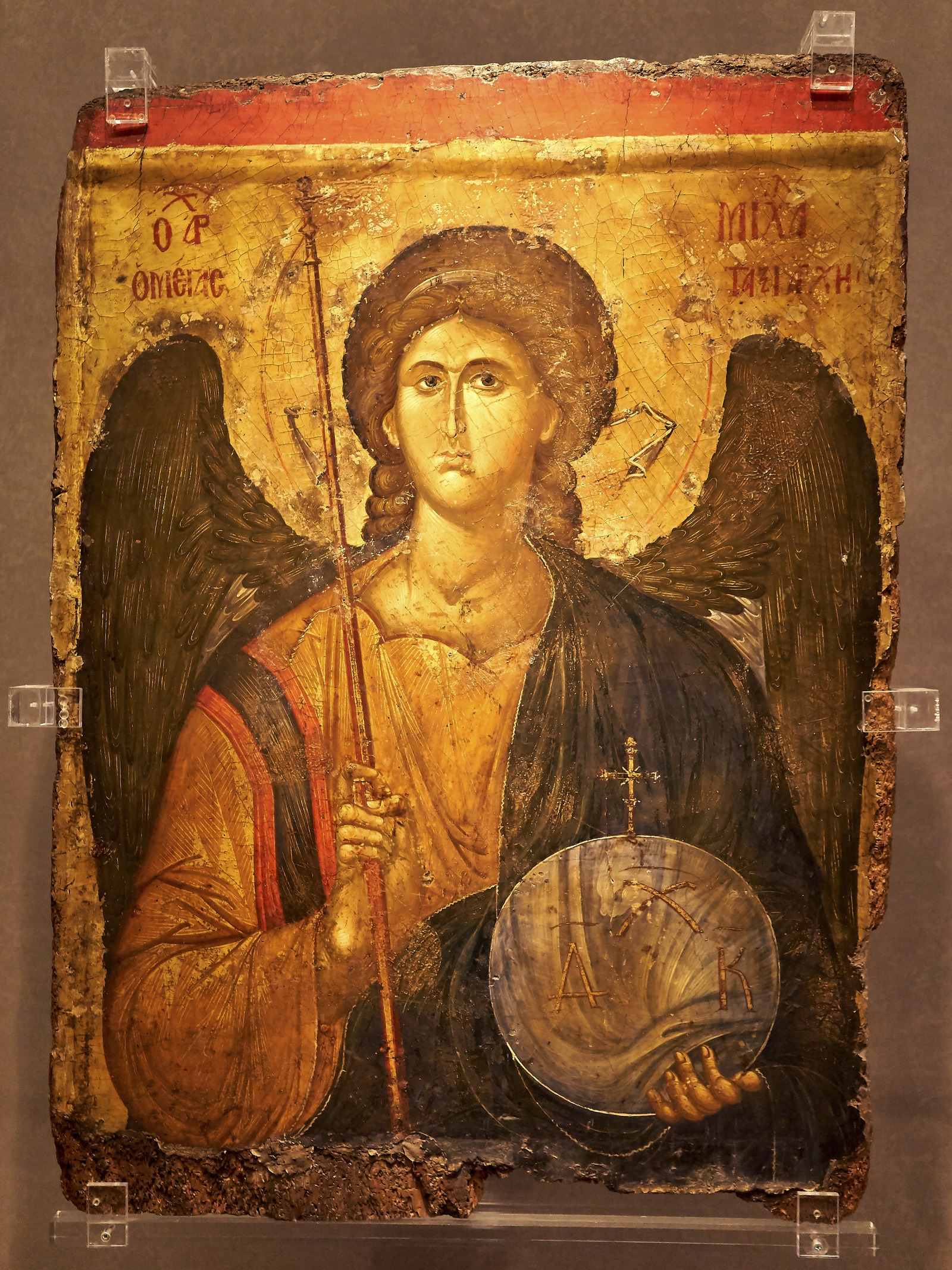
The Archangel Michael
Panel Icon, c. early 14th century, Constantinople Workshop — Byzantine and Christian Museum, Athens (BXM 1353)
Doctrinal reflection
The archangel stands frontal, in formal court dress, head haloed, wings folded behind. His right hand holds a scepter; his left holds a transparent globe of the world with a gold cross set at its top. Within the orb — partly visible through its transparency — is the figure of a lion and three Greek initials: Χ Δ Κ — Christos Dikaios Krites, Christ the Just Judge. The Greek inscription beside the figure names him Ο ΑΡΧ(ΩΝ) ΜΙΧΑΗΛ Ο ΜΕΓΑC ΤΑΞΙΑΡΧΗ(C) — the Chief [among angels] Michael, Grand Taxiarches. The icon is c. 1300–1350 Constantinople workshop, now in the Byzantine and Christian Museum, Athens (BXM 1353), 110 × 80 cm. The painting style links to the Chora Monastery wall-paintings; the corpus reads it as Palaiologan-era Constantinopolitan craftsmanship at its high point, in the final flowering before 1453.
The transparent orb is doctrinally precise. The archangel holds the world, but the world's content names Christ. The orb is transparent — it does not obscure; what shows through is Christos Dikaios Krites. The iconographic discipline registers cleanly: Michael does not judge the world. Michael does not own the world. Michael holds the orb, but the orb names Christ. The iconographer's compositional choice protects against any reading that the angel is the judge or the world's possessor. The angel ministers; Christ judges. The eye-line passes through the angel's hand to the One named in the orb.
Hebrews 1:14 — the angelological frame. "Are they not all ministering spirits, sent forth to minister for them who shall be heirs of salvation?" Hebrews 1's argument is that the Son is greater than the angels: angels worship him (Heb 1:6), are made winds and flames of fire (1:7), are ministers (1:14), and never sit at God's right hand — that seat belongs to the Son alone (1:13). Collection 8 anchors here. The Athens Michael icon renders Heb 1:14 visible: the megas taxiarches — the Grand Commander of the heavenly hosts — is painted holding the orb of Christ-the-Judge, not a separate orb of his own authority.
The OT-NT Michael sequence. Daniel 10:13, 21 names Michael as one of the chief princes and the prince who holds with Daniel for Israel; Daniel 12:1 names him as the one who shall stand up in the time of trouble. Jude 9 records Michael disputing with the devil about the body of Moses, who durst not bring against him a railing accusation, but said "The Lord rebuke thee." Revelation 12:7–9 names Michael as the one who fights the dragon and casts him down. Across the canon, Michael is the militant defender — but always operating under the LORD's authority (Jude 9 explicit), never as autonomous principle. The icon's scepter in the right hand is authority delegated; the orb in the left names the One whose authority it is.
Collection 7 named-decline applied to angel-veneration. The apostles named the trajectory: Colossians 2:18 — "Let no man beguile you of your reward in a voluntary humility and worshipping of angels"; Revelation 22:8–9 — when John fell down to worship the angel, the angel said "See thou do it not... worship God." The corpus's named-decline of saint-veneration → mediation (Collection 7) extends to angel-veneration → mediation: any iconography that lets Michael become an autonomous mediator drifts past the apostolic line. The Athens icon does not drift. The Χ Δ Κ in the orb is the iconographer's discipline holding the line.
Michael ministers. Christ judges. The orb is transparent. The angel does not obscure what the angel holds.