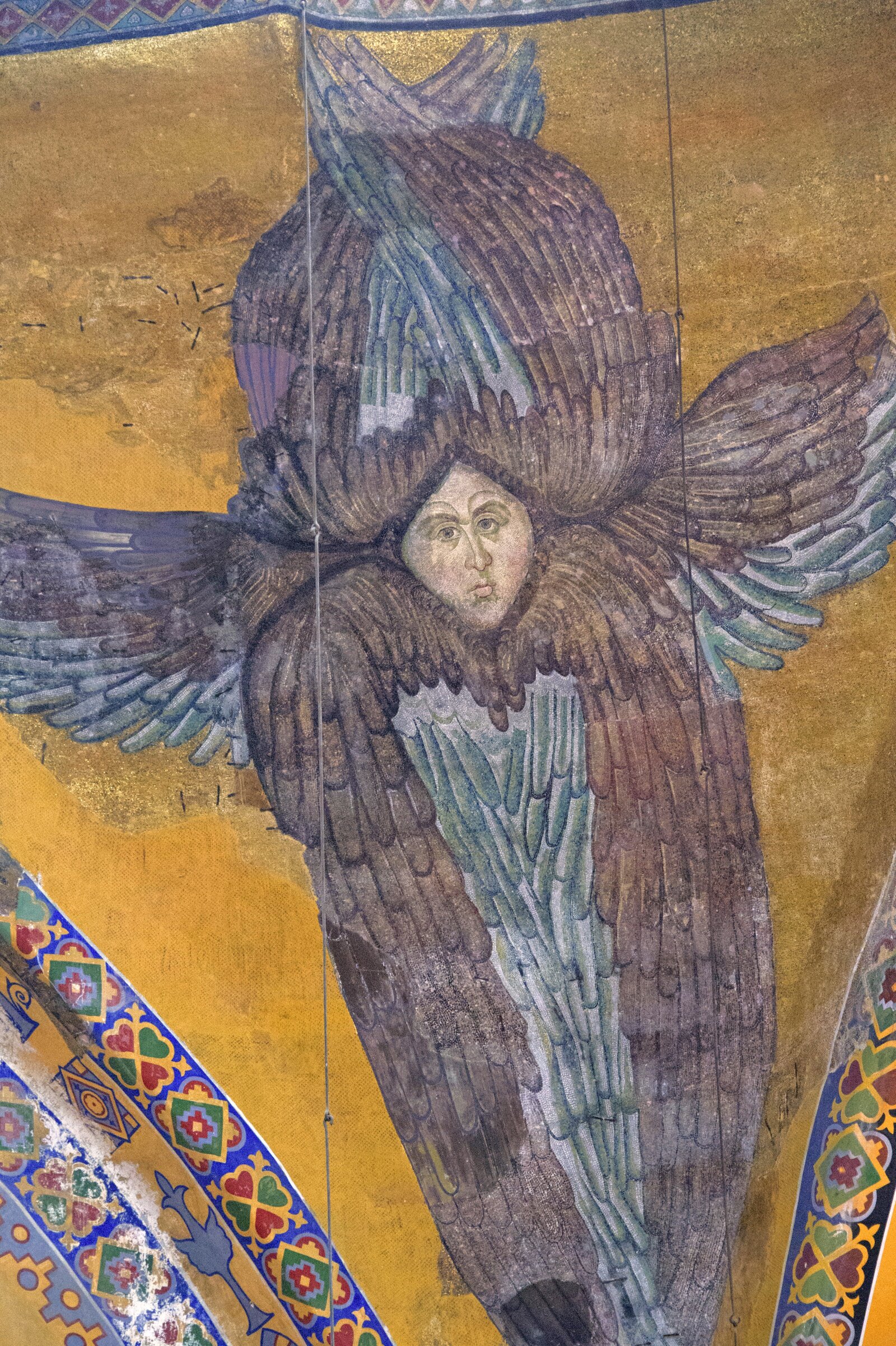
The Six-Winged Seraphim
Pendentive Mosaics, Hagia Sophia (14th-c. restoration of earlier program)
Doctrinal reflection
Look at the wings.
The four pendentives below the great central dome of Hagia Sophia carry four enormous seraphim — six-winged figures, each with a face at the wing-junction (or, in three of the four cases, a face that has been concealed by gold-leaf ornament during the Ottoman period and partly recovered in modern restoration). The seraphim mosaics in their current form are 14th-century Palaeologan restoration work over an earlier Byzantine program. In iconographic content they reach back through every layer of the basilica's history to the same biblical source: Isaiah 6.
Isaiah 6:1–3: "In the year that king Uzziah died I saw also the Lord sitting upon a throne, high and lifted up, and his train filled the temple. Above it stood the seraphims: each one had six wings; with twain he covered his face, and with twain he covered his feet, and with twain he did fly. And one cried unto another, and said, Holy, holy, holy, is the LORD of hosts: the whole earth is full of his glory."
The mosaicists at Hagia Sophia placed the seraphim exactly where the architecture stages the temple-throne vision. The pendentives sit at the corners between the four arches and the dome above. The dome was originally crowned with a Pantocrator (now lost). The seraphim ring the throne, four of them, six wings each, faces hidden in modesty before the One they attend. The architecture is Isaiah 6 in stone and gold.
What the seraphim do in Isaiah 6 is sing. "Holy, holy, holy." That is the sum of their iconographic activity. They cry the Sanctus to one another; the smoke of the temple fills with the sound; Isaiah collapses ("woe is me, for I am undone"). The angels are not the focus of the vision — the Lord on the throne is. The seraphim cover their faces because even they cannot bear to look directly. Modesty is the angelic posture before God, not the human posture before angels.
The iconographic detail to notice: each seraph in the Hagia Sophia pendentives has a face, but the face is partly concealed by the upper pair of wings. "With twain he covered his face" — the artist read Isaiah 6:2 literally and rendered the wing-as-veil over the face. This is theologically pointed. The angels themselves practice what we are commanded: do not look at me; look at the One I attend.
We do not pray to the seraphim. We do not invoke them as a class of intercessors. Colossians 2:18 forbids angel-worship; Revelation 22:8–9 records an angel rebuking John for the same impulse. The seraphim's posture in Isaiah 6 — faces covered, attending the throne, crying holy holy holy — is the iconographic instruction for our own posture. Don't worship the angels. Do what the angels do. Cover your face before God's holiness. Cry holy. Send fire-coal forgiveness through the prophet's lips (Isaiah 6:6–7). Then, when the Lord asks whom shall I send, answer like Isaiah did. Here am I; send me.
When you preach the angels, preach them as workers. They sing. They fly. They are dispatched. They cover their faces. None of that requires us to bow to them.