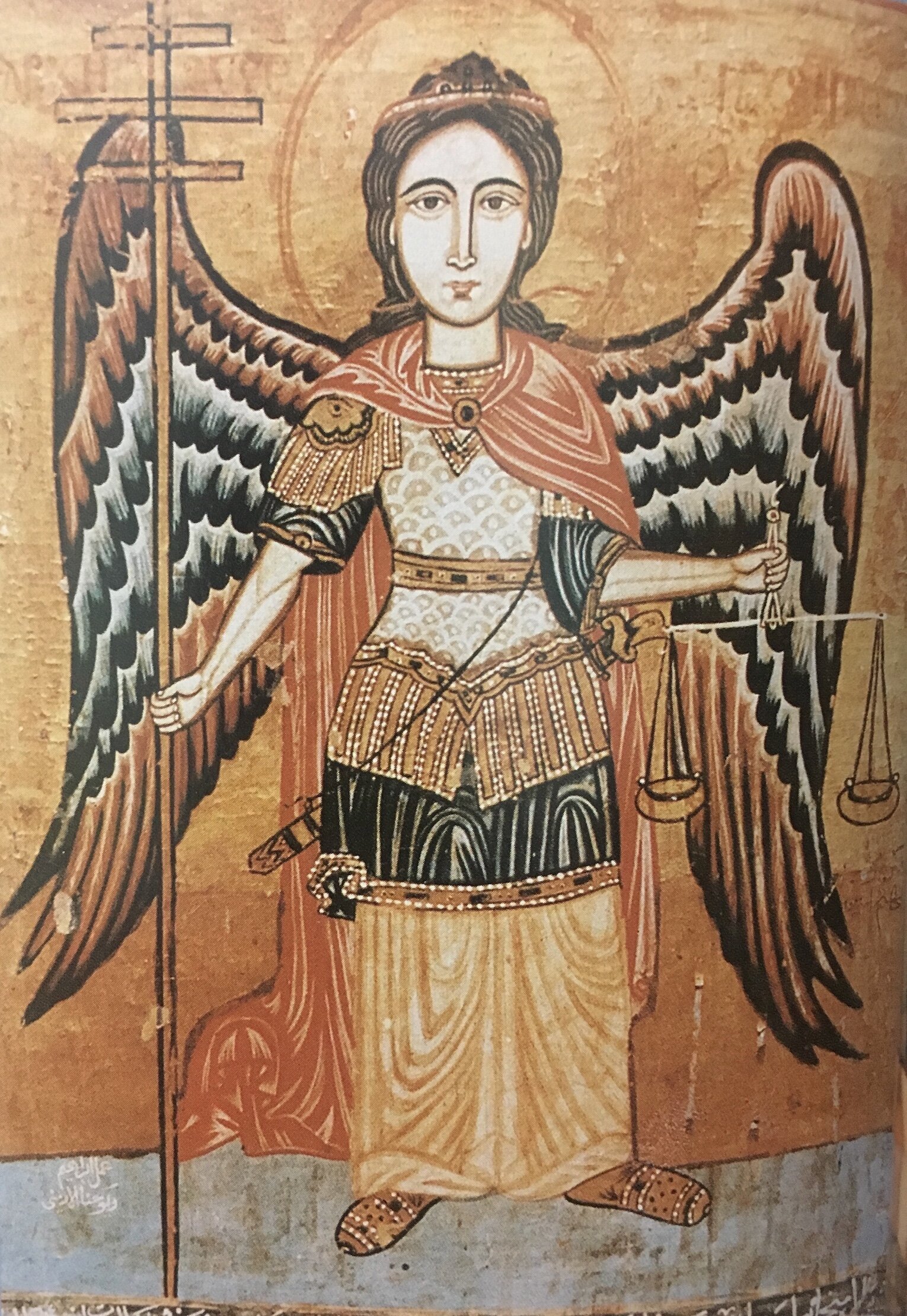
Michael Weighing Souls
Coptic Icon of the Psychostasia Tradition (18th c., Byzantine-tradition iconography)
Doctrinal reflection
Michael does not own the scale.
This 18th-century Coptic icon, in the Coptic Museum in Cairo, shows the Archangel Michael in martial pose holding a balance-scale. The scale is the psychostasia — Greek for "the weighing of souls" — an iconographic motif inherited by Christian art from much older Egyptian and Mediterranean precedents. In ancient Egyptian funerary religion, the god Thoth (or Anubis) weighed the deceased's heart against the feather of Maat. The Christian tradition borrowed the iconography but redirected it: the weigher is now Michael, the field is now the Last Judgment, and the criterion is no longer Egyptian Maat but the verdict of God.
The motif appears across Byzantine and Eastern Christian Last Judgment iconography (Torcello [#16], Voronet [#19], Vatopedi [#22] all include psychostasia scenes). This Coptic icon presents it as a stand-alone composition: Michael alone, with the scale, in armor, against a gold ground.
We affirm what scripture warrants and decline what it does not.
Scripture warrants: Michael is a real angel with real eschatological work. Daniel 12:1: "At that time shall Michael stand up, the great prince which standeth for the children of thy people: and there shall be a time of trouble, such as never was since there was a nation even to that same time: and at that time thy people shall be delivered." Jude 9: Michael disputes with the devil over the body of Moses, refusing to "bring against him a railing accusation, but said, The Lord rebuke thee." Revelation 12:7: Michael wars against the dragon. Three canonical mentions, three real eschatological roles — defender of God's people in the time of trouble, lawful adversary of the devil, captain of the heavenly armies in the last battle.
Scripture does not warrant Michael as the judge of individual souls. The judgment of every soul belongs to Christ alone. John 5:22: "For the Father judgeth no man, but hath committed all judgment unto the Son." John 5:27: "And [the Father] hath given him authority to execute judgment also, because he is the Son of man." Acts 10:42: Christ "was ordained of God to be the Judge of quick and dead." Romans 14:10: "we shall all stand before the judgment seat of Christ." The judge is Christ. The judge has been Christ since the gospel was preached. The judge will be Christ at the parousia. Michael does not hold the scale of judgment in the canonical witness.
The iconography of Michael-with-scale is therefore a species/figure split case (#48 George template). The species is right — there is a weighing, a judgment, a verdict — but the figure is wrong. Christ is the weigher, not Michael. The Egyptian-Coptic iconographic borrowing assigned the function to a familiar figure (an angel-with-scale, like Anubis-with-scale before him) but the canonical text gives the function to the Son.
We do not pray to Michael for a favorable weighing. We do not invoke him as the patron of souls awaiting judgment. The judgment belongs to Christ; the appeal belongs to Christ; the verdict will be rendered by Christ. Michael's actual eschatological role — defender of God's people, captain of the angelic armies, the one who in Daniel 12:1 stands up on behalf of the people — is more than enough for the angel without giving him a role scripture does not assign.
When you preach the Last Judgment, do not preach Michael with the scale. Preach Christ on the throne. The Son of Man, who lived a human life, is the Judge of human lives. Michael will be there. He will not be the one weighing.