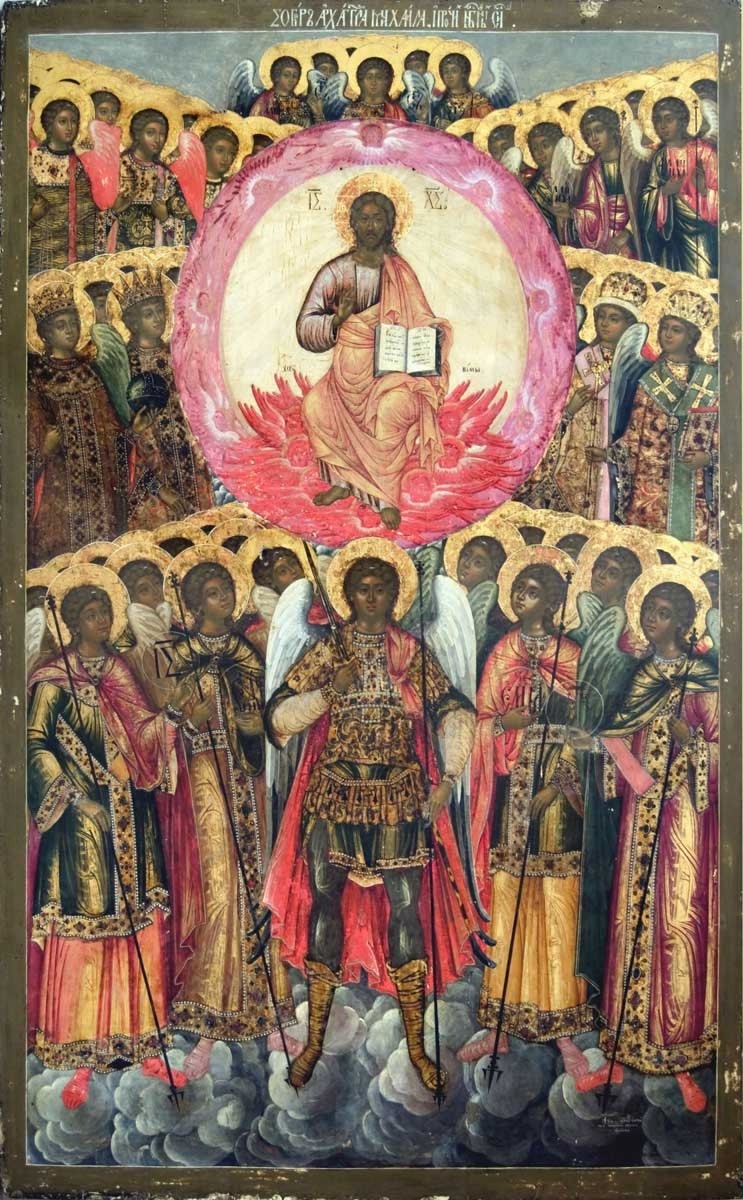
Synaxis of the Archangel Michael and the Other Bodiless Powers
Panel Icon by Kirill Ulanov, 1704 — Andrey Rublev Museum of Ancient Russian Culture and Art, Moscow (originally Archangel Michael Cathedral, Bronnitsy)
Doctrinal reflection
Seven archangels arranged in a semicircle hold a central medallion of Christ Emmanuel (the youthful Christ with cross-halo). The composition is the canonical Synaxis of the Archangels (Σύναξις τῶν Ἀσωμάτων — Synaxis of the Bodiless Powers) — the Byzantine iconographic feast (November 8) gathering the seven archangels around Christ. Each archangel holds an attribute of his liturgical-cosmic role: Michael (sword), Gabriel (lily), Raphael (alabaster jar with healing-balm), Uriel (scroll), Salaphiel (orant-prayer posture), Jegudiel (gold wreath), Barachiel (white roses). The icon is signed and dated 1704 by Kirill Ulanov (c. 1640s–c. 1731), a leading icon-master of the Armory Chamber school. Now at the Andrey Rublev Museum of Ancient Russian Culture and Art in Moscow. Andrey Rublev Museum opens as fresh institution.
The Collection 8 framework anchored — angels organized around Christ. The Synaxis composition is iconographically precise about angelic theology: the seven archangels do not stand alone or above Christ; they stand around Christ and hold a medallion of Christ at the visual center. The compositional theology renders Hebrews 1:6 — "And again, when he bringeth in the firstbegotten into the world, he saith, And let all the angels of God worship him." The angels' iconographic position is worshipping-around-Christ, not between-Christ-and-the-worshipper. The Synaxis specifically protects against angel-mediation drift by making Christ the iconographic center the angels surround.
The seven archangels — apostolic-tradition extension carefully held. The seven-archangel iconographic tradition draws on Tobit 12:15 ("I am Raphael, one of the seven holy angels") — the apocryphal-deuterocanonical text Eastern Orthodoxy treats as scripture but Protestants treat as deuterocanonical. The seven names (Michael, Gabriel, Raphael, Uriel, Salaphiel, Jegudiel, Barachiel) are partly from canonical scripture (Michael — Jude 9, Rev 12; Gabriel — Luke 1; Raphael — Tobit 12) and partly from later patristic-tradition extension. The corpus's discipline applies the three-fence rule: affirm Michael and Gabriel as canonically-named (NT-named); affirm Raphael as deuterocanonically-attested with apostolic-tradition reception; decline the four remaining named-archangels (Uriel, Salaphiel, Jegudiel, Barachiel) as patristic-tradition extension that the corpus does not adjudicate as binding doctrinal claim; refuse the iconoclast erasure that would remove all named archangels from iconography. The Ulanov painter renders the seven-archangel tradition; the corpus reads two as canonical, one as deuterocanonical, four as patristic-tradition naming.
The Russian Armory Chamber school. Kirill Ulanov was one of the leading icon-masters working at the Moscow Kremlin's Armory Chamber (Оружейная палата) — the imperial workshop where the highest-quality Russian iconography was produced for the Romanov court in the late 17th and early 18th centuries. The Armory Chamber school adopted some Western (Latin Catholic / Italian Baroque) compositional techniques while preserving the Byzantine-Russian iconographic tradition's doctrinal core. Ulanov's Synaxis carries this hybrid register: traditional Synaxis composition with somewhat naturalistic facial modeling.
The Christ Emmanuel medallion at the center. The central medallion shows Christ Emmanuel — the youthful Christ-figure rendered as a beardless child or young man, signifying the Word that became flesh in his pre-Crucifixion humanity. The compositional choice anchors the Synaxis in the incarnation: the angels worship the Christ who became human, not the Christ-figure abstracted from the incarnation. The corpus reads this as the iconographer's compositional argument that angelology must be tethered to Christology — the angels serve the incarnate Lord, not a generic divine-power.
Andrey Rublev Museum opens. The corpus's fourth Russian institutional opening (Tretyakov, Khanenko, Russian Museum, now Andrey Rublev Museum). The museum is housed in the Andronikov Monastery in Moscow — where Andrei Rublev (after whom the museum is named) lived and painted in the 1410s–1420s. The museum's icon collection focuses on Russian iconography from the 14th–18th centuries.
Seven archangels around Christ. Christ Emmanuel at the center. The angels worship the incarnate Lord. The 1704 master signed his work. The Andrey Rublev Museum opens at one entry; the Synaxis tradition rendered in late-Russian iconographic-Baroque register.