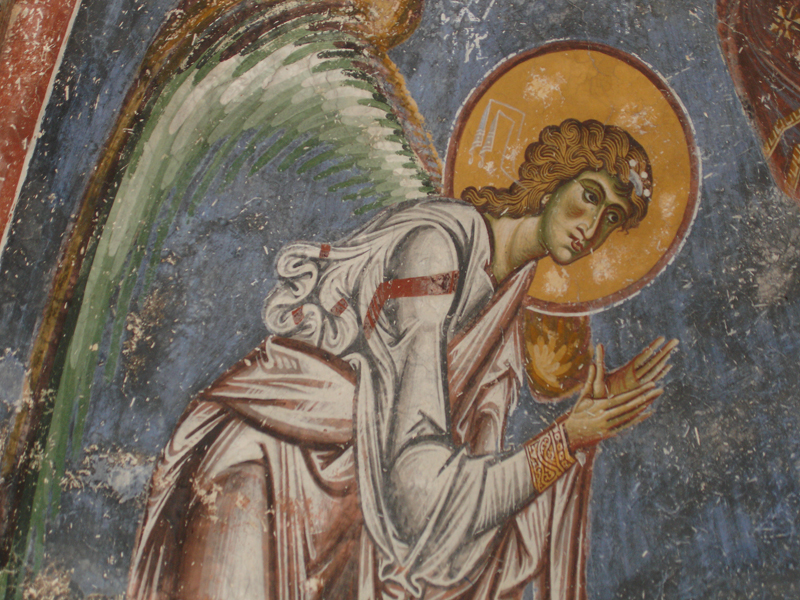
The Archangel Gabriel of the Annunciation
Apse Conch Fresco, Saint George Church, Kurbinovo, North Macedonia — c. 1191
Doctrinal reflection
The archangel comes in motion. Gabriel's wings sweep behind him as if still in flight; his right hand extends in the speaking-gesture of Byzantine iconography; his robes flow in the wind of arrival. He is in the apse conch on the left side, Mary across the conch on the right. Between them is the airspace of the message. The fresco is one of the most-photographed angel images in the entire Byzantine iconographic corpus — featured on the Macedonian 50-denar banknote — at Saint George Church in the village of Kurbinovo, c. 1191. The iconographer's inscription dates the start of the program to April 25, 1191, during the reign of Isaac II Angelos. Late Komnenian fresco painting at its sophisticated peak. Macedonia opens to 2 sites (Nerezi at #lamentation-nerezi + Kurbinovo here).
Collection 8 primary, Gabriel foregrounded. The corpus already has the Annunciation in Collection 2 (Theotokos primary) at Chora (#annunciation-chora) and Sinai (#annunciation-sinai). This entry takes the same iconographic moment — Luke 1:26–38 — and foregrounds Gabriel as iconographic protagonist, reading the composition through Collection 8 angelology rather than Collection 2 Marian theology. The doctrinal angle is distinct and non-duplicative: the existing Annunciation entries handle Mary's fiat (her consenting reception); Kurbinovo handles Gabriel's commission (his message-bearing).
Gabriel as messenger — Luke 1:19. "I am Gabriel, that stand in the presence of God; and am sent to shew thee these glad tidings." The role decomposes into three actions: stand in presence, be sent, bear message. Hebrews 1:14 ministering-spirit pattern in action. Gabriel does not author the message; he carries it. The corpus's locked Collection 8 framework (#109 archangel-michael-byzantine-museum) reads angelology consistently: angels minister, not mediate. Gabriel's three-step is the iconographic illustration: he comes from God's presence, he comes by sending, he comes to deliver. The whole arc terminates in Christ; Gabriel is not what the message is about.
Eye-line as doctrine — composition tracks the messenger's posture. The Kurbinovo Gabriel does not look at Mary as he speaks. His eyes are directed upward — toward the divine source from which he comes. His extended hand points toward Mary, but his gaze points toward the One who sent him. The compositional theology: the messenger does not center himself in the message-bearing; he points away from himself toward the One who sent him. The eye-line-as-doctrine principle (locked at #72 Ladder of Divine Ascent) operates here in messenger-iconography register. Look at where Gabriel is looking. He is looking at God.
The 17th-flagship cousin frame — Theotokos honored without mediation. Luke 1:28 — "Hail, thou that art highly favoured, the Lord is with thee: blessed art thou among women." Gabriel honors Mary; the honor is real; the honor is grammatically greeting-form, not enthronement. The 17th flagship at #88 Met Koimesis ivory locked the corpus's reading: Mary is honored; Mary is not Mediatrix. Gabriel's word at the Annunciation is the originating point of all Marian honor — and the word's content is the Lord is with thee. The honor refers to Christ being-with; the honor does not establish Mary as the locus of devotion. Brief pattern-match; no re-articulation.
The Komnenian iconographic register. The late 12th century was the high point of Komnenian-period Byzantine fresco painting — sophisticated drapery rendering, expressive line, subtle modeling of faces, dynamic compositions. The Kurbinovo master was almost certainly Constantinople-trained, working with local Macedonian hands at a small village church far from the imperial center. The iconographic vocabulary's portability is itself the gospel-trajectory continuing — unto the uttermost part of the earth (Acts 1:8) means iconographic excellence travels north into village churches in Slavic territory, and the village painter at Kurbinovo could render an angel in such motion that the fresco is still in motion 800 years later.
Gabriel comes in motion. He looks at God. He points at Mary. The message lands. Be it unto me according to thy word.