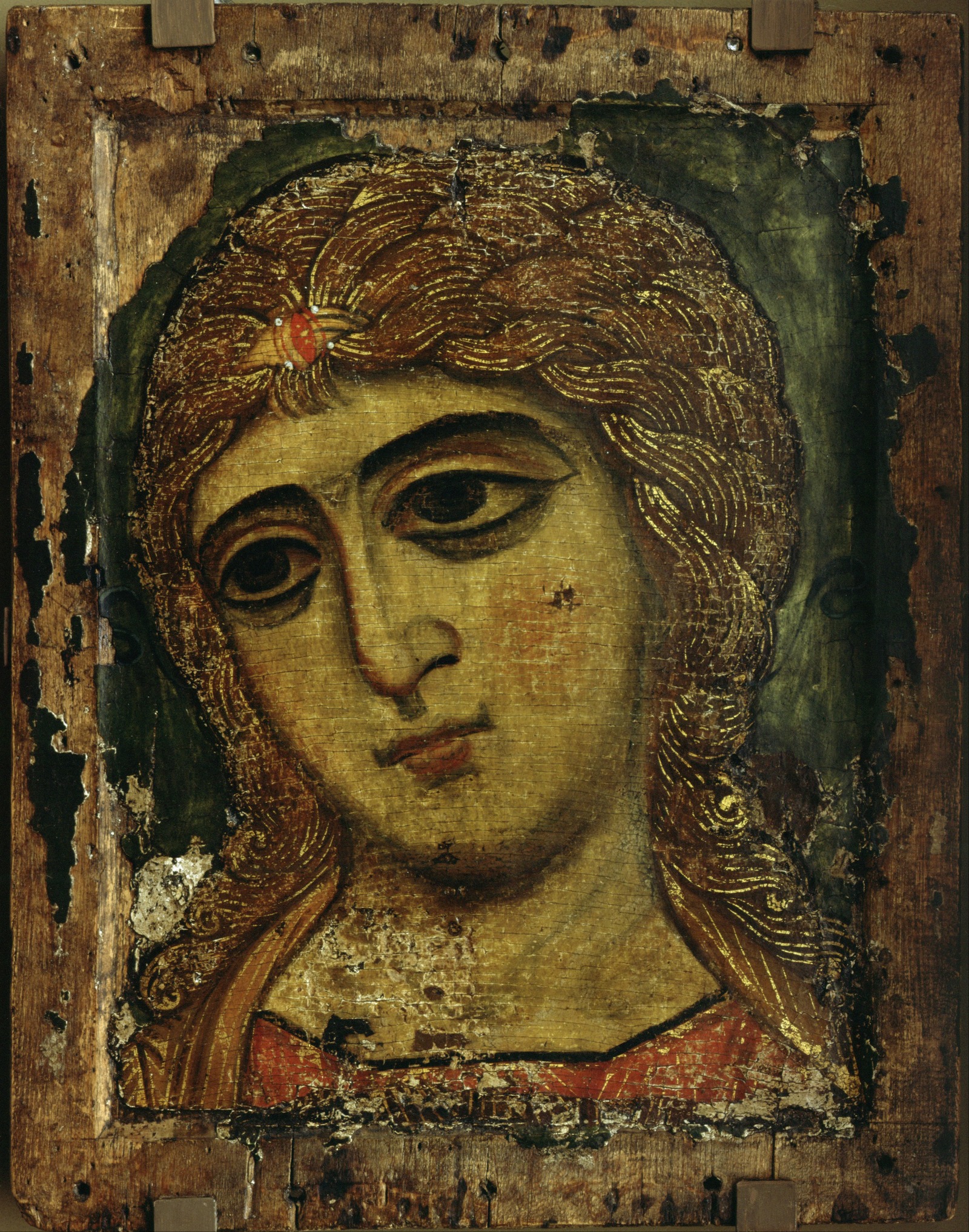
The Angel with Golden Hair (Archangel Gabriel)
Panel Icon, second half of 12th century, Novgorod school — State Russian Museum, St Petersburg
Doctrinal reflection
The archangel's face fills the panel, head turned slightly to the viewer's right. Long curling hair literally gilded — each strand a thin gold-leaf strip — gives the icon its Russian name Ангел Златые Власы (Angel of the Golden Hair). The composition is simple: head and shoulders, halo behind, no scepter or orb, no inscription text. The icon's intimate scale and contemplative register place it among the earliest surviving Russian icons. Originally part of a 12th-century Deesis tier (the iconostasis row showing Christ flanked by interceding saints), the panel was likely the archangel-side flanking-figure — Gabriel or Michael in the supplicating posture. Identification as Gabriel is the more common attribution. Now at the State Russian Museum (after passing through Tretyakov 1930–1934). The corpus's fourth Russian Museum entry — Russian Museum closes at 4/4 ceiling.
Collection 8 framework pattern-matched (no re-articulation per #109). Hebrews 1:14 ministering-spirits architecture handles this entry. The archangel rendered in contemplative half-length register — no scepter of authority, no orb of delegated rule — emphasizes the attentiveness of angelic ministry rather than the imperial-court framing of Athens icon (#109) or Bode ivory (#124). The same Collection 8 doctrinal payload at a different compositional register: the angel's attentiveness-to-God is what the iconographer renders.
The Deesis-tier originating context. The icon was originally part of a Deesis (Δέησις — prayer / supplication) tier — the iconographic row above the iconostasis royal doors in which Christ enthroned is flanked by intercessors: Mary on his right, John the Baptist on his left, then archangels, apostles, prophets, and saints in successive flanking positions. The corpus has handled the Deesis register critique through the 17th-flagship Theotokos-not-Mediatrix (locked at #88) — the iconographic supplicating-pose can read as intercession-by-honor (the saint inclines toward Christ in a posture of honor that the church can join) without sliding to intercession-by-mediation (the saint mediates the worshipper's prayer to Christ). The Angel of the Golden Hair operates in this register: the archangel's tilted head and contemplative gaze are the iconographic rendering of attentive-toward-Christ, which is what every angel does in scripture (Heb 1:6 — let all the angels of God worship him; Rev 5:11–12 — the voice of many angels round about the throne... Worthy is the Lamb).
The Novgorod-school continuation. The corpus's Novgorod-school thread now spans #anastasis-novgorod-russian-museum (#111), #boris-gleb-russian-museum (#112), #peter-paul-belozersk-russian-museum (#113), #spas-nerukotvorny-tretyakov (#130), and now Angel of the Golden Hair (#135). Five Novgorod-school entries across two institutions (Russian Museum and Tretyakov). The school's iconographic discipline — frontal compositional clarity, restrained emotional register, gold-ground saturation — holds across all five. The Angel of the Golden Hair is the school's earliest-attested major work in the corpus.
The gold-hair compositional theology. The iconographer's distinctive choice — applying gold leaf strip-by-strip to render the angelic hair — is doctrinally meaningful at the medium-iconography level. Gold in Byzantine iconography registers the divine light; the iconographer's choice to gild the angel's hair specifically (not the halo alone, not the entire figure) registers the angelic body as light-bearing in proportion to the angel's nearness to the divine source. The compositional theology: the angel reflects light because the angel is near God; the gold-leaf hair is the iconographic illustration of Hebrews 1:7 — Who maketh his angels spirits, and his ministers a flame of fire.
Russian Museum program closure at 4/4. The Russian Museum's four-entry program now reads as a coherent Old Russian iconographic catalog spanning the late 12th to late 15th century: Angel of the Golden Hair (Collection 8, c. 1150-1200) + Peter-and-Paul Belozersk (Collection 4 apostles, c. 1190-1210) + Boris-Gleb passion-bearers (Collection 4 saints, c. 1340-1370) + Novgorod Anastasis (Collection 3, c. 1480-1500). Four collections, four iconographic flagships across 350 years of Old Russian iconographic continuity. Per the iconographic-program-coherence rule (locked after #71), Russian Museum closes with full program. No further Russian Museum entries.
The angel's golden hair catches the divine light. The angel attends. The hair is gilded; the gilt is the light; the angel is near God. The Old Russian icon survives 850 years to teach the apostolic line.