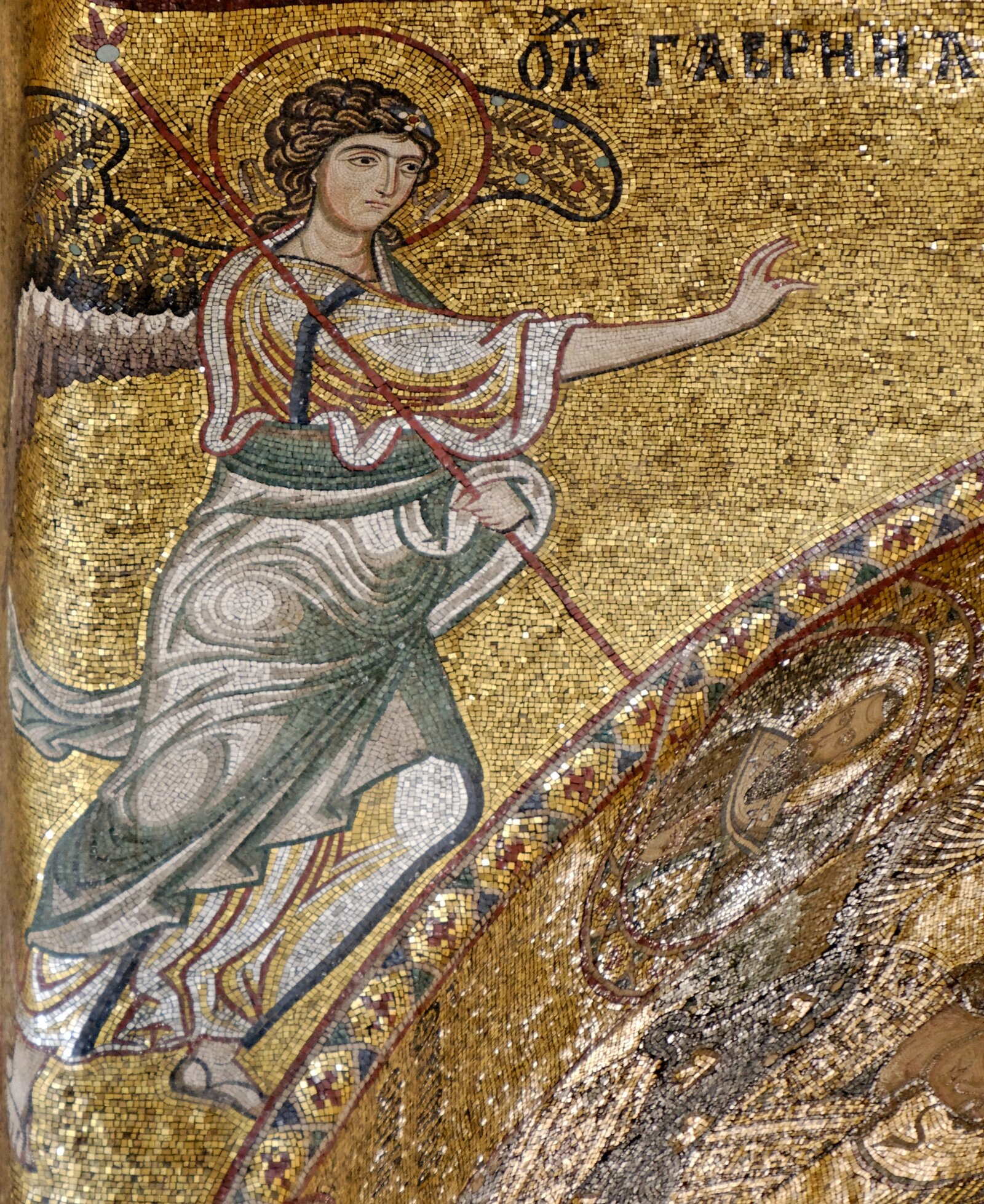
The Archangel Gabriel
Annunciation Mosaic, La Martorana (Santa Maria dell'Ammiraglio), Palermo
Doctrinal reflection
He is in motion. He is carrying a sentence.
The Archangel Gabriel in the Annunciation mosaic of La Martorana in Palermo — Santa Maria dell'Ammiraglio, the church built in 1143 by George of Antioch, admiral of the Norman Sicilian fleet — is shown mid-stride. His left foot lifts behind him; his right hand extends toward the absent Mary; his himation flares back from his body in the wind of his arrival. The Byzantine mosaicists at La Martorana caught the angel between the throne-room he was sent from and the Galilean girl he was sent to. He is an arrow in flight.
This is the right way to picture an angel. Ministering not mediating — Gabriel is on his way somewhere, carrying a message, dispatched. He does not stop and ask for prayer. He moves. The iconography of motion is the iconography of obedience.
Gabriel is one of two named archangels in the Protestant canon (Michael is the other; see corpus #58). Luke 1:19: "I am Gabriel, that stand in the presence of God; and am sent to shew thee these glad tidings." The grammar names two postures — standing in the presence (his domestic position, attending the throne) and being sent (his missional position, dispatched to humans). Both are angelic work. Both are about the One he serves, not himself.
At La Martorana, Gabriel was originally part of an Annunciation pair — Gabriel on one side of the entrance arch, Mary on the other, with the worshipper passing between them as they crossed the threshold into the nave. The architectural staging makes the worshipper pass through the moment of incarnation each time they enter the church. Gabriel is mid-message; Mary is at the moment of saying yes (Luke 1:38, "be it unto me according to thy word"); the worshipper walks under the announcement as it happens.
We do not pray to Gabriel. We do not invoke him as patron of communications, of messengers, of telegraph operators (no, this is a real medieval-Catholic patronage). The Catholic and Orthodox traditions assigned Gabriel patronages he never asked for. The Byzantine artist at La Martorana, however, painted him in the right posture: moving. An angel running an errand for God doesn't stop to receive prayer; he keeps going.
Colossians 2:18 forbids angel-worship; Revelation 22:8–9 records the apostolic rebuke when John tried it. The right response to Gabriel's iconography is to do what he does — receive the message and obey it. Mary did. Joseph (Matthew 1:20) did. Zechariah (Luke 1:19–20) needed correction first, then did. Three Annunciations in the gospel of Luke alone; three correctly received messages.
When you preach Gabriel, preach the message, not the messenger. Gabriel was content to deliver the line and disappear. "And the angel departed from her" (Luke 1:38). The message stays. The angel goes home. That is the right relation.
Deliver the line. Then go.