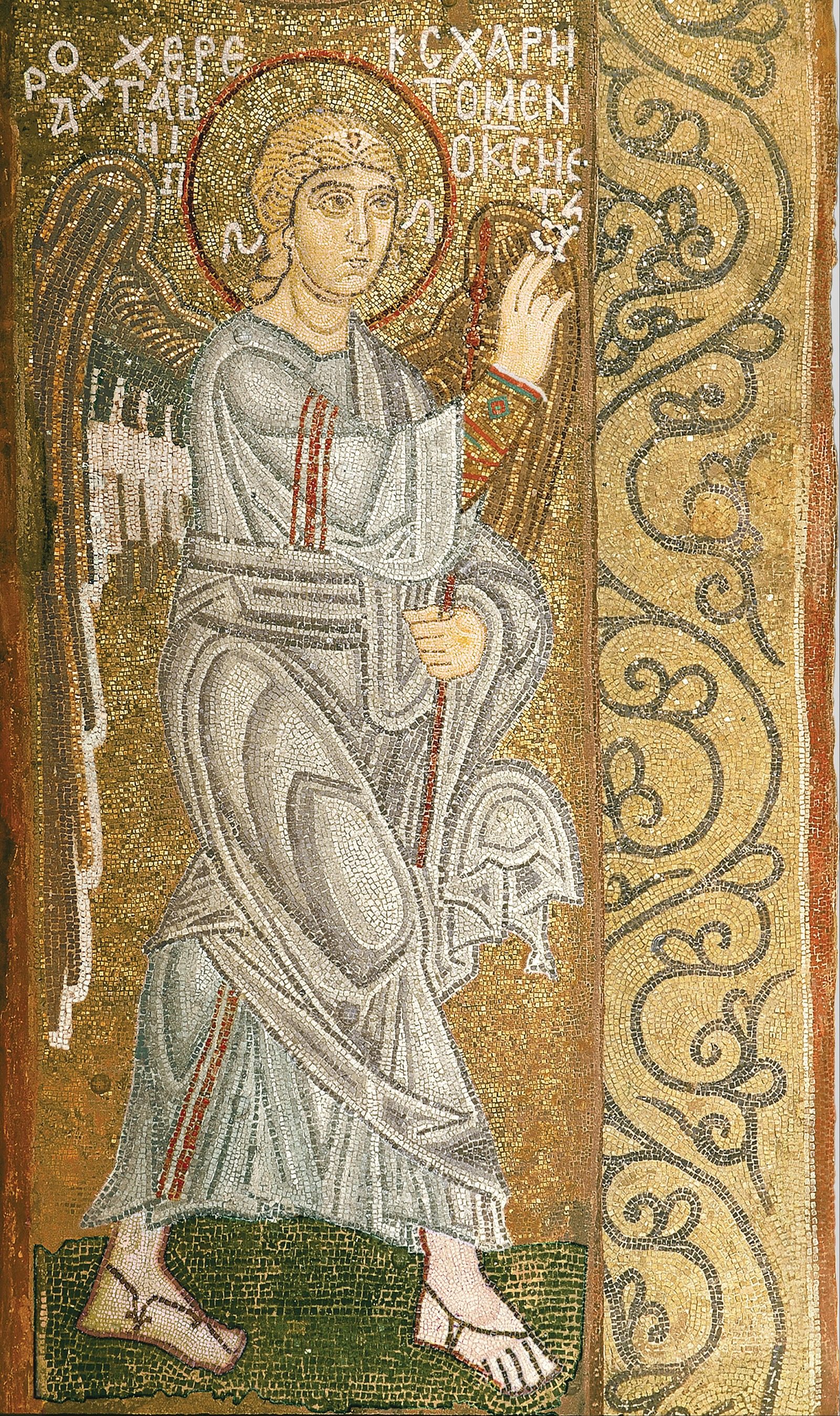
The Archangel Gabriel of the Annunciation
Mosaic on Eastern Pier of the Triumphal Arch, Saint Sophia Cathedral, Kyiv — c. 1037–1046
Doctrinal reflection
The archangel Gabriel strides into the iconographic frame, robes flowing as if mid-step from the heavenly to the earthly. His right hand extends in the speaking-gesture; his left holds a staff or scroll (the legate-of-the-king attribute). The Annunciation composition is split across the triumphal arch: Gabriel on the left pier (this entry), Mary on the right pier — between them is the actual physical space of the church, so the worshipper standing between them stands inside the moment of the Annunciation. The mosaic is c. 1037–1046, Kievan Rus' under Yaroslav the Wise, founder of Saint Sophia. The corpus's third Hagia Sophia Kyiv entry alongside apostles-communion-kyiv (#39) and virgin-orans-kyiv (#36). Kyiv at 3/4.
The corpus's split-Annunciation reading. The Kyiv compositional choice — Gabriel and Mary on opposite sides of the church arch — is iconographically distinctive. The corpus has the canonical unified-frame Annunciation at Chora and Sinai, the Gabriel-foregrounded exterior fresco at Kurbinovo (#116). The Kyiv split-arch composition does what no single panel can: the worshipper enters the Annunciation. Standing under the triumphal arch, the worshipper's body is in the place of the angelic message-passing — Gabriel speaks from one side, the message lands on the other. The compositional theology: the gospel is not a frame the worshipper looks at; the gospel is a space the worshipper stands inside.
Collection 8 framework pattern-match (no re-articulation per #109, #116, #124, #135). Hebrews 1:14 ministering-spirits architecture handles this entry. Gabriel is the messenger; Luke 1:19 ("I am Gabriel, that stand in the presence of God; and am sent to shew thee these glad tidings") anchors the role. The corpus's eye-line-as-doctrine principle (locked at #72 Climacus, applied to messenger-iconography at #116 Kurbinovo) operates here: Gabriel's gesture extends across the arch toward Mary, but his eyes look at the source from which he comes. The compositional theology consistent with the Kurbinovo Gabriel reading.
Kievan Rus' iconographic continuity with Constantinople. Yaroslav the Wise founded Saint Sophia in 1037 as the new patriarchal cathedral of Kievan Rus' — modeled iconographically and architecturally on Constantinople's Hagia Sophia (the imperial church). The mosaic program was executed by Byzantine masters, possibly with Kievan-Rus apprentices; the iconographic vocabulary is fully Constantinopolitan. The corpus reads the Kyiv program as the transmission moment for Slavic Christianity's iconographic heritage: the Constantinopolitan iconographic discipline took root in Kievan Rus' c. 1037–1046; from Kyiv the iconography traveled to Novgorod, Vladimir, Moscow, and the Russian iconographic tradition flowed for the next seven centuries.
The triumphal-arch convention. Byzantine churches traditionally placed the Annunciation on the eastern triumphal arch separating the nave from the apse — the liminal iconographic position between the gathered congregation and the altar-mystery. The compositional theology: the Annunciation is the threshold of the gospel. Christ-becoming-flesh (which the apse renders) begins at Mary's be it unto me, which Gabriel announces. The Kyiv mosaic's eastern-arch placement holds this convention precisely.
The 17th-flagship cousin frame (silent application). The Annunciation iconography always raises the 17th-flagship Theotokos-not-Mediatrix question. The Kyiv split-arch composition does this elegantly: Gabriel and Mary are on opposite sides of the arch, neither dominant, both flanking the central liminal space where the worshipper stands. The compositional choice avoids both Mariolatry-amplification (Mary alone monumental) and Theotokos-erasure (Mary subordinate). Mary stands as the consenting recipient of the message; Gabriel stands as the delegated messenger. Both witness; Christ is the One they witness to.
Hagia Sophia Kyiv at 3/4 ceiling. The corpus's three-entry Kyiv program now reads as a coherent Kievan Rus' iconographic program: Theotokos Orans (#36, Collection 2 — the apse Hodegetria/Orans foundation) + Communion of the Apostles (#39, Collection 9 — the Eucharistic frieze) + Archangel Gabriel of the Annunciation (this entry, Collection 8 — the eastern-arch messenger). The Kyiv program may close at 4/4 with a future Pantocrator-dome entry (Collection 1 currently frozen). For now, 3/4 active; Lock A's three-entry-gap activates after this cluster.
Gabriel strode in. The message extended across the arch. Mary stood on the other side, ready to receive. The worshipper stands between them, inside the gospel-moment. The Kyiv mosaic survived nine centuries of regime change to teach the apostolic line.