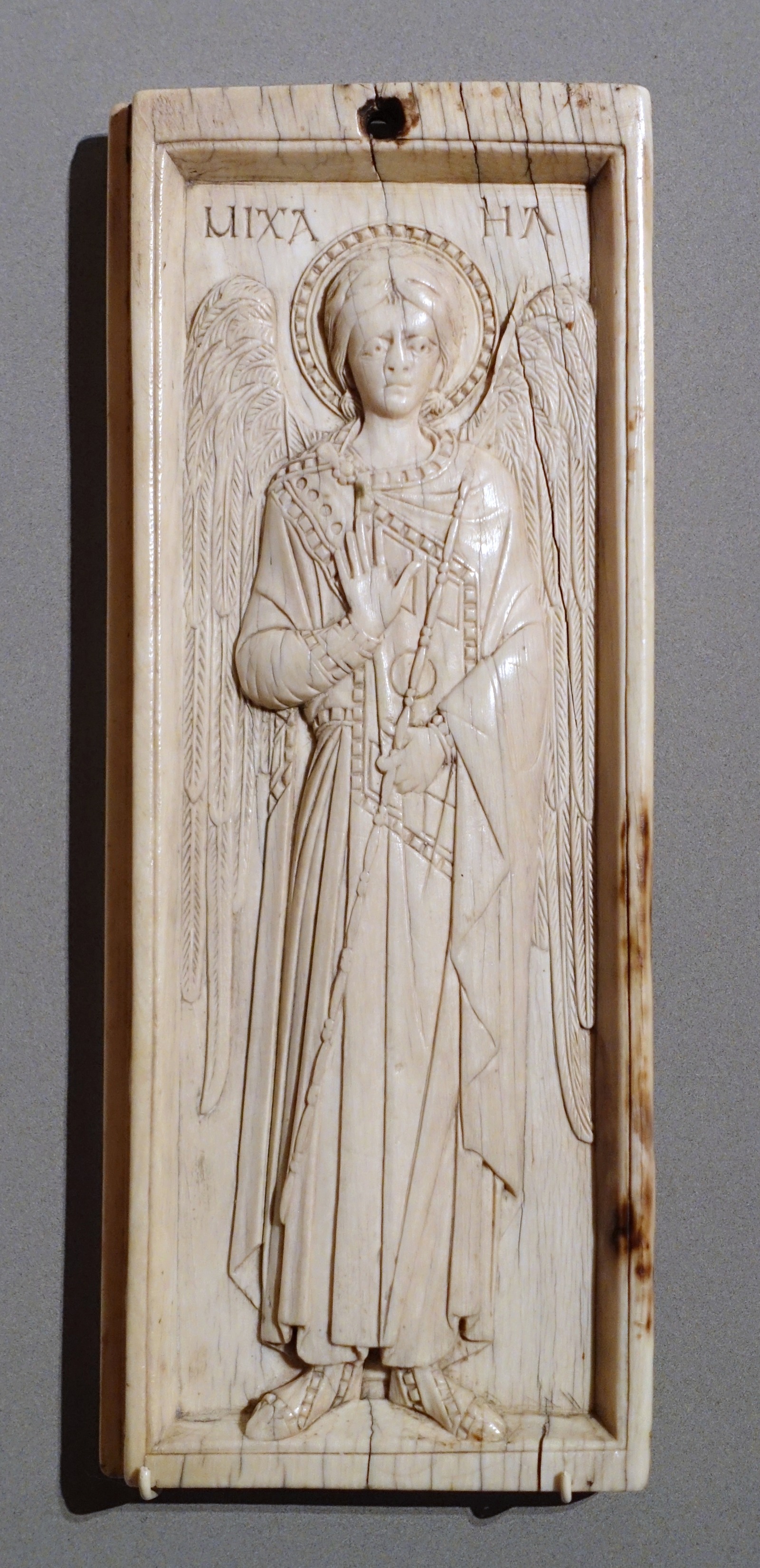
Archangel Michael Relief Panel
Carved-Ivory Relief, 11th century, Constantinople — Bode-Museum, Berlin (Skulpturensammlung und Museum für Byzantinische Kunst)
Doctrinal reflection
The archangel stands frontal in carved ivory relief, wings open behind him. He wears the formal court dress of a high Byzantine official — chiton and chlamys with the loros (the embroidered scarf reserved for emperors and archangels). Right hand holds a scepter; left hand holds an orb. The relief is 11th-century Constantinopolitan ivory carving, now at the Bode-Museum's Museum für Byzantinische Kunst. The corpus's third Bode-Museum entry alongside #hetoimasia-bode-relief (#96) and the existing forty-martyrs holding (forty-martyrs-sebaste). Bode-Museum at 3/4.
The corpus's locked Collection 8 framework pattern-matched (no re-articulation per #109). Hebrews 1:14 ministering-spirits architecture handles this entry directly: angels minister, not mediate. The archangel in court dress holding scepter and orb is delegated authority, not autonomous principle. The corpus's first Archangel Michael icon at the Byzantine Museum Athens (#archangel-michael-byzantine-museum, #109) anchored the reading; the Bode ivory pattern-matches at a different scale (relief carving rather than panel painting) and a slightly earlier century (11th vs. 14th).
The ivory medium continues its Collection 8 register. The corpus's ivory category opened at #88 Met Koimesis ivory (Theotokos register) and continued at #122 Walters triptych (Theotokos and saints). The Bode Michael relief is the first ivory dedicated to angelology in the corpus. The medium's specific affordance: ivory's hardness preserves fine detail across a millennium without paint loss, so 11th-century facial expressions and drapery folds remain crisply legible. The Komnenian-period iconographer's compositional discipline survives the medium-decay that affects fresco and panel painting.
The loros — imperial-iconographic vocabulary applied to the archangel. The loros is the long embroidered scarf worn by Byzantine emperors at coronation and on imperial state portraits. The archangel here wears the loros — registering that Michael serves the heavenly court in the regalia the earthly emperor wears in his court. The compositional theology: Michael's authority is the heavenly equivalent of imperial authority on earth — but Michael's authority is delegated by God, just as the emperor's authority was understood (in Byzantine political theology) to be delegated by God. The loros signals delegation, not autonomy. The Collection 7 named-decline of angel-veneration (locked at #109) applies: Michael in imperial regalia is still Michael under God's authority, not Michael as autonomous mediator.
The orb in the left hand — eye-line-as-doctrine. Standard archangel-iconography shows the archangel holding an orb (globus cruciger or transparent globe). The Bode Michael holds an orb without inscription visible in the surviving relief — but the iconographic convention from the Athens icon (#109) is that the orb's content names Christ as judge (Χ Δ Κ — Christos Dikaios Krites). The compositional theology operates here: the orb in the angelic hand teaches that the angel holds what the angel does not own; the world's content names Christ. Eye-line-as-doctrine principle (locked at #72 Climacus) at ivory-relief scale.
The Bode-Museum program developing. Bode now at 3 entries: forty-martyrs-sebaste (Collection 4 saints / martyrs), hetoimasia-bode-relief (Collection 3 second-coming, the prepared throne), archangel-michael-bode-ivory (Collection 8 angels). The program reads as eschatological-doctrinal triad: martyrs witness; the throne is prepared; the angel-defender stands in the court. The 4th entry (when iconography supplies an occasion) would close the Bode at ceiling — possibly with a Collection 1 Pantocrator-frozen item (when Collection 1 freeze lifts) or another doctrinal angle. Lock A's tightened three-entry-gap activates — no further Bode entries until 3 intervening.
The Constantinople-to-Berlin transmission. The Bode-Museum's Byzantine collection (formed in the late 19th and early 20th centuries) preserves Constantinopolitan craftsmanship that would otherwise have been lost or scattered. The corpus reads the museum-housed preservation as the iconographic-survival principle (#70) operating at the institutional level: scripturally-disciplined iconography survives across regimes (Byzantine empire → Ottoman empire → Western museum collection) when its doctrinal-iconographic discipline holds.
Michael in court dress holds the scepter and the orb. The orb's content names Christ. The angel ministers; Christ is named in what the angel holds. The eleventh-century ivory still teaches what the iconographer carved into it — the same lesson the panel painter rendered three centuries later at Athens.