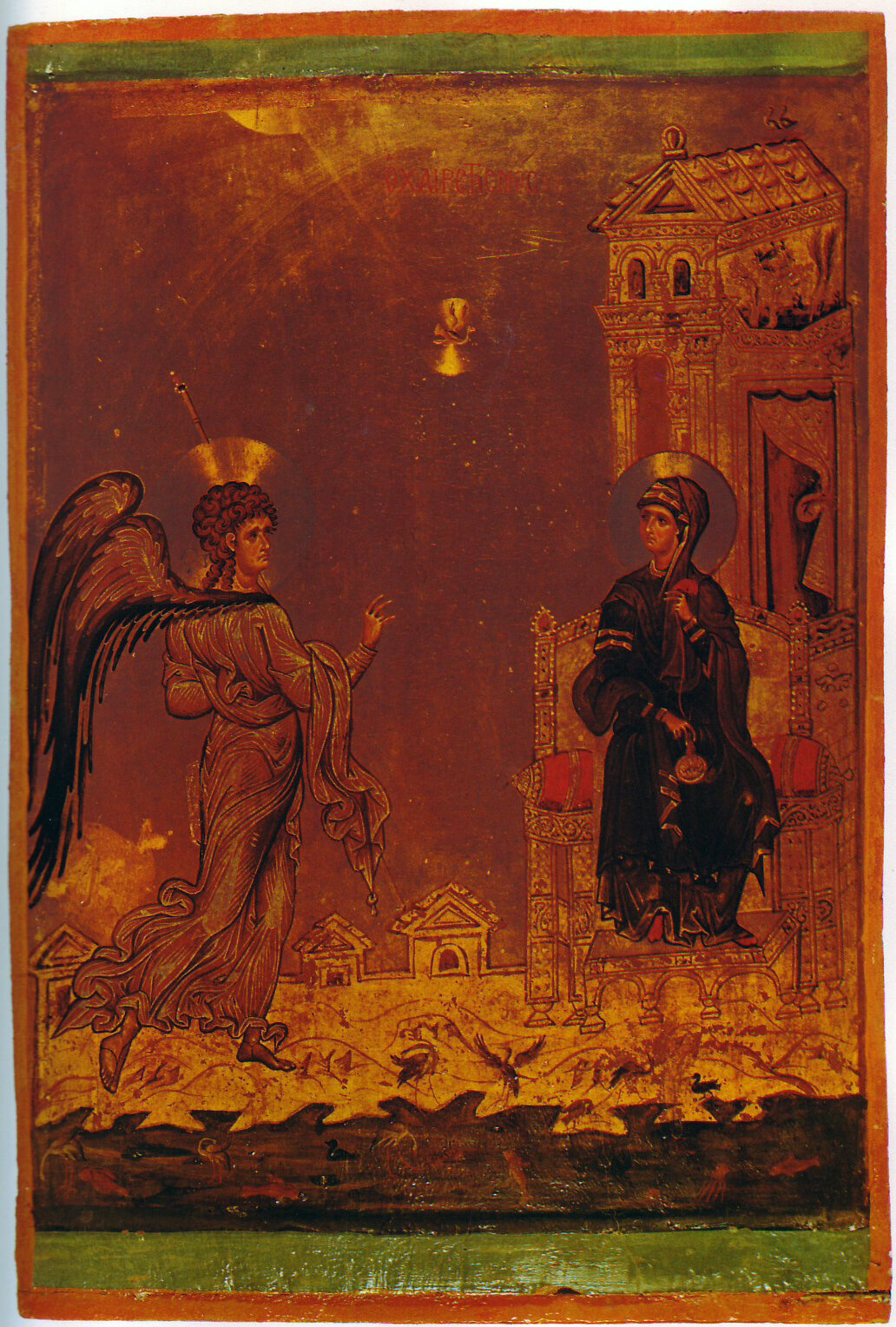
The Annunciation
Late 12th-c. Icon — Saint Catherine's Sinai
Doctrinal reflection
She is weaving the temple veil when the angel arrives.
The Sinai Annunciation icon, painted in the late 12th century at Saint Catherine's Monastery, shows Mary seated on a throne in a stylized landscape — a river at her feet, an angel descending from a starry sky. In her hand she holds a length of red fabric. The detail comes from the Protoevangelium of James, an apocryphal infancy gospel that says Mary had been chosen by lot to weave the scarlet veil for the temple in Jerusalem. The veil that separated the Holy of Holies from the world. She is making it when Gabriel speaks to her.
The apocryphal narrative is not scripture. We do not need it as scripture. But the iconographic detail accidentally hits something deeply biblical, and we should not miss it. The Annunciation is the moment when the Word becomes flesh inside Mary's body. At that same moment, according to the artist, she was weaving the curtain that hid God from his people.
Hebrews 10:19–20 is the verse the icon has stumbled into: "Having therefore, brethren, boldness to enter into the holiest by the blood of Jesus, By a new and living way, which he hath consecrated for us, through the veil, that is to say, his flesh." The author of Hebrews calls Christ's flesh the veil. The body Mary is conceiving in Luke 1:35 is the veil the temple curtain only foreshadowed. And when Christ dies, the temple curtain will rip from top to bottom (Matthew 27:51) — because the real veil, the flesh, has been torn for entry.
Look at the icon again. She is weaving a veil; she is also conceiving the veil. The cloth in her hand is a foreshadow of the body in her womb.
Gabriel knows. The artist gave him a face described by scholars as troubled. He is announcing good news that will require the sorrow of a torn flesh. The mother is calm; the angel is grieved. Both of them know what is coming.
When you preach the Annunciation, do not stop at the joy. The conception was the beginning of the tearing. The veil began to be woven on this throne, and ended on a Roman cross. The Holy of Holies has been open since.