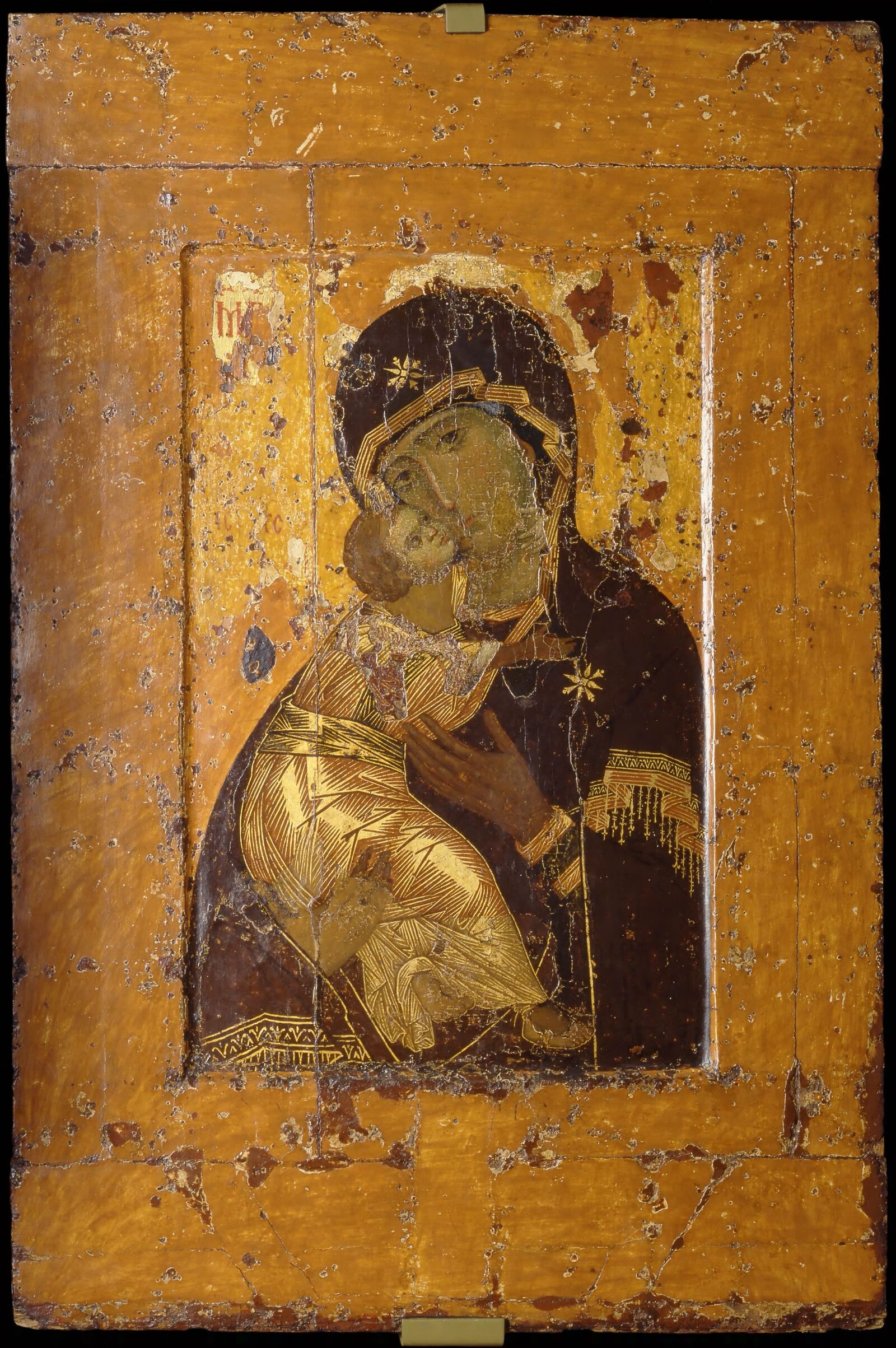
Theotokos of Vladimir
Eleousa Icon — The Word Became Flesh
Doctrinal reflection
The doctrine is in the touch.
The Theotokos of Vladimir is the most-copied icon in Christian history. It was painted in Constantinople around 1131, sent as a gift to a Kievan prince, eventually settled in Moscow, and survives now in the Tretyakov Gallery. The icon belongs to a type called Eleousa — Tenderness — in which the mother's face presses against the Child's. Cheek to cheek. Skin against skin.
Look at what the artist is teaching. He is teaching the doctrine of the incarnation — not as abstraction but as physical fact. John 1:14: "And the Word was made flesh, and dwelt among us." The Word did not put on a costume of flesh. The Word became flesh. The Greek behind "made flesh" is sarx egeneto — not appeared, not seemed, but became. The icon stages that becoming with the most direct physical sign available: a baby's cheek warm against his mother's face.
This matters. The modern church often preaches a Christ whose humanity is a temporary uniform — divine on the inside, human on the outside. The Byzantines did not allow that reading. Hebrews 2:14 says, "Forasmuch then as the children are partakers of flesh and blood, he also himself likewise took part of the same." Likewise. The same flesh. The same blood. The same hunger. The same need for a mother's arms.
The theological weight here is not on Mary. The theological weight is on the kind of son she bore. The Theotokos icon is a sermon on the genuineness of the incarnation. Mary is the necessary vehicle the doctrine requires — the womb and arms in which the Word actually became flesh, and the cheek against which the Christ-child actually pressed. Without her motherhood, the doctrine evaporates into docetic mush.
When you preach the incarnation, do not soften it into a metaphor. Preach it as a face against another face. The Word that made the universe nuzzled an ordinary woman's neck. That is what the icon says, and the icon is right.