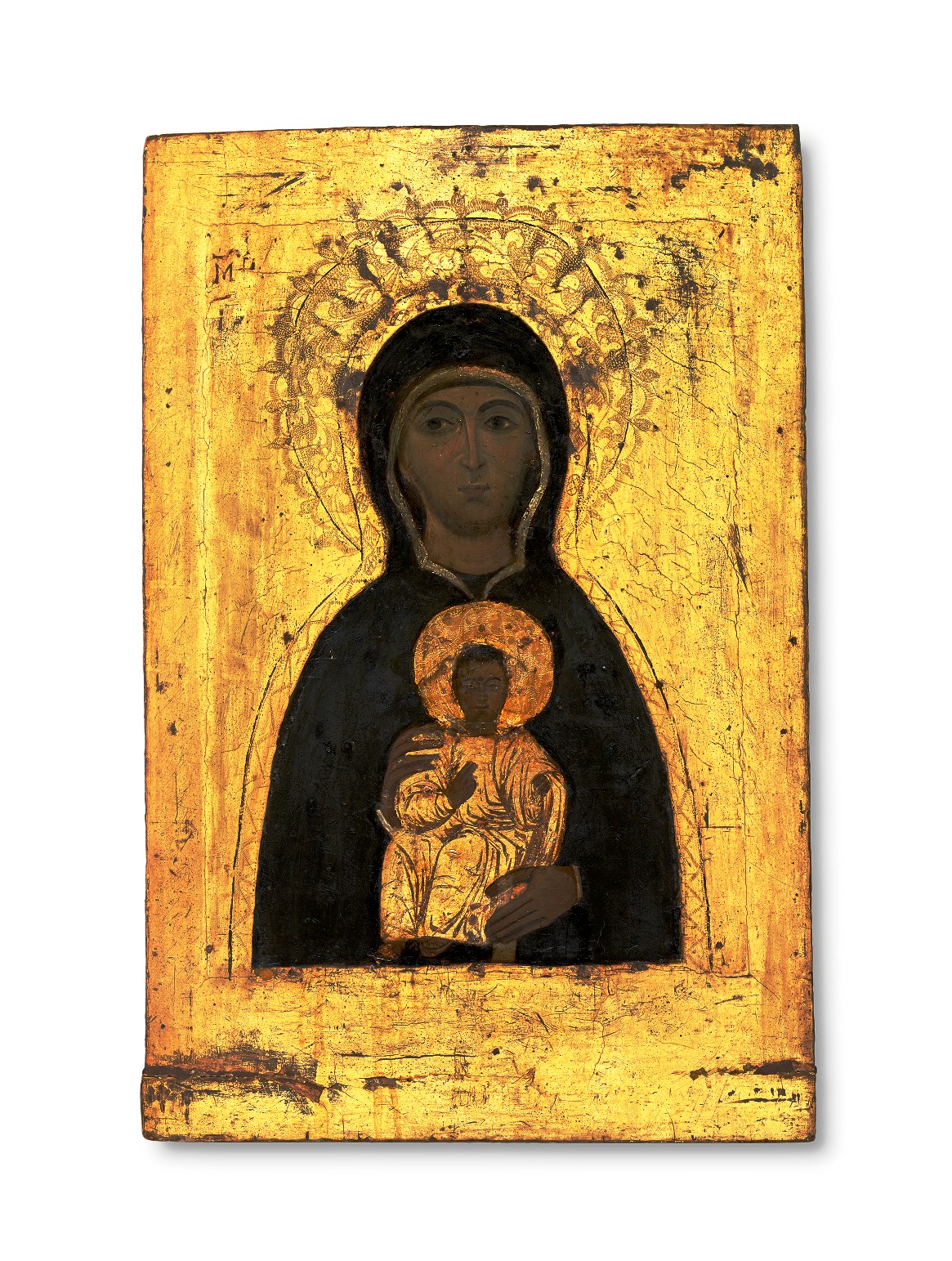
The Nicopeia (Theotokos Nikopoios — Virgin Bringer of Victory)
Panel Icon, c. 1100–1120, Constantinople — Basilica di San Marco, Venice (treasury)
Doctrinal reflection
The Theotokos sits frontally enthroned, holding the Christ-child upright before her chest in both hands. The compositional type is Nikopoios (Νικοποιός — Bringer of Victory) — a Byzantine iconographic variant in which the Theotokos displays the child to the viewer rather than holding him in the maternal embrace of the Eleousa or pointing to him in the gesture of the Hodegetria. The icon was the imperial palladium of Byzantine Constantinople — carried in military processions, displayed at imperial victories, kept at the Hagia Sophia or imperial palace until the Fourth Crusade's sack in 1204. The Venetian doge Enrico Dandolo brought it to Venice as part of the loot; it is now in the treasury of the Basilica di San Marco. The corpus's second San Marco entry alongside the Joseph cupola mosaic (#joseph-corn-san-marco). San Marco at 2/4.
The 17th flagship pattern-match — the Nikopoios as compositional theology. The corpus's locked Theotokos-not-Mediatrix flagship (#88 Met Koimesis ivory) reads: Mary is honored without being made the locus of devotion; the iconography honors her by terminating in Christ. The Nikopoios composition is theologically interesting because it places Mary as the display-frame for Christ — her hands present him to the viewer like a herald presents a king. The eye-line runs: viewer → Mary's display-gesture → Christ at the visual center. Mary's role in the iconography is to display, not to mediate. The corpus reads this as a clean iconographic-discipline move; the Nikopoios specifically protects against the Mary-as-end-of-devotion drift by making the display register dominant.
The imperial-palladium history — Collection 7 named-decline applied silently. The icon's history as Constantinople's imperial palladium (the city-protecting sacred-image carried into battle) is exactly the Nehushtan-trajectory the corpus has named at Collection 10's framing rule. The Byzantines treated the icon as protective-magic in military procession. The 1204 sack proved decisively that the icon did not protect; the Crusaders took the city, plundered the imperial treasury, carried the palladium to Venice as war-loot. The corpus reads the historical event as the apostolic line vindicated: images that the church treats as protective-mediators do not protect; they get plundered like any other artifact. Christ alone protects (Psalm 121); the icon teaches; the icon does not act.
The Constantinople-to-Venice transmission and iconographic-survival. The icon survived 1204 because the Venetians valued it as treasure rather than destroying it as idol. The corpus reads this preservation under the iconographic-survival principle (#70): scripturally-disciplined iconography survives when the iconographic content holds even across hostile-tradition transitions. The Byzantine palladium became the Venetian treasure; the Komnenian-period composition stayed intact; the iconographic argument — the Theotokos displays Christ — outlasted the political-religious upheaval of the Fourth Crusade.
The compositional restraint at the imperial scale. Komnenian-era iconography's compositional discipline is documented across the corpus: Daphni's Crucifixion (#crucifixion-daphni), Hosios Loukas's Pantocrator program (#pantocrator-hosios-loukas), and now the Nikopoios at San Marco. The 11th–12th centuries were the Byzantine iconographic high point — figures rendered with restrained emotion, monumental scale, theological precision. The Nikopoios fits the Komnenian register: no extra ornament; the Theotokos displays the child; the doctrinal claim lands.
San Marco's program developing. San Marco now at 2: Joseph-and-corn (#107, Collection 6 OT typology) and Nicopeia (this entry, Collection 2 Theotokos). The basilica's Byzantine-Venetian iconographic patrimony is among the most substantial in the Latin West; the corpus may grow San Marco entries to 3–4 over time as iconography supplies occasion. Lock A's three-entry-gap activates on the next San Marco entry attempt.
The Theotokos displays the Christ-child. The icon was carried in imperial processions; the icon did not protect Constantinople; the icon was taken to Venice as loot; the icon is now in the treasury at San Marco. Mary displays; Christ is at the center; the empire fell; the iconography survived.