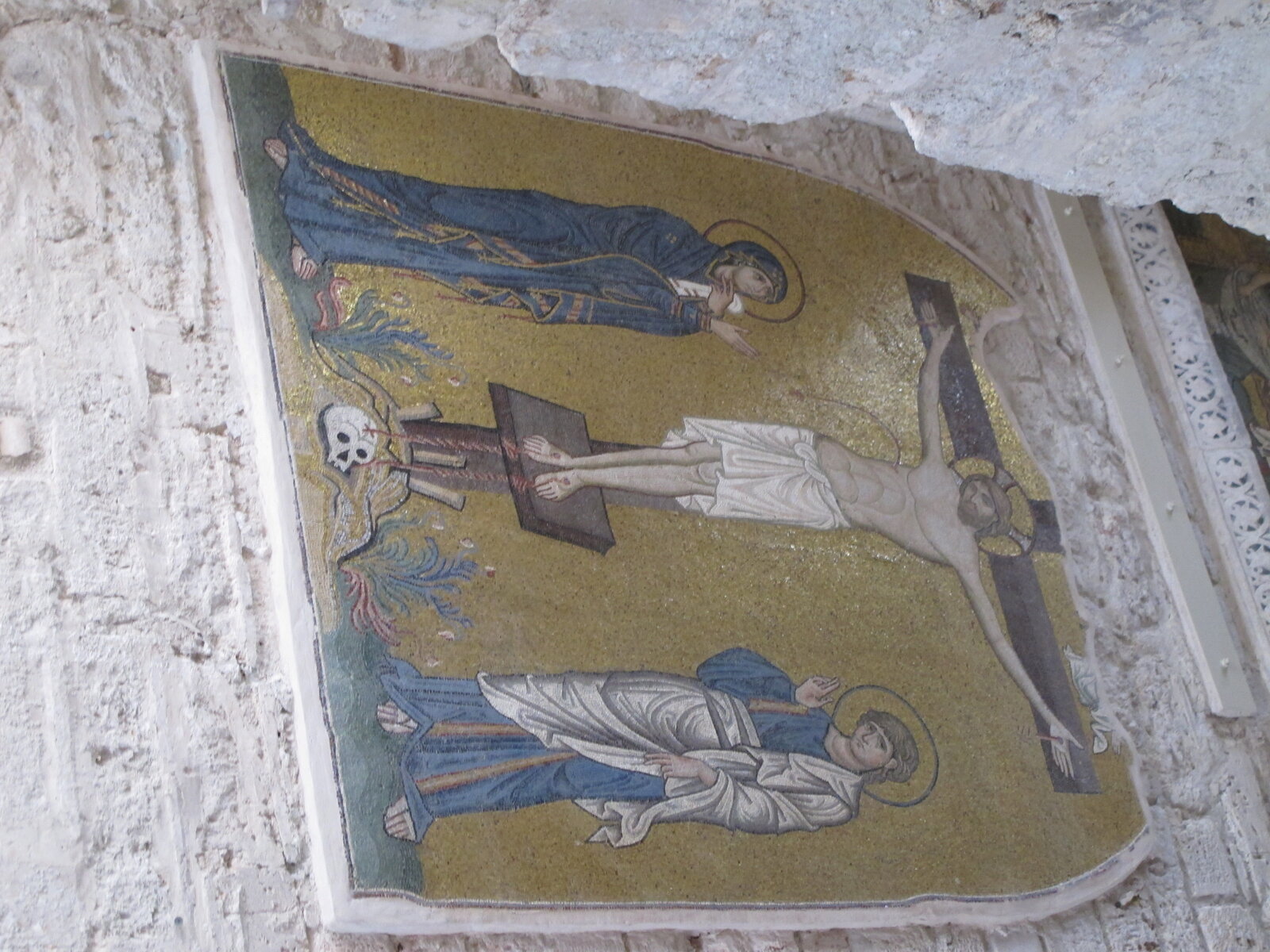
The Crucifixion
North-Arm Mosaic, Daphni Monastery
Doctrinal reflection
He bled.
The Crucifixion mosaic in the north arm of the Daphni catholicon, made around 1100, shows three figures against gold: Christ on the cross, Mary on his right, John on his left. The composition is reduced to its essentials. No thieves. No Roman soldiers. No spectators. Just the man dying and the two who loved him.
Look at his side. Blood and water are flowing. The Byzantine artist did not soften this. He painted the wound and what came out of it. John 19:34 records the moment exactly: "But one of the soldiers with a spear pierced his side, and forthwith came there out blood and water." The mosaicist read that verse and put it on the wall.
This matters because the modern church often loses the body. The cross gets symbolized into a metaphor — Christ's "sacrifice" treated as a vague spiritual transaction. The Byzantines did not allow that. They painted the blood. They painted Adam's skull at the base of the cross, the old legend that Calvary stood over Adam's grave, so that you would understand: a real man died over the place where the first man had been buried. The blood on the cross dripped onto the dust of the man who had brought death into the world. Pauline typology in pigment: "as in Adam all die, even so in Christ shall all be made alive" (1 Corinthians 15:22).
The figures of Mary and John below are the church taking shape at the foot of the cross. John 19:26–27 records what Christ said as he was dying: "Woman, behold thy son!... Behold thy mother!" The first instruction Christ gave to his church was given from the cross: a son and a mother to care for each other. The mosaic stages this — Mary and John flanking the cross are the pattern of the gospel community, founded in the moment of his death.
When you preach the Crucifixion, do not abstract it. The wound is in his side. The blood is real. The mother is grieving. The friend is silent. Adam's skull is at the base. Christ died. That is the doctrine — and from this real death come the real resurrection, the real ascension, and the real return.
The cross is not a metaphor.