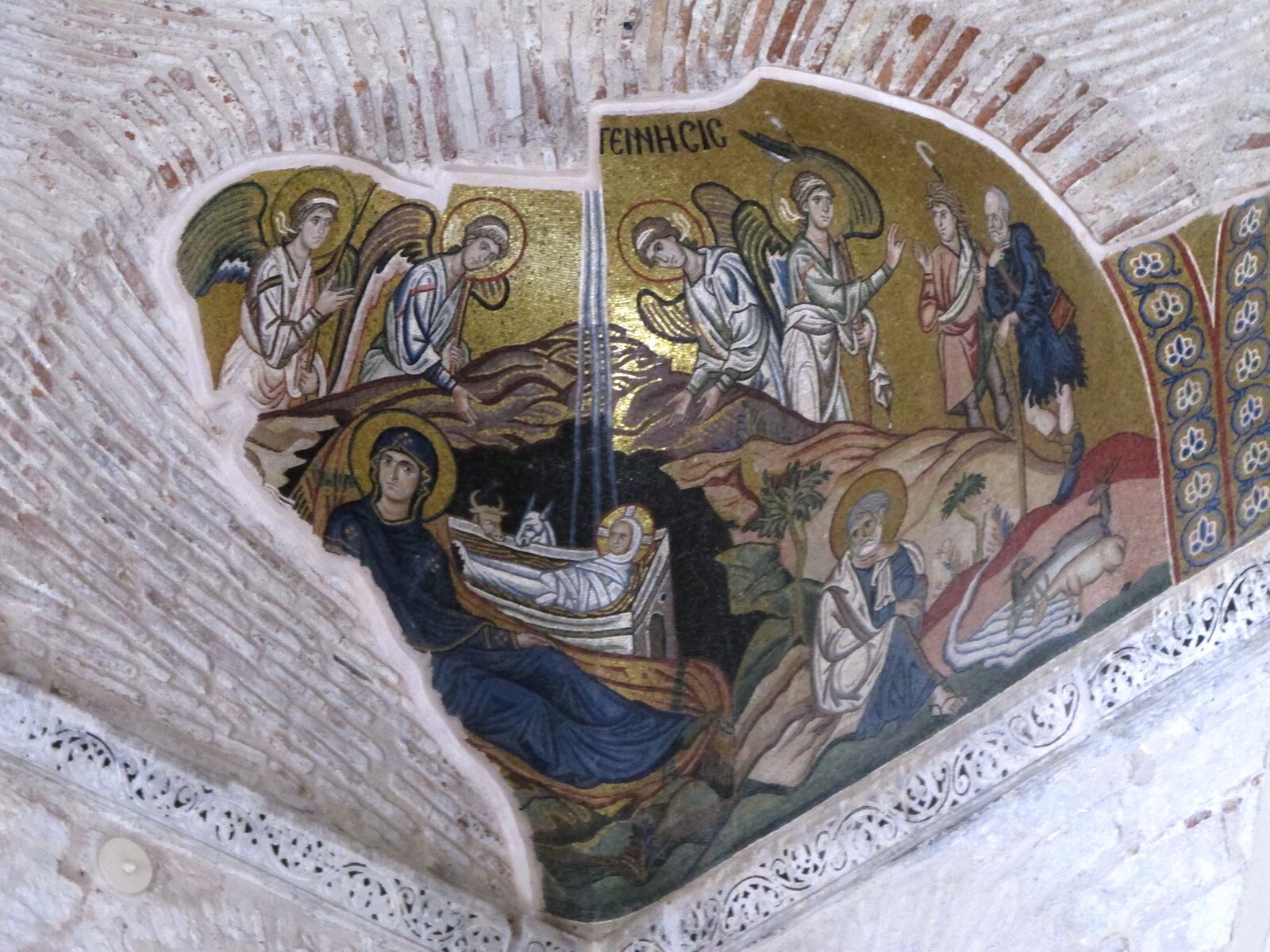
The Nativity
Mosaic, Daphni Monastery
Doctrinal reflection
Look at the cave.
The Daphni Nativity mosaic, made around 1100, follows the Byzantine convention of placing Christ's birth not in a stable but in a cave. Mary reclines on a mattress inside a dark opening cut into rock. The Christ-child is wrapped in swaddling clothes in a stone manger. Above, the star sends rays into the cave. To the lower right, two midwives wash the newborn. To the lower left, Joseph sits with his head in his hand, troubled.
Some of these elements are not in Luke or Matthew. The midwives' bath comes from the Protoevangelium of James, an apocryphal infancy gospel. The midwives are not scripture, and we should not need them to preach the Nativity.
But the cave is older than the Protoevangelium. Justin Martyr, writing around AD 150, locates Christ's birth in a cave near Bethlehem (Dialogue with Trypho 78). This may be authentic early-Christian tradition. Bethlehem houses were commonly built over stone caves, and "the inn" of Luke 2:7 may have been the upper room of such a house, with the manger in the cave-stable below. The Byzantine artists were reaching back toward something that may genuinely have happened.
What does the cave teach us? First: Christ is born in the dark. The God who made light enters the world in shadows, in a stone cleft, hidden. Second — and this is the move the Byzantine artists understood — Christ is born in a cave and will be buried in one. Mark 15:46: Joseph of Arimathea "laid him in a sepulchre which was hewn out of a rock." Same cave-shape. Same darkness. The gospel arc starts and ends in stone-cut openings, and the resurrection is the morning when one of them stays empty.
Look at Joseph in the corner. Matthew 1:19 says he was "minded to put her away privily" when he learned of Mary's pregnancy. The Daphni mosaicist painted Joseph's struggle into the Nativity because the man closest to the incarnation almost did not believe it. The angel had to come to him in a dream. If Joseph required that, what should be required of us?
When you preach the Nativity, do not soften it into a sentimental scene. Christ was born in stone darkness. Joseph almost walked away. The cave he was born in is the same shape as the cave he came out of three days after dying.
Preach the cave.