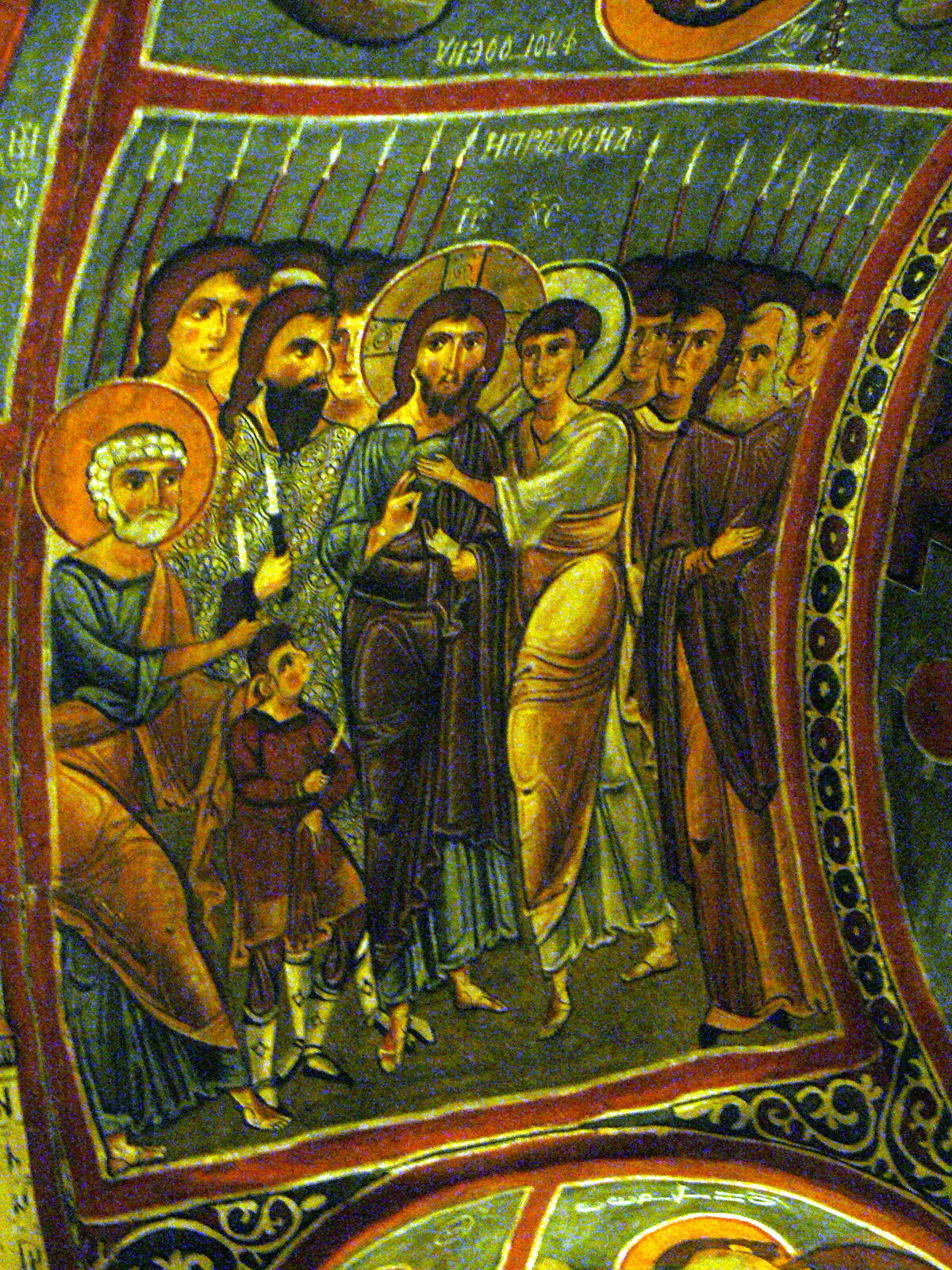
The Kiss of Judas
Fresco, Karanlık Kilise (Dark Church), Göreme, Cappadocia — 11th century
Doctrinal reflection
The two faces are almost touching. Judas leans in, beard cropped close, mouth at Christ's. Christ stands frontal, head only slightly inclined, eyes neither closed against the kiss nor hardened in rejection. Behind Judas, soldiers crowd in with torches and spears. To the right, Peter swings his sword and severs Malchus's ear (John 18:10) — caught mid-motion, the violent reflex the Lord will rebuke a moment later. The Cappadocian iconographer of the 11th century has compressed the entire Gethsemane arrest into a single fresco panel, with the kiss at its center.
This is the Passion-cycle's hinge — the moment between the Last Supper (#71 Sant'Apollinare Nuovo) and the Crucifixion (#5 Daphni) that the corpus had not yet held. The Karanlık Kilise (Dark Church) at Göreme, c. 1050–1100, was buried for centuries under accumulated pigeon droppings before its rediscovery — preserved by the very neglect that protected it from iconoclasm and Ottoman whitewash. The narrative cycle is one of the best-surviving in Cappadocia.
The kiss inverts the kiss. In the apostolic communities, the kiss of greeting was the marker of brotherhood — Salute one another with an holy kiss (Romans 16:16; cf. 1 Cor 16:20, 1 Thess 5:26, 1 Pet 5:14). Judas weaponizes the sign. He inverts the gesture's meaning by giving it as the betrayal-signal: Whomsoever I shall kiss, that same is he: hold him fast (Matt 26:48). The Cappadocian fresco shows the inversion compressed: bodies positioned for the kiss of greeting, soldiers in the background ready to seize.
Christ does not recoil. Matthew 26:50 records Christ's reply as Judas approaches: "Friend, wherefore art thou come?" The Greek word is hetaire — companion, friend. Christ addresses Judas at the moment of betrayal with a word of relational standing, not of denunciation. Iconographically, the Karanlık painter renders this. Christ's posture does not flinch. The face does not recoil. The kiss is received. Then Judas, which betrayed him, said, Master, is it I? He said unto him, Thou hast said (Matt 26:25). The Lord knew before the kiss. The Lord went into the garden anyway. The Lord did not strike Judas down. The fresco preserves what the gospel preserves — the willing receipt of the betrayal-kiss as part of Christ's chosen path to the cross.
The sword in Peter's hand is the contrary instinct. Put up again thy sword into his place: for all they that take the sword shall perish with the sword (Matt 26:52). The Cappadocian iconographer sets the contrast in a single composition: Christ accepts the kiss without recoil; Peter, beside him, lashes out in anger and is rebuked. Two responses to betrayal in one frame. The icon argues for the first.
The kiss is given by one of the Twelve. Apostolic standing does not foreclose apostasy. Judas was numbered with the Twelve (Matt 10:4), sent out to preach, entrusted with the bag (John 12:6), present at the Last Supper. Standing in apostolic company did not save him. Acts 1:25 names what happened next: that he might go to his own place. The fresco does not show Judas's interior. The iconographer paints the kiss, not the heart. The corpus does not speculate beyond what the iconography and the gospel text together affirm.
When we preach the Betrayal, do not stop at Judas. The fresco's argument is Christ's posture, not Judas's. He came unto his own, and his own received him not (John 1:11) — Christ knew, walked in anyway, took the kiss as it came. The fresco shows the love that does not recoil from the one who has come to betray.
The kiss inverts. Christ does not recoil. The icon does not speculate.