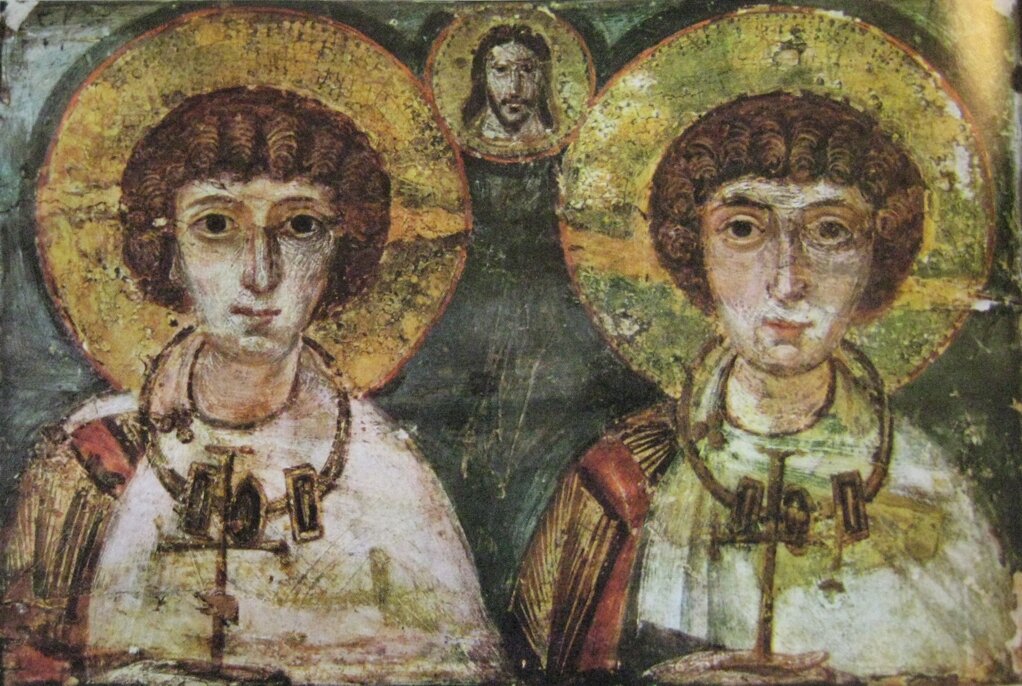
Saints Sergius and Bacchus
6th–7th-c. Encaustic Icon (originally Sinai; now Khanenko Museum, Kyiv)
Doctrinal reflection
They are looking at you. Christ is between them.
This 6th–7th-century encaustic icon of Saints Sergius and Bacchus, painted at Saint Catherine's Sinai and now at the Khanenko Museum in Kyiv, is one of the rarest surviving panel icons from before the iconoclasm. The two saints stand frontally side by side, wearing the chlamys and the maniakion — the cloak and the gold collar of Roman military officers. Between their heads, at the top of the icon, a small roundel contains the bust of Christ.
That medallion is the entire theology of the icon. The viewer's eye is drawn to the saints' faces — they are turned toward us — but the painter has placed the Lord between them as the figure they testify to. They look at us; we look at them; together we look at Christ above. The composition is a teaching about how saint imagery should function: not as the destination of attention but as the frame around the destination. A saint who points away from himself is doing his job.
Sergius and Bacchus were officers in the Roman army at the start of the 4th century. When the emperor Maximian required all soldiers to sacrifice to the pagan gods, they refused. They were stripped of their rank, paraded through the streets in women's clothing as humiliation, and eventually executed for treason — that is, for refusing to give the empire what belonged to God. Bacchus was scourged to death first; Sergius was beheaded later. They died around 303 AD, the early years of the Diocletianic persecution.
The iconographic medallion between them takes up Acts 4:19–20: "Whether it be right in the sight of God to hearken unto you more than unto God, judge ye. For we cannot but speak the things which we have seen and heard." Sergius and Bacchus could not stop speaking the things they had heard about Christ. The Roman state demanded they stop. They could not. They died for what is between their heads in this icon.
We do not pray to Sergius and Bacchus. We do not light candles to them as intercessors. The mediation work in heaven and on earth belongs to Christ alone (1 Timothy 2:5). But we read this icon honestly. Two faithful men, with Christ between them, dead for their refusal to bow to anything else. Hebrews 11:36–38 named men like them: "of whom the world was not worthy." Revelation 12:11 named the pattern: "they loved not their lives unto the death."
When you preach the saints, preach them like the icon paints them. Side by side, looking at the worshipper, with Christ between them.
The Christ is what they were pointing at. Look there.