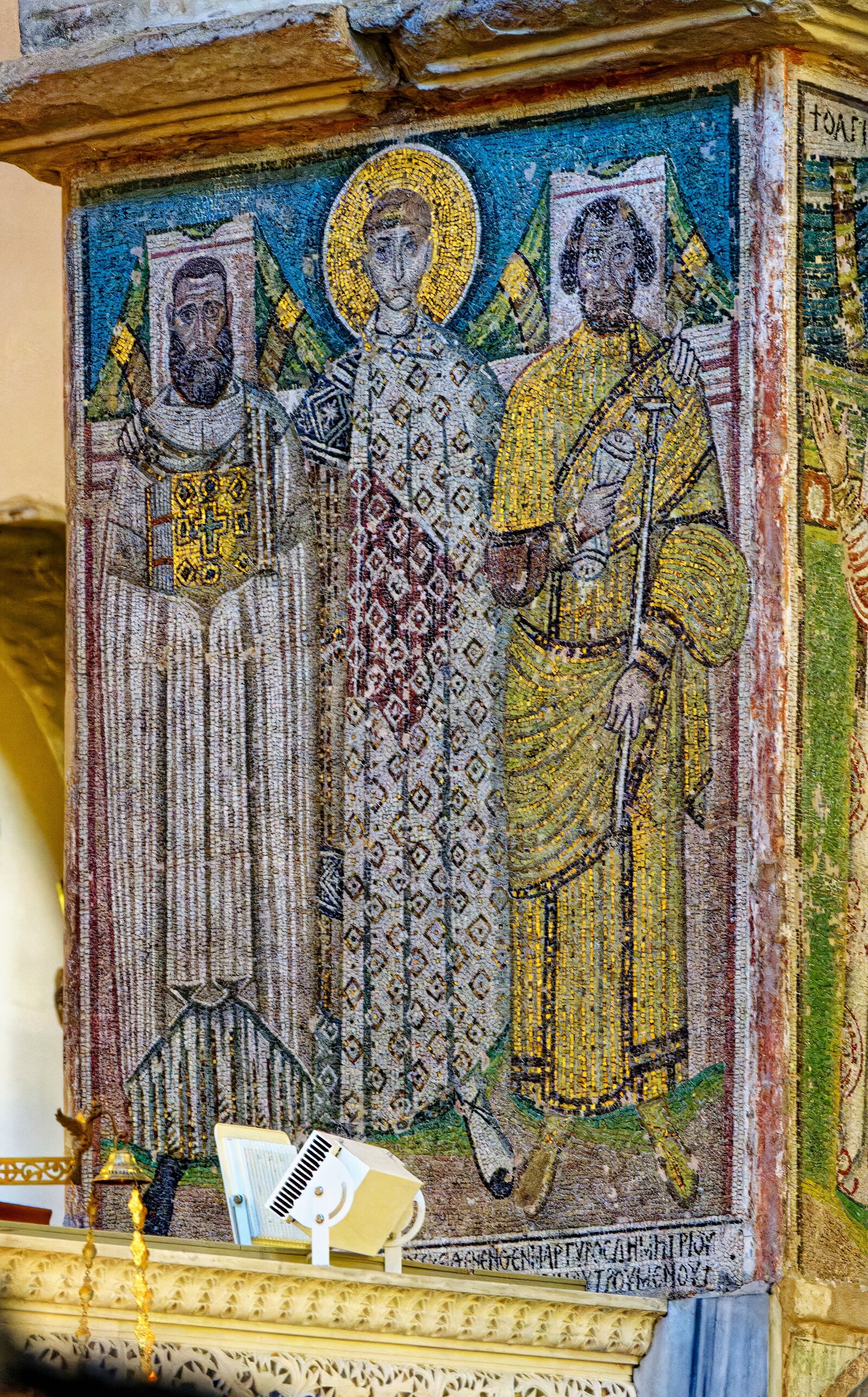
Saint Demetrios
Mosaic Program, Hagios Demetrios Basilica, Thessaloniki
Doctrinal reflection
He died for refusing to recant.
The Basilica of Hagios Demetrios in Thessaloniki preserves a mosaic program from the late 6th and 7th centuries — votive panels around the church showing the saint with bishops, with civic officials, with parents and children he is said to have protected. The mosaic shown here is from that program, painted on the walls after the basilica was rebuilt following the 620 earthquake. The figures stand frontally, hands raised in prayer or in gesture of presentation, with Demetrios's name written above them in Greek so the worshipper would know who was being painted.
Demetrios was a Roman officer in Thessaloniki under Diocletian and Maximian. Around 306 AD he was arrested for openly preaching Christ to a city the empire had ordered to remain pagan. He was speared to death in the public bath-house complex on which this basilica was later built. The Christians buried him on the spot. By the 5th century a small church marked the grave; by the 7th, after fires and earthquakes, the great basilica we have now.
The iconography is votive. The panels were commissioned by individual Thessalonians thanking Demetrios for protection — from Slavic raids, from plague, from ordinary domestic perils. This is where Eastern Christian saint-cult is concentrated: in the request, the gratitude, the candle, the kiss. We engage the iconography for what it teaches about faithfulness and decline what it asks of us in cultic terms.
What does Demetrios's life teach? Acts 4:19–20 again: "we cannot but speak the things which we have seen and heard." That was Demetrios's crime against the empire. He could not stop preaching. The empire executed him for what is biblically the simplest possible Christian obedience — speaking what he had heard. Hebrews 11:36–38 names men like him among the cloud of witnesses: "of whom the world was not worthy."
We do not pray to Demetrios. We do not look to him for protection from Slavic raids or anything else. The protection of the church belongs to Christ, who has not lost a single one his Father gave him (John 18:9). But we read this mosaic the way Hebrews 12:1 says to read the saints: as a cloud of witnesses, surrounding us, finished with their race, watching us run ours.
When you preach the saints, do not preach intercession. Preach imitation. Demetrios preached and died; the Thessalonians remembered; the basilica was built; the mosaics were painted; and a thousand years later the faith he kept is still being kept in the city he died for. The race is the inheritance. Run.