Christ and Saint Menas (the Bawit Icon)
Wax-Tempera Panel Icon, c. 6th–8th century, Originally Bawit Monastery, Egypt — Louvre Museum (Acc. E 11565)
Doctrinal reflection
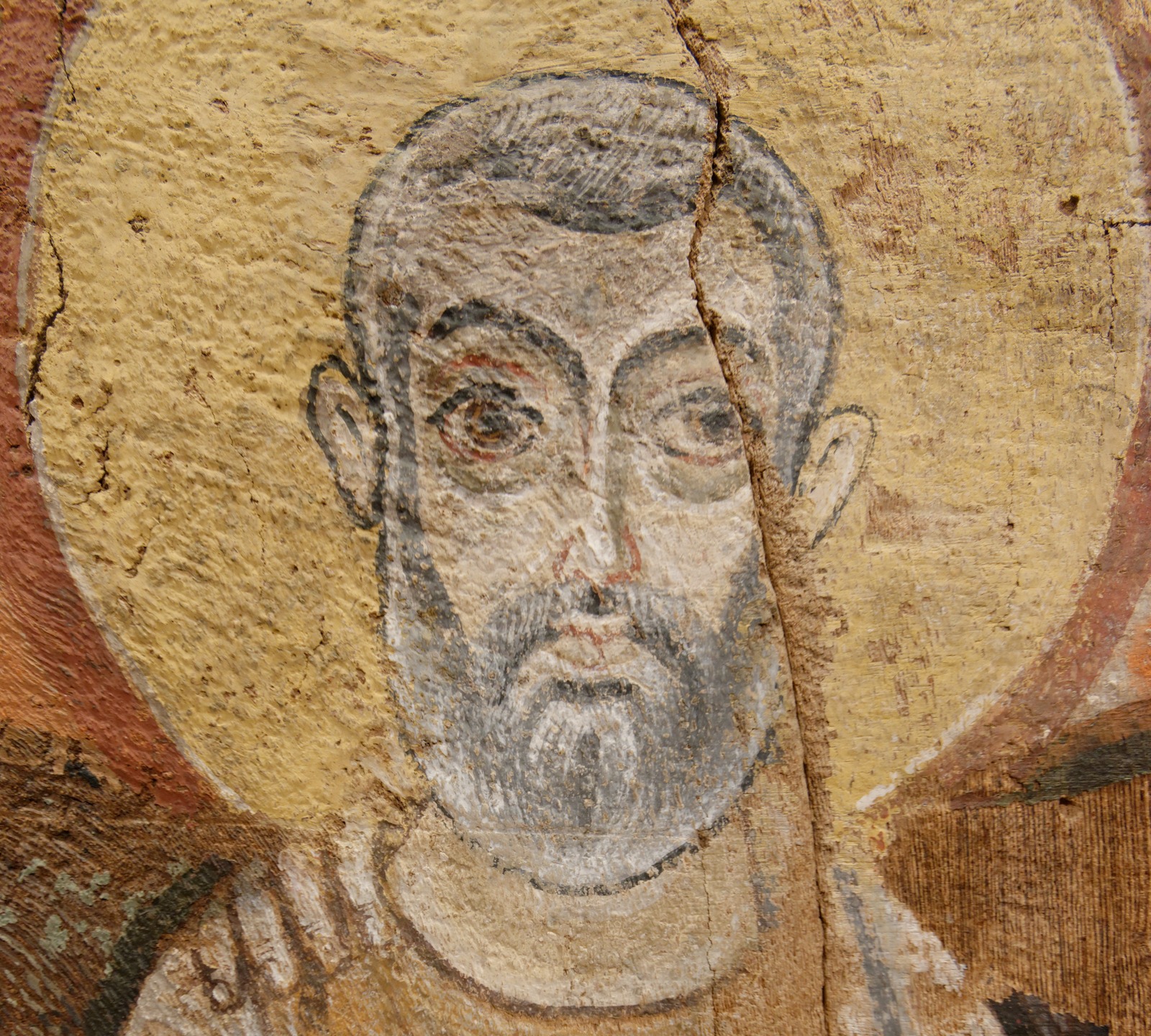
Two figures stand side by side at the iconographic center. On the right, Christ — bearded, halo with cross, gospel-book in his left hand. On the left, Saint Menas (Apa Mena) — Coptic monastic figure, halo, monastic habit, hands holding a scroll. Christ has his right arm around Menas's shoulders. The gesture is companionate, protective — Christ-and-saint as friends-in-the-gospel. The icon is c. 6th–8th century Coptic, originally from the Apa Apollo Monastery at Bawit in Middle Egypt; recovered by Jean Clédat's 1900–1903 excavations and now at the Louvre (Acc. E 11565), wax-tempera on sycamore wood, 57.7 × 58.5 cm. The Louvre opens as a fresh institutional opening in the corpus. Egypt broadens to 3 entries (Bawit-origin trail: Christ-and-Menas Louvre + Christ-mandorla-Bawit Coptic Museum + Saint-Barbara Coptic Museum).
One of the oldest surviving Christian panel icons. Pre-iconoclasm Christian panel paintings are extraordinarily rare; the Bawit icons survived because they were sealed in monastic ruins under desert sand for over a millennium. The corpus's pre-iconoclasm-survivors (Sinai's Pantocrator #2, Sinai Theotokos #20, Sinai Annunciation #29, Sinai Sergius-Bacchus #43, Sinai Peter #56, Bawit Christ-mandorla #84) all owe their existence to the same preservation accidents — desert climate, monastic isolation, Islamic conquest's iconographic tolerance toward enclaves. Christ-and-Menas joins the catalog of pre-iconoclasm survivors at the earliest documented dating (some scholars place the icon as early as the 6th century, others 7th–8th).
The corpus's Collection 4 framework — saint-and-Christ companion register. The pattern matches sergius-bacchus-khanenko (#43): the iconographic protagonist is the saint; Christ is rendered as companion-friend, hand on the saint's shoulder, signifying the saint's incorporation into the divine fellowship. The 15th-flagship cloud-of-witnesses framework (locked at #83 Rotunda) reads this companionship register as iconographic illustration of being with Christ — the saint in whose company Christ has placed himself, the saint who walks with the Lord. Hebrews 12:1–2's cloud of witnesses, looking unto Jesus is the apostolic anchor. Menas is in the cloud; Christ is at the center; the icon renders the company.
Saint Menas of Egypt — the historically defensible figure. Menas (Apa Mena) was a 4th-century Egyptian Christian martyr, traditionally killed under Diocletian (c. 309). His shrine at Abu Mena west of Alexandria was one of the major early-Christian pilgrimage sites — ampullae (small pilgrimage flasks) bearing Menas's image were distributed across the Mediterranean from the 4th–7th centuries. The corpus reads Menas as canonical-martyr-tradition: the historical core (Egyptian Christian martyr under Diocletian) is well-attested by 4th–5th-century sources; the legendary embroidery (the camels, the miracle-stories) accumulated later. Mode 4 application: affirm the martyr-witness; decline the legendary-cult expansion that grew at Abu Mena pilgrimage center.
The Coptic register continues. The corpus's Coptic-iconography thread (Bawit, Coptic Museum) carries the pre-Chalcedonian Egyptian Christian tradition — Coptic Orthodoxy split from the Byzantine imperial church at Chalcedon (451) over the Christological formula. The Christ-and-Menas icon predates or is contemporary with that split; the iconographic content is doctrinally compatible with Chalcedonian orthodoxy regardless of which side of the 451 controversy the local community took. The Coptic painter rendered Christ with full divine-and-human attributes (cross-halo, gospel-book = divine; bearded man embracing the saint = human). The corpus reads the icon's Christology as apostolically grounded across confessional-tradition boundaries.
The Louvre opening. The Louvre's Egyptian-Coptic and Byzantine collections are among the world's most extensive. Christ-and-Menas is one of the most iconographically significant items in the entire collection. The corpus opens the Louvre at 1 entry; the Louvre may grow to 2–3 over time as iconography supplies further occasion (Coptic textiles, Byzantine ivories, illuminated manuscripts).
Christ's arm around Menas's shoulder. The gospel-book in Christ's left hand. The scroll in the saint's. The walk-with-Christ register. The cloud of witnesses; the company of saints; the friend-of-the-Lord register. The icon survived 1300+ years under desert sand. The witness continues.