The Cloud of Witnesses
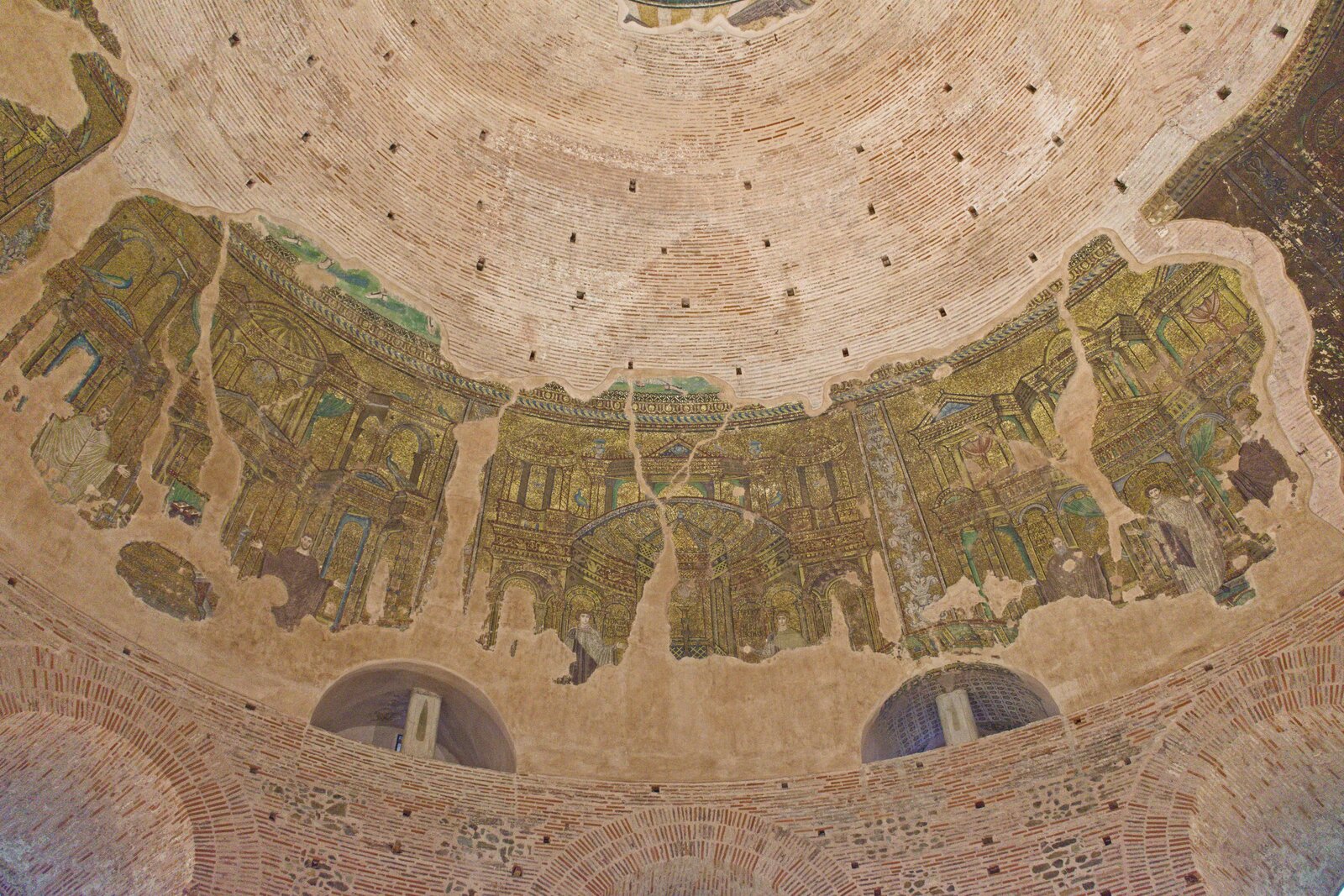
Dome Mosaic Register, Rotunda (Hagios Georgios), Thessaloniki — late 4th / early 5th century
Doctrinal reflection
The middle band of the Rotunda dome is a procession of fifteen named witnesses, each standing in his own jeweled architectural frame — palaces, basilicas, ciboria — like a city of gold. Hands are raised in orans prayer. Faces tilt upward. The gaze of every figure runs out of his frame and up the curve of the dome toward what was once a cosmic-Christ apex. That apex is lost. What survives is the witnesses in the act of looking; what does not survive is the One they look toward.
Named inscriptions identify the cloud. Onesiphoros the soldier. Philemon the flute-player, choraulos, in his purple cloak. Kosmas and Damian the doctors. Beside them: more soldiers (Leo, Eukarpios, Basiliskos, Priskos, Therinos); priests (Romanos, Ananias); bishops (Philipos, Kyrillos); a servant (Porphyrios). Soldier and musician and doctor and priest and bishop and servant. The cloud is plural; the witnesses came from every walk.
This is the 15th flagship articulation in the corpus's doctrinal-position emergence map: the cloud of witnesses — the witness-not-mediator flagship.
"Wherefore seeing we also are compassed about with so great a cloud of witnesses, let us lay aside every weight, and the sin which doth so easily beset us, and let us run with patience the race that is set before us, looking unto Jesus the author and finisher of our faith" (Hebrews 12:1–2). The two verses are a single hinge. The cloud surrounds the runner; the runner's gaze is unto Jesus. Witnesses on every side, but the eye-line goes forward, not lateral. Hebrews 11 supplies the named catalogue — Abel, Enoch, Noah, Abraham, Sarah, Moses, Rahab, Gideon, Barak, Samson, David, Samuel, the prophets, those of whom the world was not worthy (Heb 11:38). The Rotunda extends the catalogue into the post-apostolic age. Onesiphoros and Philemon and the doctors are added to the cloud Hebrews 11 began to enumerate.
The corpus holds three claims around the flagship. Affirm the cloud as real — the witnesses are historical persons whose faith is named and held forth as example; Hebrews 11–12 is not metaphor in the sense of unreal. Decline the intercession overlay — saints in iconography are often given the role of receiving petitions and forwarding them to Christ; Hebrews 12:1 does not authorize this. The witnesses witness the race; they do not intercede in it. Refuse the reductionist move that treats the cloud as merely literary or merely past — the witnesses are real, named, and remain in some genuine sense with the church (whatever exactly the writer of Hebrews means by their compassing about). Both ends — over-claim and under-claim — are wrong; the apostolic middle is the doctrine.
The eschatological closure is Revelation 7:9–17. The same cloud, in heavenly view, is arrayed in white robes before the throne, crying... salvation to our God which sitteth upon the throne, and unto the Lamb. Worshiping the Lamb, not receiving petitions from earth. The earthly cloud and the heavenly cloud are the same cloud in two viewing positions. Neither authorizes intercession-toward-saints.
**Compositional theology — the orans posture.** Look at where the saints' hands and faces go. Up, not out. Out would be petition-receiving posture — saint facing the viewer, receiving veneration. Up is petition-offering posture — saint praying alongside the church, joining the same gaze. The saints pray with us; we do not pray to them.
The lost apex is not a small irony. The mosaic that survived is the witnesses; the mosaic that fell is the Christ they look at. The iconographic-survival principle (#70) inverts here: what is lost can still be reconstructed from the direction of what survives. The eye-line of fifteen saints points to a Christ-apex that is the doctrine's center. We do not need the apex restored to know where the gaze went.
The cloud surrounds. The runner runs. The witnesses pray with us, eyes upward. Looking unto Jesus.