The Theotokos Hodegetria
Apse Mosaic, Cattedrale di Santa Maria Assunta, Torcello (Venetian Lagoon) — c. 11th century, with 12th-century rework
Doctrinal reflection
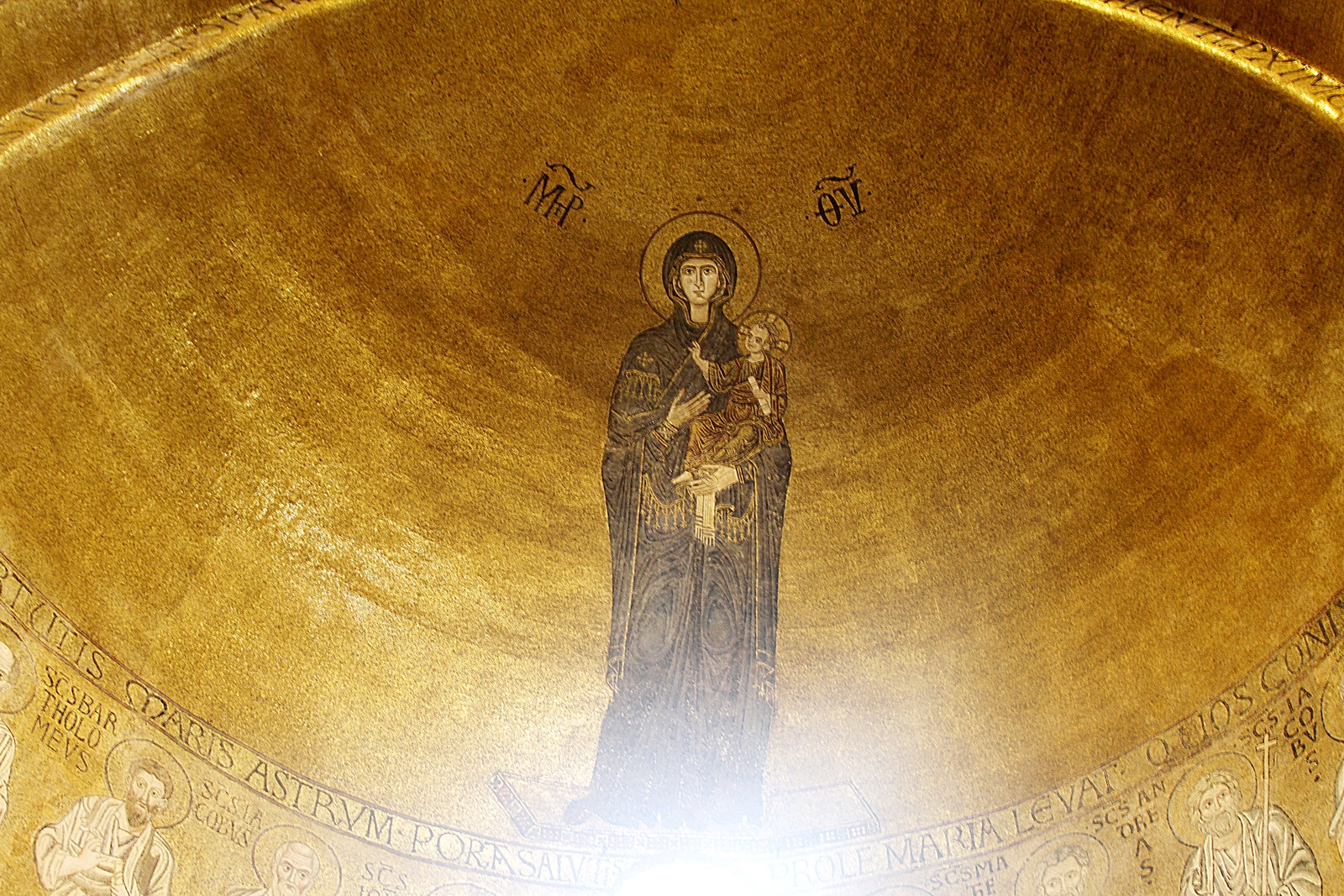
The Theotokos stands alone in the apse, isolated against an immense gold ground, the Christ-child held in her left arm and her right hand gesturing toward him. The gesture is the defining mark of the Hodegetria type — she who shows the way — and the iconographic argument is encoded in the gesture itself: Mary points away from herself, toward the Son. The mosaic is at Santa Maria Assunta, Torcello, in the Venetian lagoon, c. 1080–1130, with the main Virgin figure reworked after a 12th-century earthquake. Below her stand twelve apostles in a register of saints from the first program. The corpus's second Torcello entry alongside the Last Judgment (#16). Torcello 2/4.
The 17th flagship pattern-match — the gesture as doctrine. The corpus locked the Theotokos-not-Mediatrix flagship at #88 Met Koimesis ivory: Mary is honored without being made the locus of devotion; the iconography honors her by terminating in Christ. The Torcello apse is the iconographic illustration of the principle in the most architecturally prominent position any Byzantine church has — the apse over the altar, the position the Pantocrator takes at Hagia Sophia and the Anastasis takes at Chora. Torcello places the Theotokos there, but the iconographer's compositional choice is not Mary-as-throne or Mary-as-mediator. The choice is **Mary as the one whose hand says *go to him***. The eye-line-as-doctrine principle (locked at #72) operates here in Marian register: Mary's eyes look out at the viewer; her hand points to the child; the viewer's eye runs Mary's hand → the child → upward to the resurrection-victory the apse-program implies. The gesture is the doctrine.
The Hodegetria tradition. The Hodegetria type originated at the Hodegon Monastery in Constantinople, where the prototype icon (attributed by tradition to Saint Luke) was housed until 1453 when the Ottoman conquest destroyed it. The corpus has the tradition-type entry at theotokos-hodegetria (single-entry tradition-type ceiling, since the prototype is lost). The Torcello apse is the iconographic-tradition-type rendered in the most monumental form available — a 6-meter standing Virgin in an apse-position. The Veneto-Byzantine context (Torcello was Venice's Byzantine-orbit cathedral before the lagoon city consolidated) makes this one of the earliest Hodegetria-type renderings in the Latin West, transmitted through Byzantine iconographic vocabulary into Venetian church-building.
**Luke 1:38 — be it unto me according to thy word.** The Theotokos at Torcello is rendered standing (not enthroned). The compositional choice is registers Luke 1:38: Mary is the handmaid (δούλη, doulē) of the Lord. Her standing posture — vertical, columnar, simple — refuses the throne-iconography that would foreground her as queen-of-heaven. The standing figure says: the handmaid received the word; the word became flesh; the flesh is in her arms; her arms hold the One who is the way.
The twelve apostles below. The register beneath the Theotokos shows the Twelve. The compositional theology: apostolic foundation beneath; Theotokos with Christ above; the entire program organized around what the apostles preached and what Mary held. Ephesians 2:20 again — the foundation of the apostles and prophets, Jesus Christ himself being the chief corner stone. The Torcello apse program embeds the ecclesiological architecture in the church's literal architecture: apostles ground-level, Theotokos above, the Christ-child at the visual center.
The architectural scale. The Torcello apse is roughly 6 meters tall. The Theotokos is rendered at a size that makes her the building's central figure — the worshipper looking forward at the altar sees the Hodegetria. The corpus's reading: the size is rhetorically meaningful (Mary is given the dignity of monumentality) but the rhetoric is ordered (her hand still points to Christ). Scale-as-rhetoric and gesture-as-doctrine work together — the iconographer used both registers to argue the same point: honor terminating in Christ.
The Theotokos stands. The Christ-child is in her arms. Her hand is open in the gesture of pointing. She who shows the way. Mary honored; Christ pointed to; the gesture is the doctrine.