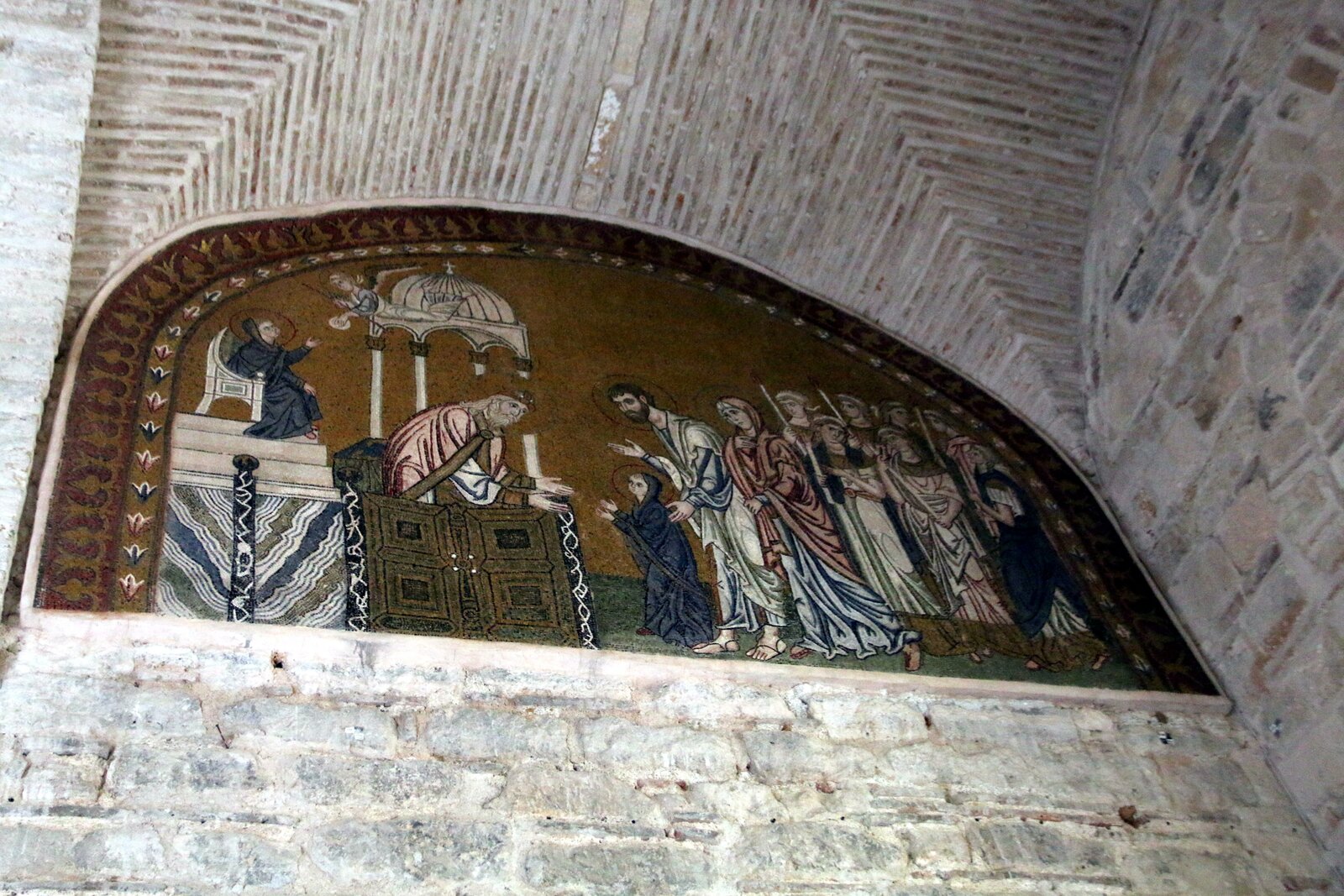
The Presentation of the Theotokos
Squinch Mosaic, Daphni Monastery
Doctrinal reflection
This scene is not in the Bible.
The mosaic at Daphni shows a small Mary, perhaps three years old, climbing the steps of the Jerusalem temple. Her parents Joachim and Anne stand behind her. The High Priest waits at the door, hands extended to receive her. Tradition says the priest brought her into the Holy of Holies — the only woman ever to enter — where she lived in the temple until her betrothal to Joseph at age twelve.
The story is from the Protoevangelium of James, a 2nd-century apocryphal infancy gospel. The canonical scriptures say nothing about Mary's childhood. Luke 1:27 introduces her as a virgin betrothed to Joseph; that is the first time she appears. The Protoevangelium narrative — Joachim and Anne's barrenness, Mary's miraculous conception, her temple childhood, her betrothal — is not historically reliable and was never accepted as scripture by the apostolic church.
Why then engage the icon at all? Because the Byzantine artists were reaching for a doctrinal point that is biblical, even when the narrative they used to reach for it is not. The doctrinal point: Mary's body becomes the new temple. The Holy of Holies, behind the veil, was the place God's presence dwelt with his people in the old covenant. In the new covenant, God's presence dwells in flesh — in Christ — and that flesh was formed in Mary's womb. Her body is the new Holy of Holies. The temple iconography in this mosaic is straining toward that truth via an apocryphal vehicle.
The canonical version of this point is in John 2:19–21. "Destroy this temple, and in three days I will raise it up," Jesus said. "But he spake of the temple of his body." Christ is the temple. Christ formed in Mary's womb means Mary, for nine months, carried the temple. The Daphni mosaic gestures at this with a story we cannot verify and should not need.
When you preach the Theotokos doctrine, do not import the apocrypha. The canonical scripture is enough: the Word became flesh; the flesh was the new temple; Mary's womb was where the temple was built. Engage the iconography for what it teaches about Christ. Leave the apocryphal narrative outside the canon, where it belongs.