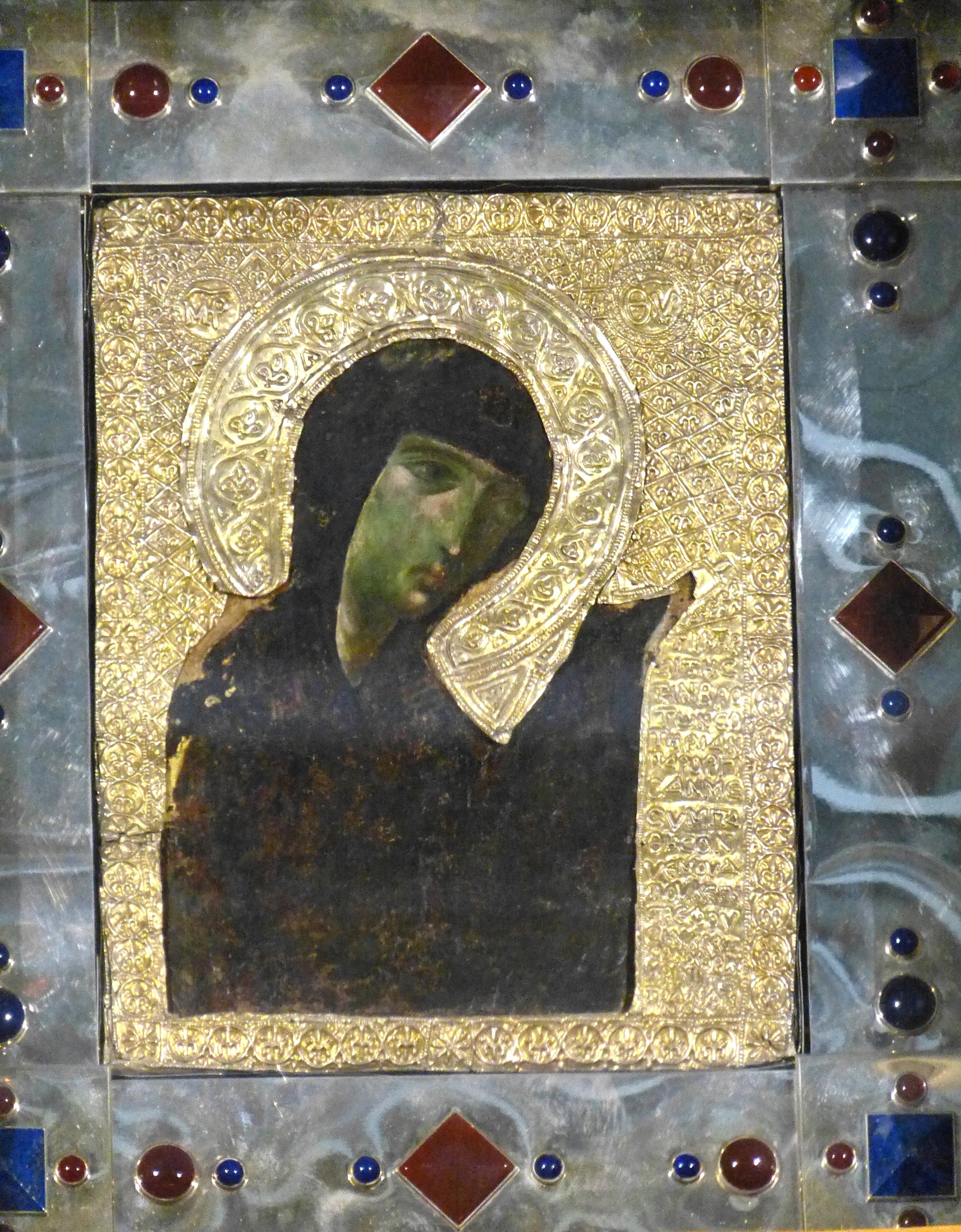
Theotokos Agiosoritissa
Panel Icon, 11th/12th century, Constantinople — Cappella della Santissima Icona, Spoleto Cathedral, Umbria, Italy
Doctrinal reflection
The Theotokos turns three-quarters to the viewer's right, hands raised in supplication-gesture — palms open, fingers extended in the iconic supplicating-pose. There is no Christ-child in her arms; the iconographic type is Agiosoritissa (Ἁγιοσορίτισσα — Holy-Reliquary-Mother), named after the Constantinopolitan reliquary-chapel of the Theotokos. The Agiosoritissa-type renders Mary alone, in the supplicating posture toward an implied Christ-figure, making her interceding-stance the iconographic content. The icon is 11th-12th century Constantinopolitan workmanship, donated by Holy Roman Emperor Frederick I Barbarossa in 1185 to the Spoleto Cathedral after the Italian city submitted to imperial authority. Spoleto opens as fresh Italian site.
The 17th-flagship Theotokos-not-Mediatrix architecture under careful application. The Agiosoritissa-type is the iconographic register the corpus must handle most carefully under its locked 17th-flagship reading (#88 Met Koimesis). The supplicating-gesture iconography depicts Mary in the intercessor-posture — and intercession is the territory where the Mediatrix tradition grew most strongly in Eastern and Catholic devotion. The corpus's discipline applies the three-fence rule: affirm the iconographic content (Mary inclines toward Christ in the disposition the church can join — be it unto me according to thy word, Luke 1:38, is itself a posture of supplicating consent); decline the doctrinal expansion that turns the iconographic supplicating-pose into a mediating function (Mary praying to Christ on behalf of the worshipper, the worshipper directing prayer through Mary to Christ); refuse the iconoclast counter-overreach that would erase Mary from iconography altogether. The Agiosoritissa is iconographically rendering Mary's posture of consent-toward-Christ; the corpus reads what's rendered without expanding to what's not.
Luke 1:38 — the apostolic anchor. "Behold the handmaid of the Lord; be it unto me according to thy word." Mary's posture of supplicating consent is the archetypal Christian disposition: open hands, attentive listening, let it be unto me. The Agiosoritissa-type renders this Lukan posture iconographically. The corpus reads the type as iconographic illustration of the handmaid-disposition that the church is called to imitate, not as iconographic warrant for treating Mary as the church's mediator-with-Christ.
The 1 Tim 2:5 cross-flagship anchor (locked across corpus). "There is one God, and one mediator between God and men, the man Christ Jesus." The corpus's structural defense against any human-mediation expansion. The Agiosoritissa-type's compositional theology must be read in 1 Tim 2:5's light: Mary's supplicating posture inclines toward the One mediator; her posture is not the mediation. The compositional framing — Mary alone, gesturing toward an implied Christ-figure outside the panel — actually clarifies this: she does not stand between the worshipper and Christ; she models the worshipper's own disposition of consent toward Christ.
The 1185 transmission and the Latin custody. The icon's transmission to Spoleto in 1185 is itself the iconographic-survival principle (#70) operating across the Greek-Latin tradition boundary. Frederick Barbarossa was negotiating his rule over northern Italy; the gift of a Constantinopolitan icon registered both political alliance and religious continuity. The icon survived 800+ years in Latin Catholic custody at Spoleto Cathedral, preserving the Komnenian-period iconographic vocabulary intact. The corpus's Italian-Byzantine thread (Torcello #117, San Marco Venice ×2, Sant'Apollinare ×4 + Classe ×3, San Vitale ×3, Cappella Palatina ×3, Cefalù 1, Monreale 1, Martorana 1, Santi Cosma Rome, Vatican, Genoa) extends to Spoleto (Umbria, central Italy).
The 17th-flagship architecture demonstrably applied to harder iconographic territory. The Met Koimesis ivory (#88 anchor) and the Torcello Hodegetria (#117 monumental scale pattern-match) handled relatively-clean Theotokos iconography (Mary in maternal-display posture). The Spoleto Agiosoritissa is harder territory — the supplicating posture is closer to the iconographic register where Mediatrix-drift accumulates. The corpus's structural discipline holds: the iconography is read; the apostolic line is named; the patristic-tradition extension is acknowledged where it stays apostolic; the late-medieval mediation drift is declined.
The Theotokos turns toward an implied Christ. Her hands open in the supplicating gesture. The handmaid's disposition is the iconographic content. Be it unto me according to thy word — the church inclines with her, looking toward the One mediator.