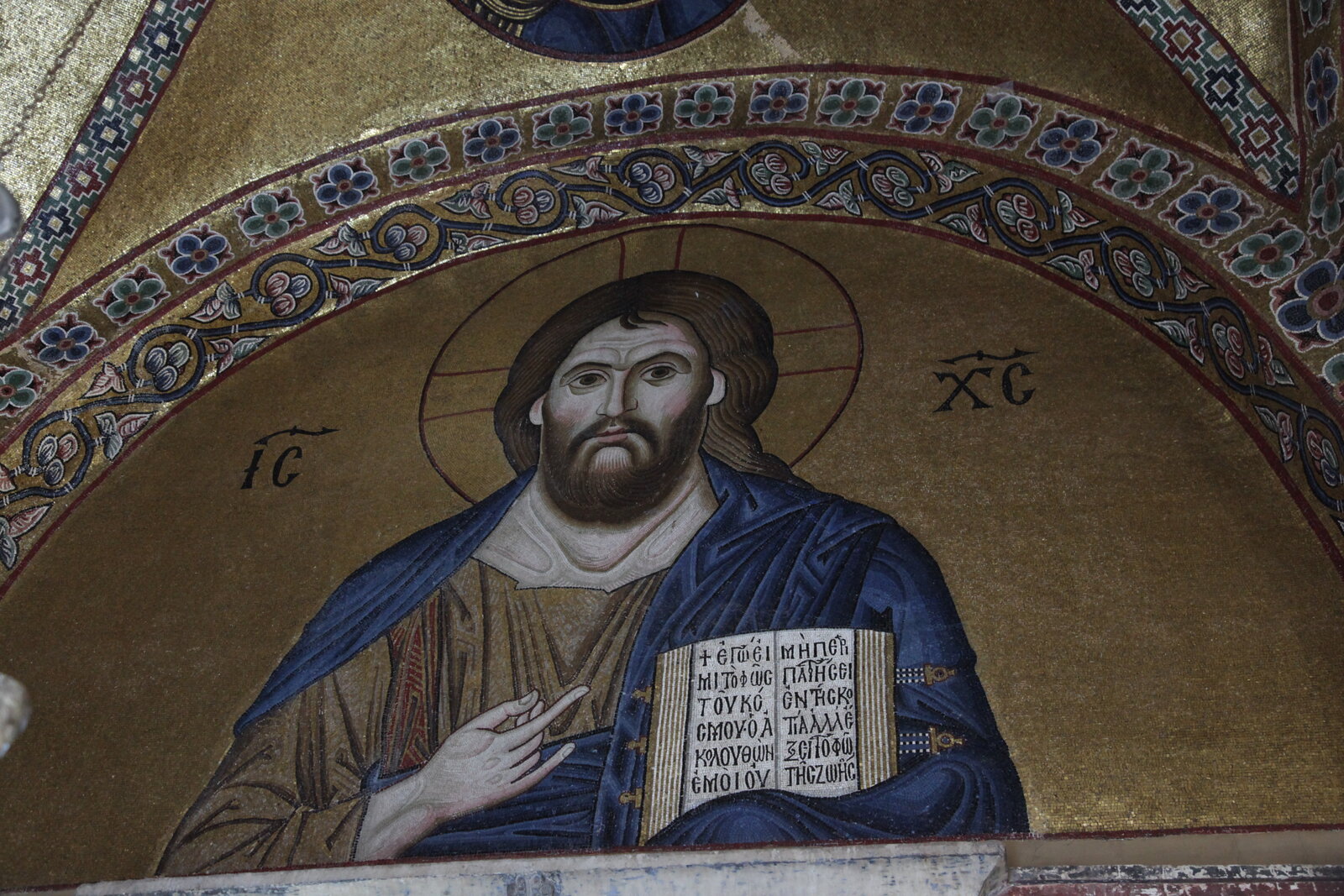
Christ Pantocrator
Narthex Mosaic, Hosios Loukas
Doctrinal reflection
You cannot enter the church without passing under him.
The Hosios Loukas Pantocrator is set above the central door of the narthex, and the door he sits over is the entrance into the main sanctuary. The 11th-century builders made you cross under Christ to come into worship. This is not architecture as decoration. This is architecture as theology. The doorway preaches before the priest does.
Look at the book in his hand. It is open, and it is unjeweled — no rich binding, no metalwork, only the words on the page. He wants you to read the text, not admire the cover. The Greek inscription is John 8:12: I am the light of the world. He that followeth me shall not walk in darkness, but shall have the light of life.
The Lord himself said in John 10:9, "I am the door: by me if any man enter in, he shall be saved." The mason who set this Pantocrator over the threshold knew what he was doing. The man passing through the narthex into the naos was being told, in the visible language of the building, that there is no other way in. Not into the church. Not into worship. Not into life.
There is severity in the face. This is early Middle Byzantine — the style is frontal, the gaze direct, the abstraction sharp. He looks at you, not past you. He is the door, and the door has eyes.
When you preach Christ, preach him as the threshold. There is no Christianity that goes around him. The believer who tries to enter without him stays outside in the dark.
Be Obedient. Be Bold.