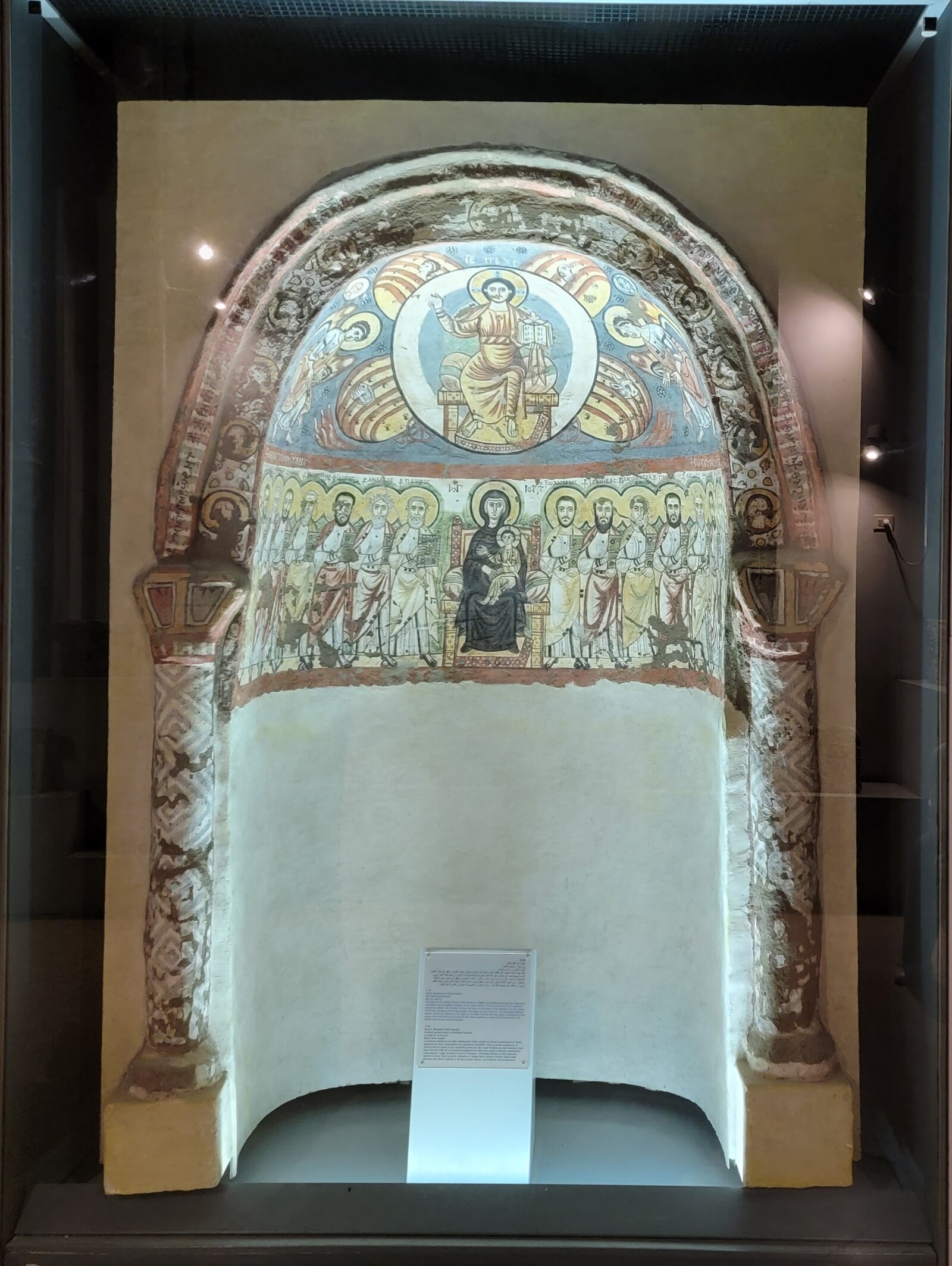
Christ in the Mandorla
Niche Painting from the Monastery of Apa Apollo at Bawit — 6th–7th century (Coptic Museum, Cairo)
Doctrinal reflection
Two registers, one Christ.
The upper register: Christ enthroned in a deep blue almond-shaped mandorla, hand raised in blessing, held aloft by the four living creatures of Ezekiel and Revelation. Two archangels flank the mandorla; personifications of day and night attend at their sides; figures labeled in Greek. The cosmos attends. The lower register: the Theotokos enthroned with the Christ-child on her lap, surrounded by the twelve apostles in two flanking groups. The incarnation, with its witnesses arranged on either side. Above and below in one composition, with no rupture between them.
The Bawit niche, c. 6th–7th century, was painted at the Monastery of Saint Apollo in Middle Egypt and is now at the Coptic Museum in Cairo — the corpus's first Coptic entry and one of the earliest surviving Christ-in-Glory compositions in any Christian iconographic tradition. The Coptic painter, working in tempera on a small chapel niche, did exactly what Paul does in Colossians 1:15–20.
This is the 16th flagship articulation: the unity-of-attributes flagship — one Christ, all attributes coherent, no bifurcation between cosmic-Lord and incarnate-servant.
Colossians 1:15–20 keystone. "Who is the image of the invisible God, the firstborn of every creature: For by him were all things created... and he is before all things, and by him all things consist... having made peace through the blood of his cross." Paul refuses the bifurcation in one breath. The same Christ who upholds all things by the word of his power is the one who made peace through the blood of his cross. The Bawit composition is Colossians 1 in tempera. John 1:1–14: the same Word is eternal and incarnate — the Word was God... the Word was made flesh. Two states, one subject. Hebrews 13:8: Jesus Christ the same yesterday, and to day, and for ever — temporal unity across all his self-disclosures. Revelation 1:17–18: Christ on Patmos says it himself — I am the first and the last: I am he that liveth, and was dead. Three predicates, one subject, in his own voice.
The corpus refuses three bifurcations the iconography rules out.
(a) Loving-Jesus vs. wrathful-Father — Marcion in modern dress. Affirm: love and wrath are real categories; the gospel distinguishes Christ's saving work from the Father's holy judgment. Decline: the splitting move that locates love only in the Son and wrath only in the Father. Christ himself drives traders from the temple (John 2); the Father gives his only Son in love (John 3:16). Refuse: the resulting two-Gods theology where the OT-God is repudiated. Marcion in the second century; much of popular American evangelicalism in the twenty-first. The drift is real and naming it is the flagship's job.
(b) Social-gospel-Jesus vs. judging-Jesus — the liberal/fundamentalist split. Affirm: Christ fed the hungry and healed the sick; Christ also said depart from me, I never knew you (Matt 7:23). Decline: liberal theology takes the social-gospel register and treats judgment as primitive; fundamentalism sometimes inverts. Both halve Christ. Refuse: the two-Christs theology where one Christ feeds and the other judges. **The same Jesus who washed the disciples' feet (#76) said hear ye him on the mountain (#80) and will judge the world (#16 Torcello).** One Christ.
(c) Cosmic-Lord-Christ vs. suffering-servant-Christ — the gnostic split. Affirm: Christ is cosmic Lord (Col 1:16–17) and Christ suffered (Col 1:20). Decline: the gnostic move that puts a divine-Christ-above-the-cross alongside a human-Jesus-on-the-cross. Refuse: the resulting two-Christs theology where suffering and cosmic lordship are predicates of different subjects. The Bawit niche shows the refutation compositionally — cosmic Christ in the mandorla above; the same Christ, incarnate of his mother, in the register below. Two registers, one Christ.
Relationship to the Chalcedonian flagship (pantocrator-sinai). Two layers of the same doctrine. Chalcedonian reads the person (one person, two natures); the 16th flagship reads the attributes (one Christ across cosmic and incarnate registers, love and judgment, temporal states). Both true, complementary. Future Pantocrator entries pattern-match: face → Chalcedonian; composition → unity-of-attributes; both invokable together when warranted.
He is one Christ. The Lord we worship is the servant who suffered. The servant who suffered is the Lord we worship. The Christ of the upper register is the Christ of the lower. One Christ.