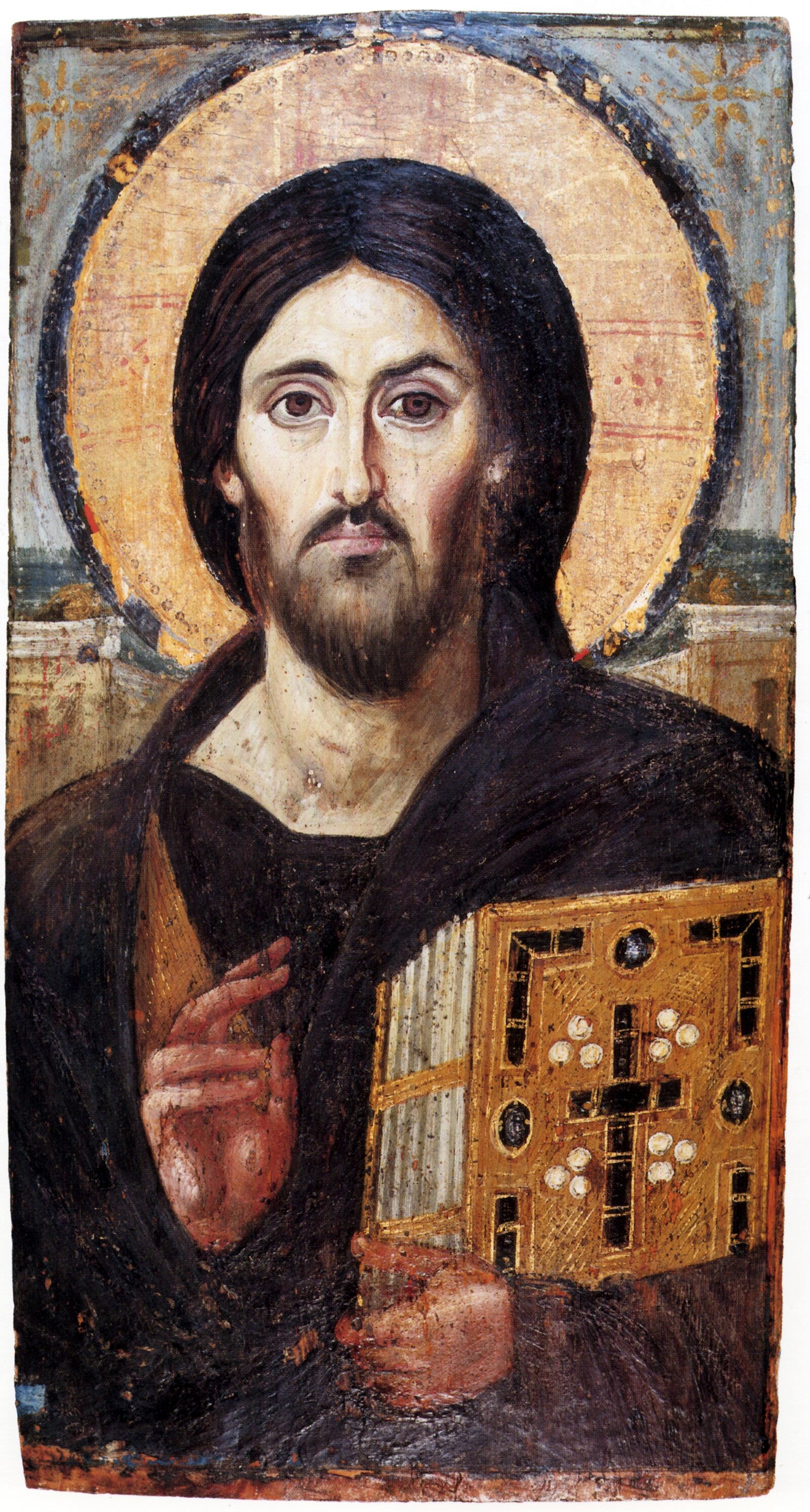
Christ Pantocrator
The Sinai Encaustic — Oldest Surviving Pantocrator
Doctrinal reflection
Look closely. The face does not match itself.
The right side of Christ is broader, more peaceful. The left side is narrower, more drawn. The eyes do not sit at the same level. This is not a flaw. The 6th-century painter of this Sinai icon was a theologian with a brush, and he was teaching the Chalcedonian confession of 451 — that Christ is one person in two natures, fully God and fully man, without confusion, without change, without division, without separation. Look at one side and you see his humanity: what hungered in the wilderness, what wept at Lazarus's tomb, what bled in the garden. Look at the other and you see his divinity: what spoke galaxies into being and what will sit on the throne of judgment. They are not two Christs. They are one face.
This icon survived because Sinai was forgotten. By the 8th century the Byzantine empire was smashing its own art — iconoclasm raged from 730 to 843 — but Saint Catherine's Monastery sat in territory the iconoclasts could not reach. So the oldest surviving picture of Christ outlived the empire that produced it. That is its own quiet sermon: the things of God endure when the institutions that hold them collapse.
Hebrews 1:3 calls the Son "the express image of his person" — the charaktēr, the imprint pressed into wax. The encaustic image you are looking at — Christ painted in hot wax on a wooden panel — is itself a picture of what Hebrews says Christ is to the Father: an exact impression. And Hebrews 13:8 adds, "Jesus Christ the same yesterday, and to day, and for ever." The face you see in this fifteen-hundred-year-old panel is the same face the apostles saw, the same face John saw on Patmos, the same face that will appear at the eastern sky.
He has not changed. The question is whether you have.