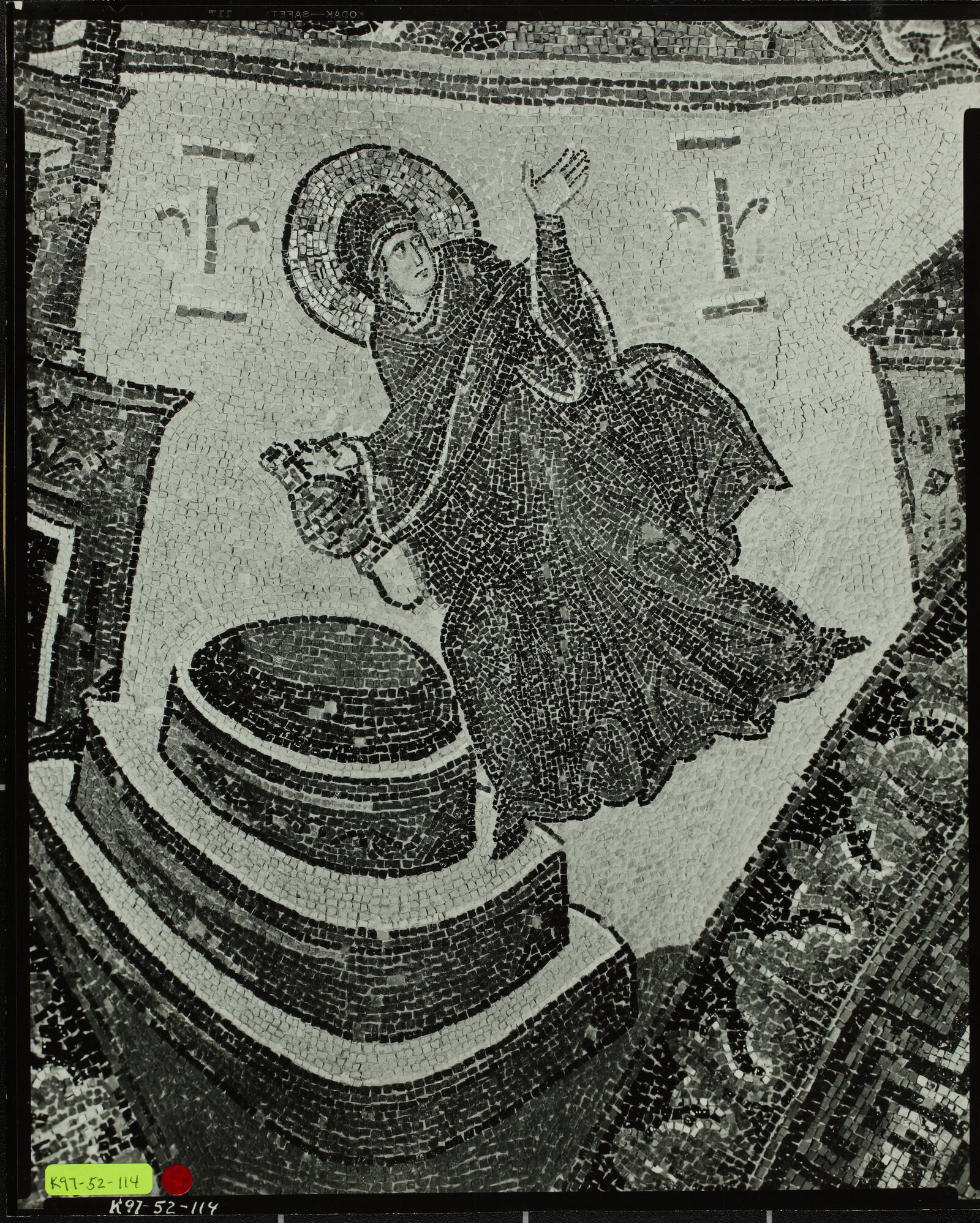
The Annunciation at the Well
Inner Narthex Mosaic, Chora Church
Doctrinal reflection
This is the moment the Word became flesh.
The Annunciation at the Well in the inner narthex of the Chora Church shows Mary turning at the sound of an angel's voice. She is at a public spring, drawing water in a clay pitcher. Gabriel descends behind her. She looks back over her shoulder, surprised. The composition is twisted into the triangular shape of the pendentive — and that awkwardness is theologically appropriate. This was an interruption.
The setting is from the Protoevangelium of James, an apocryphal infancy gospel that places a first Annunciation at a public well. The canonical Annunciation in Luke 1 happens privately in Mary's house. The Byzantines combined both traditions visually. We do not need the apocryphal narrative to read what the artist is teaching. The doctrine being staged is canonical: God came down to a particular woman at a particular moment, and her consent was part of how he came.
Luke 1:35: "The Holy Ghost shall come upon thee, and the power of the Highest shall overshadow thee: therefore also that holy thing which shall be born of thee shall be called the Son of God." Luke 1:38: "Be it unto me according to thy word." Mary's word matters because of what she was saying yes to. She was not consenting to her own elevation. She was consenting to the Word taking flesh inside her.
This is why the Annunciation belongs in the Theotokos collection. It is the inception scene of the incarnation. Without Mary's "yes," the doctrine remains an idea in the mind of God. With it, the doctrine becomes a fetus in a Galilean girl's body. John 1:14 begins exactly here.
When you preach the Annunciation, do not preach Mary as exemplary woman. Preach Mary as the moment the eternal Word intersected one body in time. Her consent matters because the consent was to incarnation. The dignity is structural, and the structure is Christ.