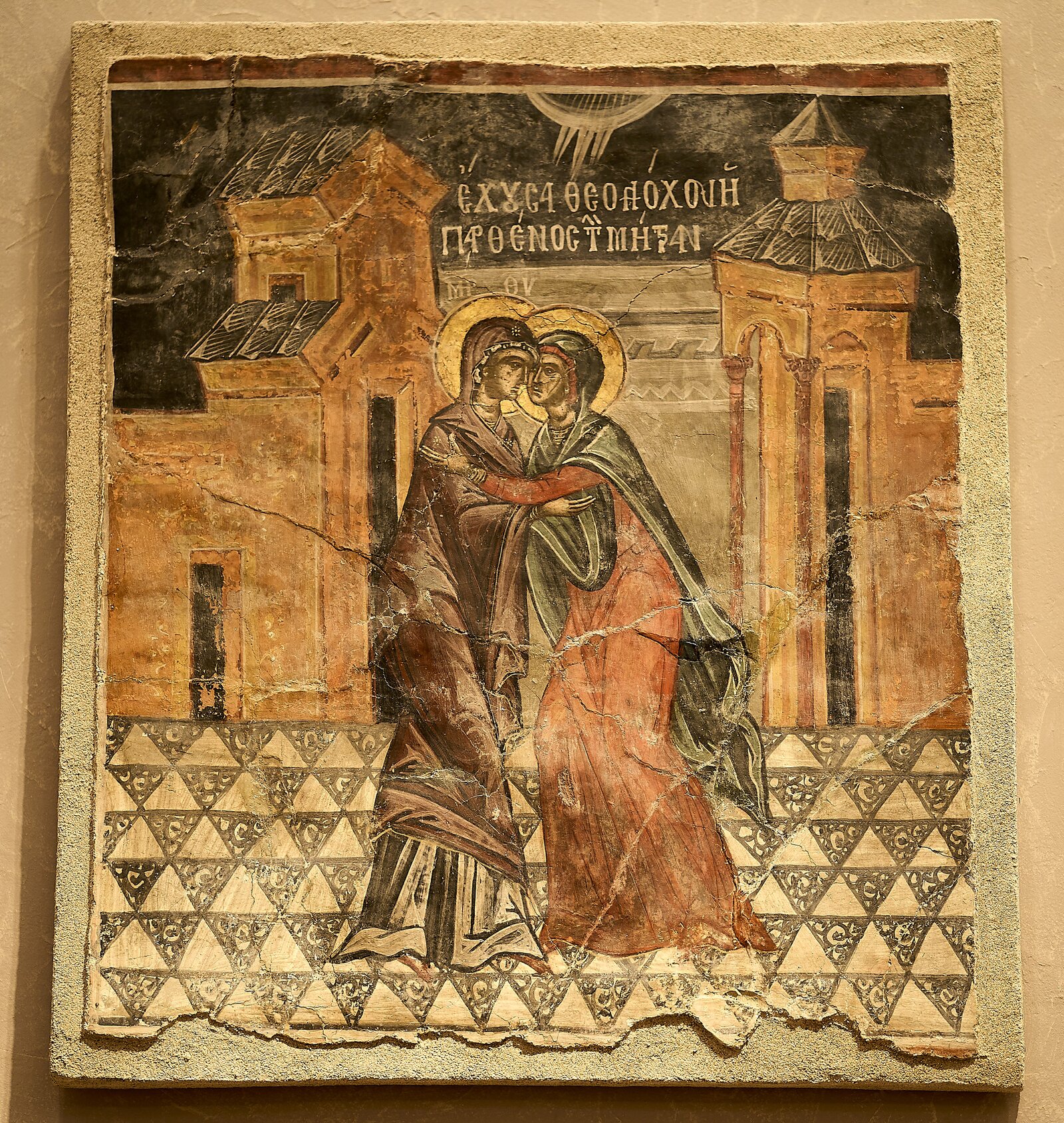
The Visitation
Mural fragment from Panagia Monastery, Delphi, 1751 — Byzantine and Christian Museum, Athens
Doctrinal reflection
Two women embrace at the doorway of a small house. Mary on the right, in a deep red maphorion; Elizabeth on the left, older, gray hair gathered, hands gripping Mary's shoulders. Their faces touch at the cheek. Behind them, the architecture is compressed into a single arched portal — Zacharias's house at Ein Karem, condensed to its iconographic essentials. The fresco is from the Panagia Monastery at Delphi, painted in 1751 and now preserved at the Byzantine and Christian Museum in Athens.
Luke 1:39–56 supplies the gospel scene. Mary, three days after the Annunciation (corpus #annunciation-sinai, #annunciation-chora), travels into the hill country of Judaea to her cousin Elizabeth, who is six months pregnant with John the Baptist. At the sound of Mary's greeting, the unborn John leaps in Elizabeth's womb, and Elizabeth is filled with the Holy Spirit and cries out: "Blessed art thou among women, and blessed is the fruit of thy womb. And whence is this to me, that the mother of my Lord should come to me?" (Luke 1:42–43). Mary's Magnificat (Luke 1:46–55) follows in response. Two pregnancies, two prophecies, one greeting at the doorway.
The Theotokos title is born here. The corpus has anchored the title at Luke 1:43 in the 17th-flagship articulation (#88 Met Koimesis ivory) — the mother of my Lord is the title Elizabeth gives Mary in apostolic-era greeting, conferred by another mother-of-a-prophet. The Visitation is the iconographic moment of that conferral. Elizabeth speaks the title; the iconographer renders the embrace; the church receives the doctrine as gift from inside the gospel narrative, not as later devotional elevation. The title is biblical at its origin.
Two women, no men. The composition's restraint is doctrinal. Zacharias is not in the scene (he is mute through this period of Luke's narrative anyway, struck silent by Gabriel for his unbelief at Luke 1:20); Joseph is not in the scene. The Visitation as iconographic type is consistently rendered as two women alone — pregnant Mary, pregnant Elizabeth, the doorway, the embrace. The scene's iconography preserves the gospel's own framing: this is a women's encounter, two cousins meeting in early pregnancy, the prophet-in-womb leaping at the Lord-in-womb. The corpus reads what scripture supplies.
The unborn John recognizes the unborn Christ. The fresco's iconographic argument extends beyond the embrace. Elizabeth's Spirit-filled cry at Luke 1:41–42 is triggered by the leap of the prophet-in-utero. The unborn John knows what the unborn Christ is. The corpus's pro-life implications are biblical, not constructed: scripture treats both unborn children as persons, both already in their vocations (the forerunner who will prepare the way; the Lord who will be prepared for) before either has drawn breath. Luke 1 is the canonical witness to personhood-from-conception in narrative form.
The Magnificat as Mary's self-positioning. The 17th-flagship articulation has already locked the Magnificat (Luke 1:46–55) as Mary's own self-description — handmaiden (doulē), recipient of God's regard, magnifying the Lord rather than herself. Visitation is the iconographic occasion that produced the Magnificat. Mary spoke it after Elizabeth's greeting. The handmaiden's self-description does not arrive as response to abstract recognition; it arrives as response to a fellow pregnant woman's Spirit-filled blessing at a doorway. The honor is real, the consent is real, the order of grace is preserved — and Mary herself sets it.
Post-Byzantine continuity. The fresco is 1751, well past Byzantine political collapse (1453), but in the continuous Greek-Orthodox iconographic tradition that the corpus has engaged before (#76 Stavronikita 1546, #93 Stavronikita Trial 1546, #87 Walters Armenian 1678, etc.). The post-Byzantine register is iconographically faithful — the embrace, the doorway, the architectural compression all match the Macedonian-Renaissance and earlier types. What was rendered in mosaic at Hosios Loukas in the 11th century is rendered in fresco at Delphi in the 18th, with the same compositional vocabulary. Iconographic continuity across seven centuries.
Elizabeth recognized. Mary magnified. The unborn John leaped at the unborn Christ. The Theotokos title was given at the doorway.