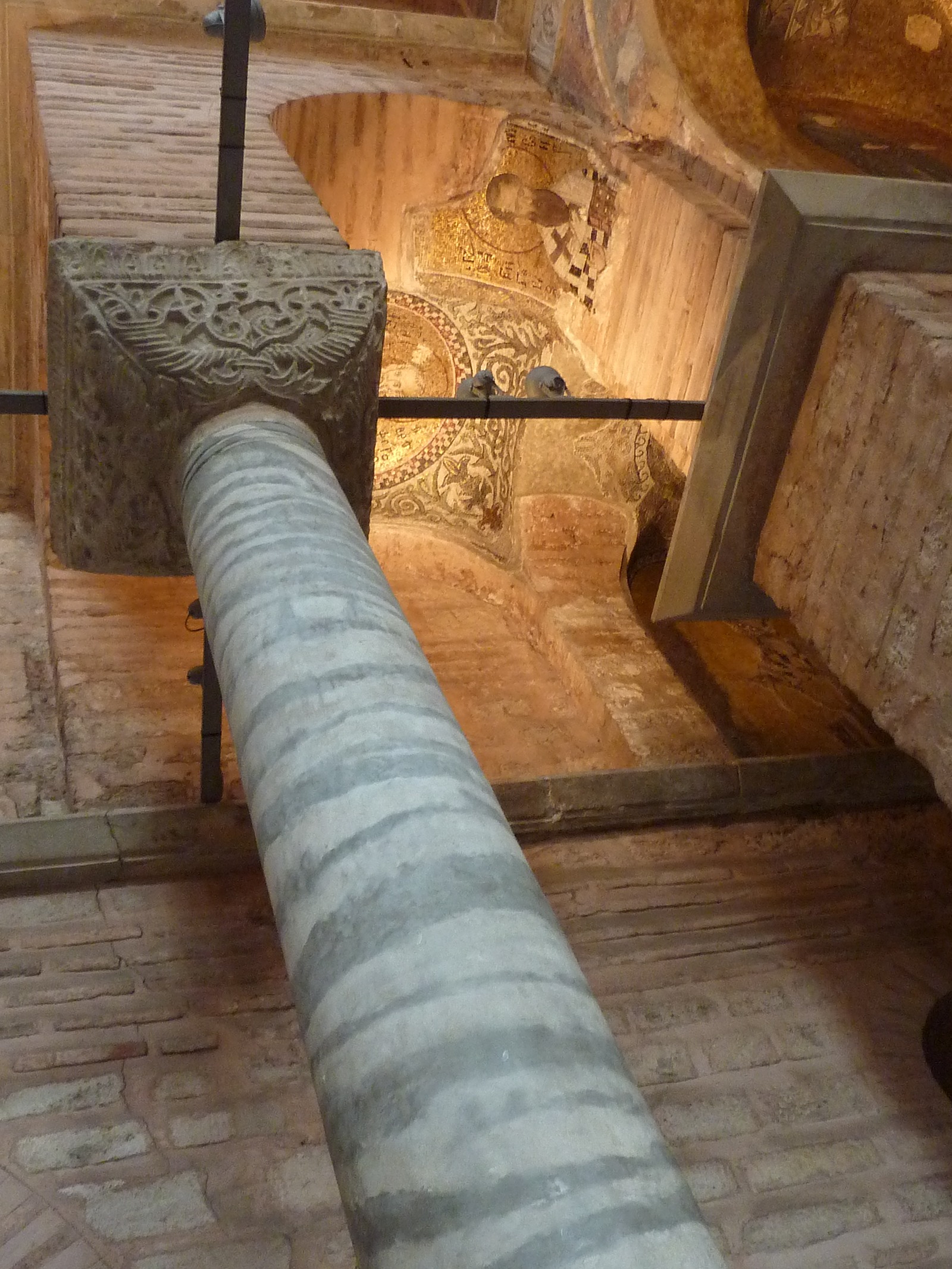
Pammakaristos Parekklesion: Old Testament Prophet
Mosaic, c. 1310, Pammakaristos Parekklesion (Theotokos Pammakaristos / Fethiye Camii) — Istanbul
Doctrinal reflection
An Old Testament prophet stands frontal, robed in the dress of a Hebrew prophet, holding an unfurled scroll inscribed in Greek with a prophetic-text fragment. The figure is one of the twelve Old Testament prophets rendered in the parekklesion of the Pammakaristos as the iconographic foundation of the central dome's Pantocrator program. The corpus's third Pammakaristos entry alongside #pantocrator-pammakaristos and #james-the-just-pammakaristos. Pammakaristos at 3/4.
The compositional theology — prophets at the foundation, Christ at the apex. The Pammakaristos parekklesion's iconographic program is structured on the apostolic-architectural principle of Ephesians 2:20: "the foundation of the apostles and prophets, Jesus Christ himself being the chief corner stone." The mosaic program renders this verse architecturally. The dome carries Christ Pantocrator at its apex; below the Pantocrator, in the dome's drum, are twelve Old Testament prophets (Moses, Jeremiah, Zephaniah, Micah, Joel, Zechariah, Obadiah, Habakkuk, Jonah, Malachi, Ezekiel, Isaiah). The compositional argument: the prophets foretold; the Pantocrator fulfilled; the church receives both as one revelation.
Collection 6 framework — the OT prophets as Mode 1 typological foundation. The corpus's Collection 6 OT typology framework (locked at #38 Rublev) reads OT figures as anchored in apostolic interpretation. The OT prophets here speak through their inscribed scrolls — each scroll carries a prophetic-text fragment that the early church and patristic tradition read as Christ-pointing. Hebrews 1:1–2 anchors the apostolic reading: "God, who at sundry times and in divers manners spake in time past unto the fathers by the prophets, hath in these last days spoken unto us by his Son." The Pammakaristos prophet program renders Hebrews 1:1–2 mosaically: the prophets pointed forward; Christ is the One they pointed to.
The 1310 Palaiologan iconographic peak. The Pammakaristos parekklesion was painted at the early-Palaiologan iconographic peak — the same generation as the Chora Church (#chora entries). The two Constantinopolitan parekklesia (Pammakaristos 1310, Chora 1316–1321) are the era's foremost surviving iconographic programs. The Pammakaristos's Martha Glabas was the aristocratic-female-patron parallel to Chora's Theodore Metochites — both endowed parekklesia with monumental iconographic programs as memorials. The corpus reads the Palaiologan period as the late-Byzantine iconographic summa — the iconography of a tradition that knew its doctrinal ground and rendered the gospel with full architectural-compositional confidence shortly before the Ottoman pressure.
The Iconographic-survival principle (#70) at extreme application. The Pammakaristos parekklesion's mosaics survived because they were plastered over when the building was converted to a mosque in 1591. The 19th-century restoration revealed them intact. The corpus reads this as the Iconographic-survival principle operating in extremis: when iconography cannot survive the iconographic-rejecting context as visible iconography, it survives by being hidden. The plaster was actually iconographically protective — the mosaics that were exposed at Hagia Sophia were obliterated; the mosaics that were plastered at Pammakaristos endured. Sometimes iconography survives by going underground; the survival is itself the testimony.
The 17th-flagship cousin frame applied silently. Martha Glabas commissioned the parekklesion as a memorial for her husband. The corpus's 17th-flagship Theotokos-not-Mediatrix (#88 Met Koimesis) handles memorial-ecclesiology: the dead saints (and the dead spouses) are remembered as cloud-of-witnesses, not invoked as mediators. Martha's commission renders this precisely: she built a memorial-iconographic program for her husband, not a prayer-mediation chapel through her husband. The compositional choice — Christ Pantocrator at the apex, prophets at the foundation, the Deesis at the apse — orients all memorial-attention toward Christ, not toward the dead general. The 14th-century iconographer's compositional discipline reflects the 17th-flagship architecture before the Reformation articulated it.
The prophet stood with his scroll. The scroll bore prophetic-text. The text pointed forward to Christ. The Pantocrator at the apex received the prophetic pointing. The prophets foretold; the Son fulfilled — and 1300 years of iconographic transmission survived the conversion-to-mosque, the obliteration of related programs, the 19th-century rediscovery, all the way to the present.