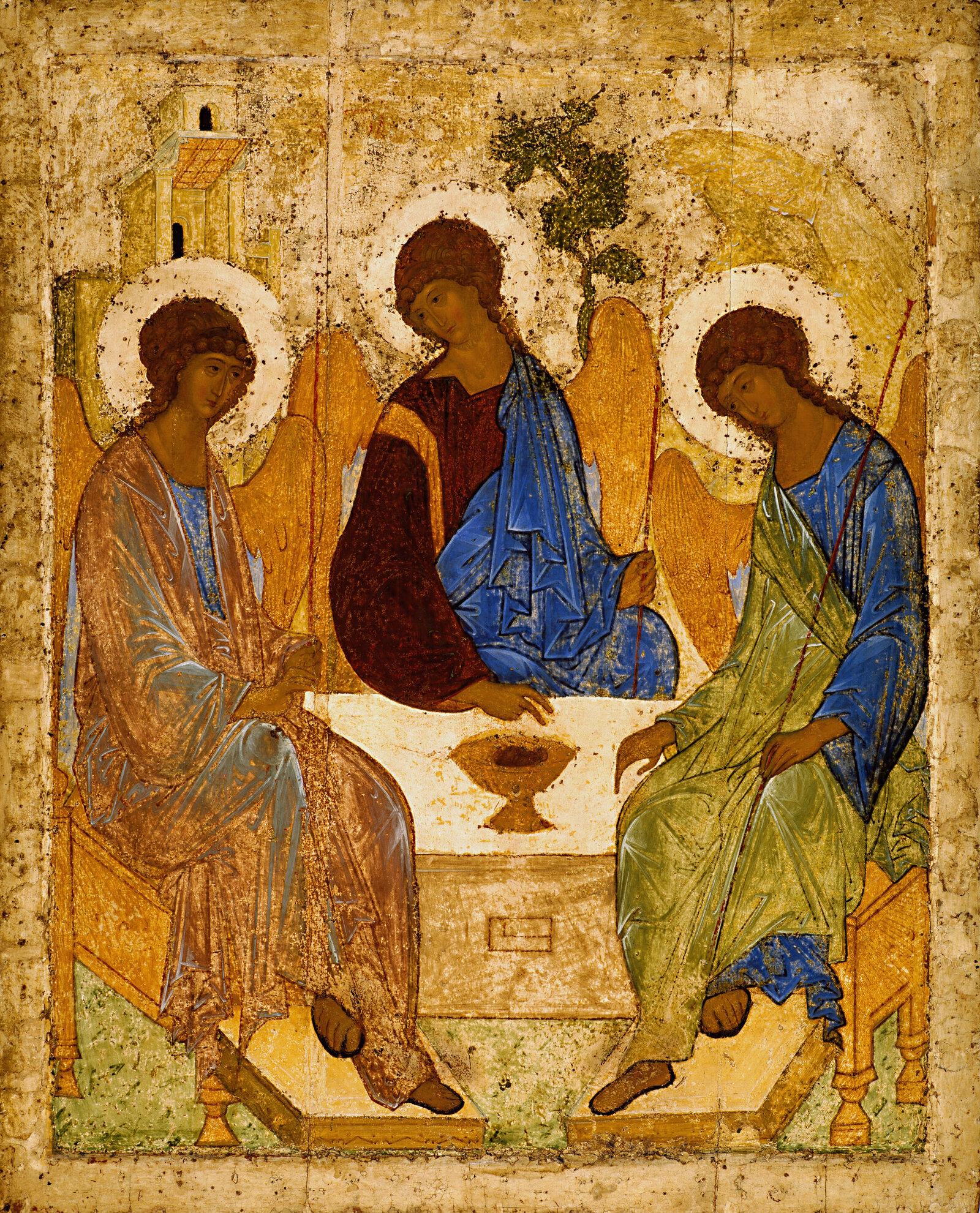
The Hospitality of Abraham
Andrei Rublev — Trinity Lavra of Saint Sergius
Doctrinal reflection
This icon reads three angels as the Trinity. We will need to disagree.
Andrei Rublev painted The Hospitality of Abraham — also called The Trinity — around 1425 for the Trinity Lavra of Saint Sergius near Moscow. It is a small panel, tempera on wood, now in the Tretyakov Gallery. Three winged figures sit around a low table. A chalice rests at the center. Behind them: a tree (the oak of Mamre), a building (Abraham's house), a mountain. Their bodies form a circle of mutual attention, each gesturing toward the others. The composition is one of the most beautiful in all Christian visual theology.
The iconographic source is Genesis 18:1–8, where three visitors come to Abraham at Mamre and Abraham extends elaborate hospitality. The Eastern Orthodox tradition reads the three as a Trinitarian appearance — Father, Son, and Spirit visiting Abraham together. Rublev's icon is the most refined visual statement of that reading.
We respectfully disagree with the strict reading. Genesis 19:1 opens by saying, "And there came two angels to Sodom at even." The narrative of Genesis 18–19 specifies that two of the three visitors continued on to Sodom, and they are explicitly called angels, not divine persons. The third stays with Abraham (Genesis 18:22) and is identified as "the LORD." The most defensible reading is that the third visitor is a pre-incarnation Christophany — the Word, before he became flesh, appearing in human form — accompanied by two angelic messengers. The Trinity is real, but Genesis 18 does not depict three coequal divine persons. It depicts the Lord plus two angels.
So the icon overreaches at one specific point. The strict Trinitarian identification is more than the text will bear.
And yet — this is where we have to be careful — the icon is reaching for something real. Look at the composition again. The three figures are positioned in mutual gaze, each yielding attention to the others, around a table set with a meal. What Rublev has rendered, even if his Trinitarian identification overreaches the text, is hospitality as the form of divine love. The Lord who came to Abraham came as a guest. He sat and ate. He received Abraham's foot-washing and his bread.
That is gold. Hebrews 13:2 picks the same theme up: "Be not forgetful to entertain strangers: for thereby some have entertained angels unawares." Abraham at Mamre is the type. Christ in his earthly ministry — hosted by Mary and Martha, by Levi, by Zacchaeus — fulfills it. The communion table is hospitality completed: the Lord who sat at Abraham's table now sets a table for us.
Look at the chalice at the center of the icon. It is on the table because it is a meal element, not because the icon is asserting transubstantiation. The Lord eats and drinks with his people. That is the doctrine, and the icon stages it.
When you preach this icon, do not over-claim the Trinitarian identification — and do not under-claim the hospitality-as-divine-character truth. Rublev's gold survives even when his identification is corrected.
The Lord sat at Abraham's table. He sets one for us.