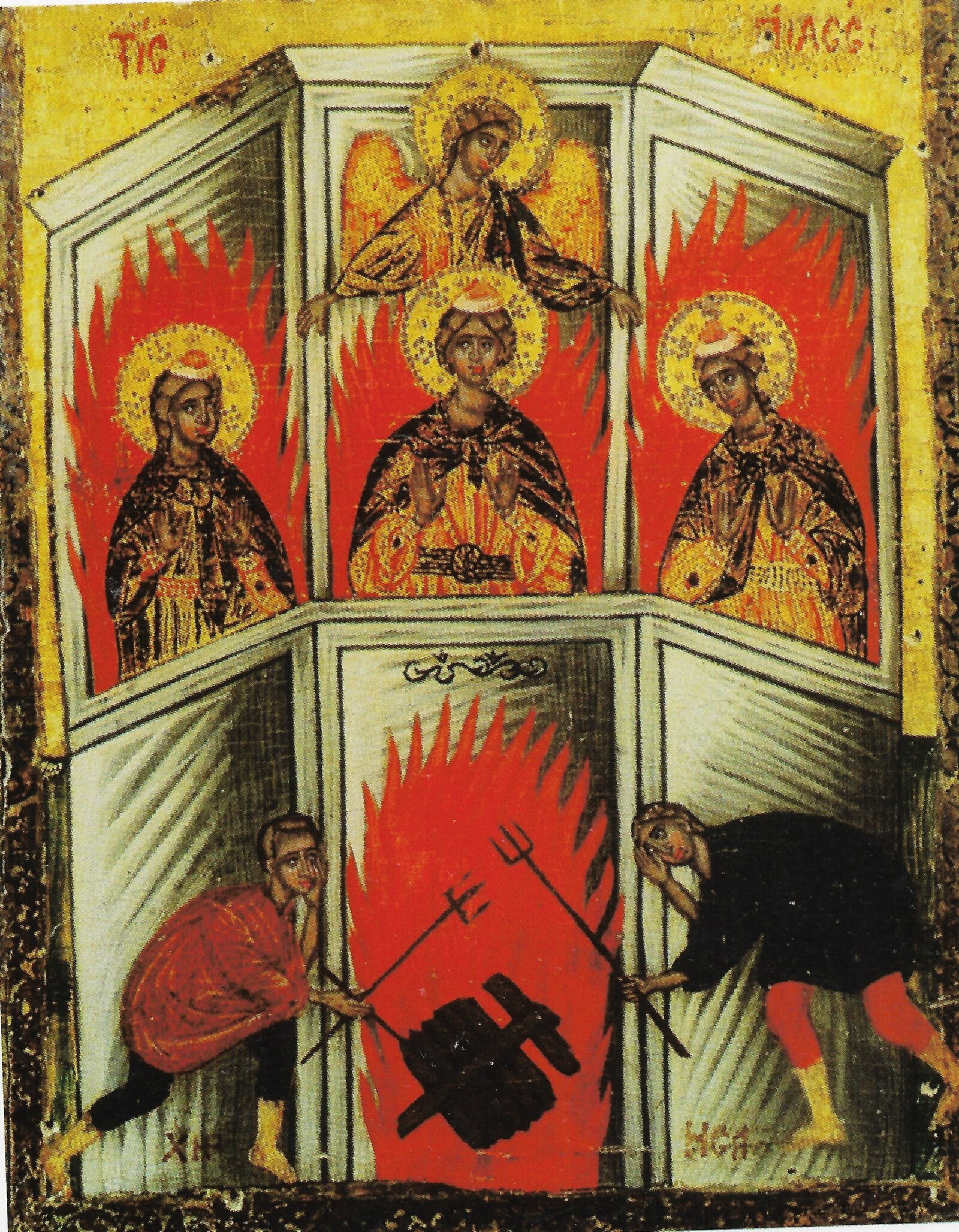
The Three Hebrews in the Fiery Furnace
16th-c. Levantine Icon (Post-Byzantine Tradition)
Doctrinal reflection
Look at the fourth one.
This 16th-century icon shows Daniel 3 in characteristic Byzantine-tradition format: Shadrach, Meshach, and Abednego (their Babylonian names; their Hebrew names were Hananiah, Mishael, and Azariah) standing unburned in the furnace, hands raised in prayer, while a fourth figure stands among them.
The Eastern Christian tradition has long read the fourth figure as a Christophany — the pre-incarnate Word in the furnace with the three. Patristic writers (Origen, Ambrose, Hippolytus) developed this typology. The KJV's translation of Daniel 3:25 supports it: "the form of the fourth is like the Son of God." Some Byzantine icons render the fourth figure with a cross-nimbus halo, identifying him explicitly as Christ.
We will read the text more carefully. Nebuchadnezzar's first impression in Daniel 3:25 is from pagan polytheism — "like a son of the gods" is a defensible alternative translation, and the KJV's "Son of God" rendering imports Christian theology that the Aramaic does not require. Three verses later, Nebuchadnezzar himself revises his identification: "Blessed be the God of Shadrach, Meshach, and Abednego, who hath sent his angel, and delivered his servants" (Daniel 3:28). The text identifies the fourth figure as an angel — a created spiritual being sent on a deliverance mission. Not Christ.
The rule for our reading of Old Testament typology is this: we affirm a type only when a New Testament author affirmed it first. Hebrews 11 reaches into Daniel 3 and pulls out exactly one theme. Hebrews 11:34: those who, by faith, "quenched the violence of fire." That is the apostolic reading. The three are faith-witnesses, not types of Christ; the fourth figure is the angel God sent, not the pre-incarnate Word.
This matters because it disciplines our preaching. Daniel 3 is enormously useful as a passage on faithfulness under threat — Hebrews 11 makes the application explicit. We do not need to find Christ inside the furnace to make Daniel 3 preach. The doctrine in this passage is faithfulness, and the doctrine survives without overreach.
Look at the three Hebrews again. Their hands are raised in prayer. Their bodies are unharmed. The flames are around them but not on them. They told the king before the furnace was lit: "Our God whom we serve is able to deliver us... but if not, be it known unto thee, O king, that we will not serve thy gods" (Daniel 3:17–18). That is what the iconography is teaching. But if not. They were prepared to die. They lived because God chose to send his angel.
When you preach this scene, preach what the apostles preached. Faith. Trust. Faithfulness under fire. The fourth figure was an angel. The three were the saints.
Be the saints.